As an affiliate, we may earn a commission from qualifying purchases. We get commissions for purchases made through links on this website from Amazon and other third parties.
Getting in and out of a car is one of the most underestimated mobility tasks in daily life. It looks simple until pain, weakness, poor balance, stiff hips, or fatigue turn one awkward pivot into a near-fall.
Car transfers are different from bed or chair transfers because the space is tight, the seat is often low or angled, the ground may be uneven, and people tend to rush. There is traffic. There is weather. There are appointments to make. That combination leads many older adults and caregivers to improvise, and improvising is exactly what makes car transfers risky.
The good news is that most people do not need a dramatic solution first. They need the right sequence, the right vehicle setup, and the right tools for the level of mobility they actually have.
If you are not sure how much standing, pivoting, and balance reserve the person still has, start with assessing transfer readiness and mobility levels. Car transfer safety depends on the same basics as any other transfer: weight bearing, core control, judgment, endurance, and how much help can be given without the caregiver getting hurt too. For the wider picture, the mobility and transfers master guide ties car-transfer technique back to the bigger safety plan.
Why This Matters
Falls often happen during transitions, not just during walking. A person may manage the parking lot with a walker, then lose balance when trying to turn, duck, lower down, and bring both legs into a car at the same time. The task asks for strength, timing, flexibility, and a stable handhold all at once.
The wrong setup creates several common hazards:
- twisting on one leg while trying to step into the footwell
- dropping too hard into a low seat
- grabbing an unstable part of the car for support
- losing the walker or cane just before sitting
- making the caregiver lift more than they can safely manage
Car transfers also decide whether people can actually leave the house. Medical appointments, family visits, errands, therapy, and community life all depend on being able to get into a vehicle safely and without panic.
For some people, the car transfer becomes the limiting step long before the rest of mobility fully breaks down. Someone may still walk around the house but avoid going out because getting into the car hurts, feels humiliating, or has already led to one bad scare.
Key Factors That Change the Decision
The first question is whether the person can do a standing pivot safely. If they can stand, turn, and sit with controlled help, a standard car transfer may still work with better technique and a few aids. If they cannot bear enough weight, cannot turn safely, or collapse into the seat, the plan may need a transfer board, a powered transfer seat, or a higher level of mobility support.
The second question is seat height. Very low sedans can force too much crouching and knee bend. Tall truck-based SUVs can be hard because the person has to climb up. Many people do best with a chair-height vehicle such as a compact or midsize crossover, or with a minivan that offers a wide opening and easier leg swing.
Door opening matters too. A tall, wide opening lets the person sit first and then bring the legs in with less ducking and twisting. A sloped roofline or narrow opening adds strain before the transfer even begins.
So does the door sill and floor height. Thick or high door frames force the legs to lift higher and travel farther. That is why two vehicles that look similar from outside can feel completely different during entry.
Pain and range of motion also change the answer. Hip arthritis, hip precautions, knee pain, back pain, foot drop, or weakness lifting the legs can turn a routine transfer into a struggle. If foot clearance is part of the problem, foot drop solutions: AFOs, FES, and shoe mods can help reduce the drag and awkwardness that often show up around vehicle thresholds.
The final factor is what happens after the person sits. Some people can lower onto the seat but cannot bring their legs inside. Others can get in but cannot get back out without pulling hard on the caregiver. The right plan has to cover both directions.
How to Use, Choose, or Set It Up Safely
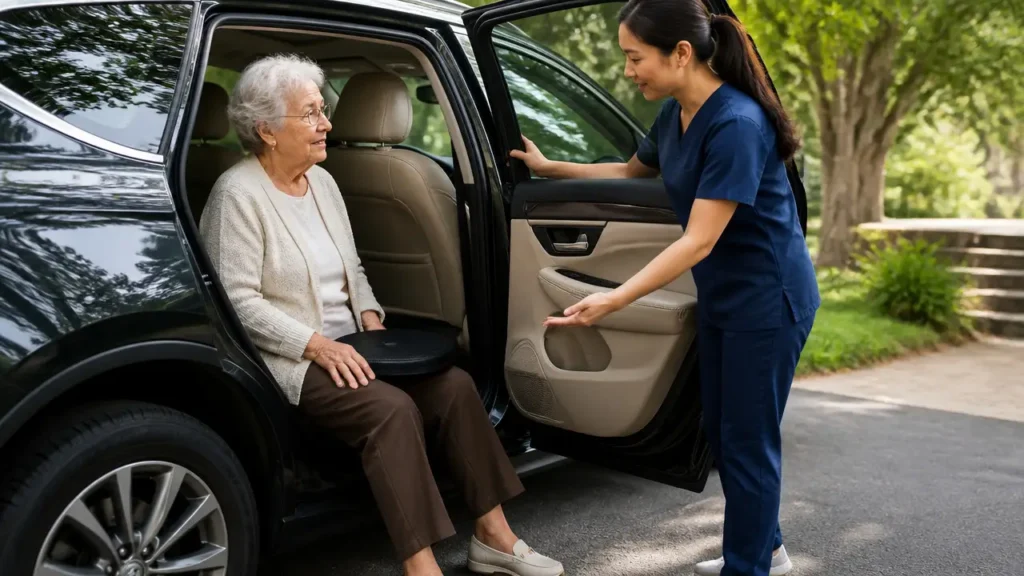
The safest basic routine: sit, then swivel
For most people with limited mobility, the safest basic sequence is not stepping one foot into the car first. It is the opposite.
Use this order:
- Park on flat ground with enough space to open the door fully.
- Move the seat back if more legroom is needed.
- Clear loose items from the floor and seat.
- Bring the walker, cane, or chair close before starting.
- Back up until the backs of the legs touch the seat.
- Reach for a stable handhold and sit down first.
- Once seated, swivel the hips and bring the legs in one at a time or together.
- Reverse the sequence to get out.
This "sit then swivel" routine reduces the dangerous one-leg twist that causes many falls. It also lets the person support the legs with the arms if lifting is hard.
Set up the environment before the transfer
Most car-transfer problems start before the person even touches the seat.
Set up matters:
- park where the ground is level and dry if possible
- avoid curbs, gravel, potholes, and sloped parking spaces
- open the door wide enough for a clean approach
- position the walker so it will still be reachable after sitting down
- if using a rollator, lock the brakes before the person turns to sit
If the person regularly struggles to walk the last few steps to the car, a lightweight transport chair or wheelchair may protect energy and reduce the chance that the actual transfer starts with fatigue.
Use the right aid for the real problem
Not every car-transfer aid solves the same issue.
An assist handle that locks into the door striker can provide a more stable handhold for sitting and standing. A swivel cushion can reduce friction when turning into the seat. A transfer board may help if the person cannot take pivoting steps safely but can still shift weight and slide with supervision. A powered transfer seat or wheelchair-accessible vehicle may be necessary when ordinary seating is no longer practical.
If you want a deeper breakdown of tool choices, see best car transfer aids, best transfer boards for home, and best portable standing aids.
The general matching rule is:
- balance problem: stable handhold or assist handle
- hip or back twisting problem: swivel cushion or transfer seat
- weak leg swing: leg lifter, caregiver assist, or different seat height
- cannot stand pivot safely: transfer board, lift, or accessible vehicle setup
Protect the caregiver too
Caregivers often get injured in car transfers because they twist, reach deep into the car, or try to lift from under the arms. That is not a sustainable plan.
Safer caregiver habits include:
- explain the sequence before moving
- stay close rather than reaching from far away
- avoid twisting your trunk while supporting weight
- bend at the knees and keep the back neutral
- never yank on the person's arms or clothing
- stop if the transfer has turned into a lift instead of guided assistance
If the person needs more than guided help to rise, pivot, or control descent, the answer is usually not "try harder." It is reassessing the equipment and method. Bed-to-chair transfers for caregivers and best gait belts can help frame the difference between controlled assistance and unsafe lifting.
Choose a more transfer-friendly vehicle when possible
If the current car is part of the problem, it is worth saying plainly. Some vehicles are simply easier than others.
Features that usually help include:
- seat height close to standard chair height
- wide, tall door openings
- less intrusive steering wheel position
- enough front passenger legroom to swing the legs in
- low cargo lift-over for walkers or folded chairs
- sliding doors or large door openings when frequent assistance is needed
In general, compact crossovers and minivans are often easier than low sedans or very tall trucks. If the mobility device has to come along too, think beyond the transfer itself. The easiest seat in the world does not help much if loading the walker or transport chair hurts the caregiver every trip.
Know when a standard car transfer is no longer enough
A person who cannot safely stand-pivot may still travel, but the travel setup usually has to change. That may mean a transfer board, a mechanical lift, a specialized vehicle seat, or staying seated in a wheelchair in an accessible vehicle with proper securement.
When the need has reached that level, articles like best patient lifts, best transfer slings, and best sit-to-stand lifts for home use become more relevant than yet another generic car handle.
Common Mistakes and Red Flags
The biggest mistake is trying to step into the car before sitting down. That move demands balance, hip mobility, and timing that many people no longer have safely.
Other common mistakes include:
- parking on a slope and pretending it is close enough
- using the open car door itself as the main support
- leaving the seat too close to the dashboard
- forgetting to bring the walker or cane back within reach for exit
- rushing because of traffic, weather, or embarrassment
- using a swivel cushion and then leaving it in place while driving
- choosing a huge SUV because it feels safer on the road, even though entry is worse
Red flags that mean the plan needs to change include:
- repeated near-falls during entry or exit
- dropping heavily into the seat
- needing to be lifted rather than guided
- inability to bring both legs into the vehicle
- severe pain with twisting, hip flexion, or standing from the seat
- caregiver back strain after routine trips
- increasing refusal to leave the house because the transfer feels too hard
Do not ignore the emotional side. Fear is often useful data. If someone has started avoiding trips, pausing at the door, or insisting they are "fine" while obviously struggling, the method is already failing in practice.
When to Get More Help
Get professional help when car transfers are becoming a repeated safety event rather than an occasional bad day.
That includes:
- one or more falls or near-falls during car entry or exit
- caregiver strain or pain from assisting
- inability to pivot safely
- confusion about which aid is appropriate
- a recent surgery, stroke, fracture, or major decline
- unclear judgment about whether the person should still transfer into a standard car seat at all
A physical therapist or occupational therapist can break down the actual movement problem and recommend the right sequence, practice plan, and equipment. A driver rehabilitation specialist can help when the person is still driving or when vehicle modifications are being considered. If the issue is the vehicle itself, a mobility dealer can evaluate transfer seats, ramps, lifts, and wheelchair securement systems.
If the person is also navigating air travel or longer transport planning, airplane travel with a wheelchair may help with the bigger logistics around getting out of the house safely and staying mobile once the trip starts.
Frequently Asked Questions
What is the safest way to get into a car with limited mobility?
For many people, the safest method is to back up until the legs touch the seat, sit down first, and then swivel the legs into the vehicle. This avoids twisting on one leg and usually gives better control.
Are SUVs easier than sedans for older adults with mobility problems?
Sometimes, but not always. Many compact or midsize crossovers are easier because the seat height is closer to chair height and the door opening is larger. Very tall SUVs and trucks can be harder because the person has to climb up.
When do you need a swivel cushion or transfer board?
A swivel cushion helps when the main problem is twisting into the seat. A transfer board is more appropriate when standing pivot transfers are no longer safe but the person can still participate in a seated sliding transfer.
Can a caregiver lift someone into a car alone?
Usually that is not a good plan. If the transfer requires lifting rather than guiding, the caregiver and passenger are both at higher risk of injury. That is usually the point to reassess technique, equipment, or the vehicle setup.
What seat height is usually easiest for a car transfer?
For many older adults, a seat close to standard chair height is easiest. That is one reason compact crossovers and many minivans are often easier than very low sedans or very tall trucks.
Car transfers get safer when they become boring. That means the same setup, the same sequence, and the same expectations every time. Sit first, then swivel. Use a stable handhold. Match the tool to the real problem. If the transfer is starting to look like a lift, stop treating it like a minor inconvenience and change the plan.
If the hard part is twisting into the seat, loading the device, or deciding whether a standard car transfer is still realistic, continue with best car transfer aids, best transfer boards for home use, best patient lifts, and bed-to-chair transfer basics.