As an affiliate, we may earn a commission from qualifying purchases. We get commissions for purchases made through links on this website from Amazon and other third parties.
Foot drop means the front of the foot does not lift well during walking. The toes may drag, the foot may slap the floor, or the person may lift the knee higher than normal just to clear the ground. That change can make walking slower, less efficient, and much less safe.
For many older adults and caregivers, the confusing part is not recognizing the problem. It is figuring out what to do next. One person is told to get an ankle-foot orthosis. Another is offered functional electrical stimulation. Someone else is told to start with better shoes. All three options can help, but they do not solve the same problem in the same way.
The practical goal is simple: improve toe clearance, reduce trips, and make walking safe enough for the person's real daily environment. That may include the hallway at home, the bathroom at night, the front steps, and the parking lot, not just a therapy gym.
If you are still sorting out overall mobility level, it helps to step back and look at the bigger picture first in assessing transfer readiness and mobility levels. Foot drop rarely exists in isolation. Balance, endurance, cognition, hand use, footwear, and home setup all affect the right answer. If the device choice is only one part of a larger decline in walking or transfer safety, the mobility and transfers master guide connects it to the wider plan.
Why This Matters
Foot drop is often linked to stroke, nerve injury, multiple sclerosis, spinal cord problems, neuropathy, or other neurologic conditions. The front of the foot does not clear the floor well during swing phase, and initial foot contact can become less controlled. In real life, that means rugs, thresholds, uneven sidewalks, and stairs become much more dangerous.
The biggest mistake is treating foot drop as only a shoe problem. Shoes can help, but they do not replace a device or treatment when the ankle is unstable or the toes keep catching. On the other hand, jumping straight to a brace without thinking about comfort, skin, shoe fit, and daily routine also causes problems. A device that stays in the closet does not reduce falls.
The right setup should do four things:
- improve toe clearance
- make the ankle and foot feel more stable
- fit the person's usual walking routine
- be realistic enough that the person will actually use it
Sometimes the safest answer is also a layered one. A person may use an AFO with supportive shoes, a cane for short walks, and a wheelchair for longer distances. That kind of mixed plan is common and reasonable. If that raises concern, does using a wheelchair make you weaker? explains why temporary or part-time wheelchair use is not automatically a setback.
Key Factors That Change the Decision
The best choice between AFOs, FES, and shoe modifications depends less on marketing claims and more on the walking problem in front of you.
First, look at how severe the toe drag is. If the toes catch often, the foot turns inward, or the ankle feels unstable with every step, shoes alone are usually not enough. A brace or FES is more likely to be needed because the issue is not only comfort. It is swing clearance and ankle control.
Second, look at the cause and pattern. Some people mainly have weakness lifting the foot. Others also have spasticity, inversion, knee instability, sensory loss, or poor balance. A person with a straightforward dorsiflexion problem may do well with either an AFO or FES. A person with major instability or heavy tone may need a more structured brace and a more cautious progression.
Third, consider whether the person can manage setup. An AFO is usually more mechanical and predictable. It has to fit well, but once it is on, it does its job. FES can work well too, but it asks more from the person. Electrodes need correct placement, skin needs monitoring, and the person has to tolerate the stimulation. If setup is likely to be inconsistent, the real-world result may be worse even if the technology is promising.
Fourth, think about shoes and clothing. An excellent AFO can still fail if it will not fit inside the person's regular shoes. Narrow footwear, slippery soles, floppy heel counters, or hard-to-manage closures can undo the benefit of a well-chosen device. This is the same reason walker and cane advice must match the person rather than the brochure. For broader walking support decisions, see 2-wheel vs. 4-wheel walkers, best rollators for seniors, and best canes for seniors.
Fifth, look at skin, swelling, and sensation. Braces can rub. Electrodes can irritate skin. Neuropathy can make pressure injuries easier to miss. If the person has reduced sensation, diabetes, fragile skin, or swelling that changes through the day, fit and follow-up matter much more.
Finally, consider the environment. Foot drop that seems manageable on a flat clinic floor may be much less manageable on stairs, carpet edges, curbs, or nighttime bathroom trips. If stair safety is already a concern, review emergency plans for stairs if someone falls midway. If fall risk is high and the person spends time alone, fall-detection wearables may add a backup layer, even though they do not prevent the trip itself.
How to Use, Choose, or Set It Up Safely
When an AFO usually makes sense
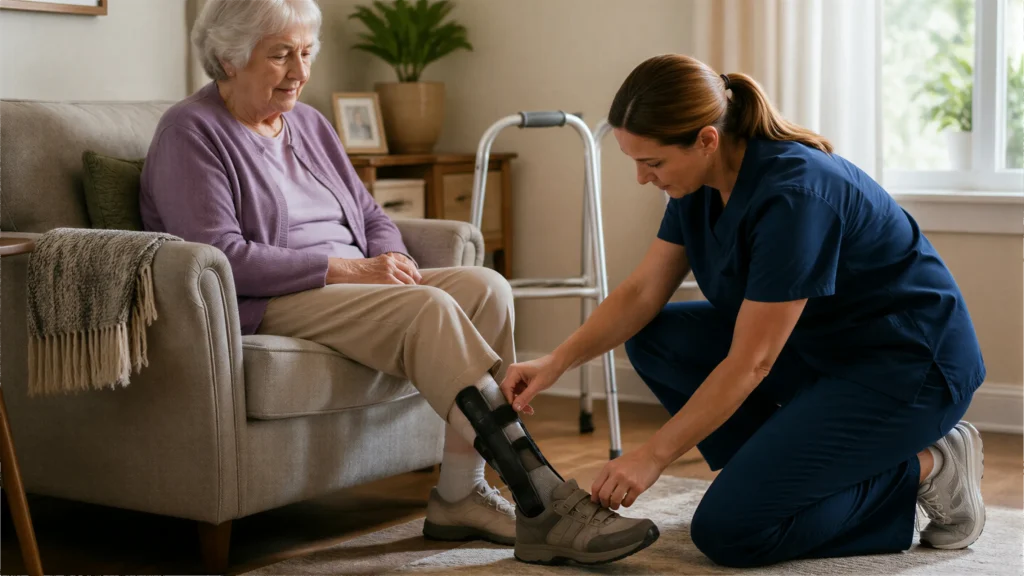
An ankle-foot orthosis holds the foot in a more neutral position and helps lift the toes during stepping. In plain terms, it is often the simplest way to reduce toe drag right away. For many people, that alone makes walking safer and less tiring.
An AFO is often the better starting point when:
- toe drag is frequent and obvious
- the ankle feels unstable
- the person needs a more consistent, low-setup solution
- cognition, vision, or hand function make FES setup unrealistic
- the person needs something that can be put on quickly for repeated short walks
AFOs and FES can both help with stroke-related foot drop, and neither is a universal winner. The better choice usually comes down to fit, tolerance, setup burden, and daily routine rather than assuming one option is always better.
When FES may be a good fit
FES uses timed electrical stimulation, often over the common peroneal nerve, to help produce dorsiflexion during walking. Some people like it because it feels less bulky than a brace and may support a more natural gait pattern. It is not automatically better than a well-fitted brace, though, and the best choice still depends on how the person walks, what they can manage, and what they will actually use.
FES may be worth discussing when:
- the person dislikes or does not tolerate a brace
- the walking pattern improves clearly during a supervised trial
- hand use, cognition, and vision are good enough for reliable setup
- skin can tolerate electrode placement
- the person wants a device that supports active muscle contraction during gait
FES is not a casual home experiment. It needs screening. Implanted cardiac devices, uncontrolled seizure disorders, skin problems at the electrode site, pregnancy, recent metal implants near the treatment area, severe osteoporosis, or other medical factors can change whether it is appropriate. If there is any doubt, the prescribing clinician needs to clear it first.
Where shoe modifications help
Shoe changes are often most useful as support for the main plan, not as a stand-alone fix for moderate or severe foot drop. Good footwear can make an AFO work better, improve stability, and reduce trip risk. In milder cases, carefully chosen shoes may reduce symptoms enough for safe short-distance walking, but that is not the norm when toe drag is frequent.
Helpful shoe features often include:
- enough depth and width to fit the foot and any brace without pressure
- a secure heel and closure so the foot does not slide
- a slip-resistant outsole
- a stable base rather than a soft, sloppy sole
- lightweight construction that does not make limb swing harder
In some cases, a pedorthist or orthotist may recommend actual shoe modifications, such as closure changes, sole flares for stability, rocker adjustments, or other custom changes to help accommodate the device and the gait pattern. These are specialist jobs. They are not the same as buying bigger shoes online.
A safe way to decide
Use this order:
- Confirm the cause is being evaluated, especially if the weakness is new.
- Trial the option that best matches severity and setup ability, often an AFO first.
- Test it in the real shoes the person will actually wear.
- Walk in the places that matter most at home, not only in a clinic hallway.
- Recheck skin, comfort, fatigue, and confidence after several short sessions.
- Adjust the plan if the person still catches toes, leans excessively, or avoids using the device.
If walking remains inefficient even with the right foot-drop plan, it may help to look at broader gait support and accessory choices such as walker accessories, wheelchair cushions, or wheelchair selection, depending on how much mobility reserve the person has.
Common Mistakes and Red Flags
One common mistake is assuming that if a person can technically walk, the current setup is good enough. If every walk involves toe catching, compensatory high stepping, grabbing furniture, or visible fear, the plan is not working well enough.
Another mistake is chasing the most advanced-looking option instead of the most usable one. FES can be excellent for the right person, but if electrode placement is inconsistent or the person stops wearing it because of skin irritation or setup burden, it is not the right tool at that moment.
Other common problems include:
- using shoes that are too narrow for the brace
- ignoring red marks, rubbing, or swelling after use
- continuing with obvious toe drag because the device feels "mostly okay"
- buying generic drop-foot products without professional fitting
- trying DIY shoe lifts, wedges, or attachments that change balance unpredictably
- assuming a brace means no strengthening or gait practice is needed
Red flags that should change the plan quickly include:
- sudden new foot drop or rapidly worsening weakness
- repeated falls or near-falls even with the current device
- skin breakdown, blisters, or persistent pressure marks
- pain, increased spasticity, or significant discomfort during FES
- worsening ankle inversion or knee instability
- inability to manage setup safely because of cognition, hand function, or vision
If the person is reluctant to admit how much help they need, it can help to shift the conversation away from pride and toward function. A cane, walker, or wheelchair used appropriately can protect mobility rather than take it away. If the support choice is still unclear, AI and app-based gait analysis explains what tech can and cannot realistically contribute to the decision.
When to Get More Help
Get prompt medical evaluation if foot drop is new, suddenly worse, or paired with new numbness, back pain, facial droop, arm weakness, or other neurologic change. Sudden onset changes need diagnosis, not a shoe purchase.
Get professional fitting help when:
- the person has frequent toe drag
- the ankle rolls or feels unstable
- there have been falls or close calls
- an off-the-shelf brace is uncomfortable or ineffective
- shoe fit becomes a constant battle
- skin is fragile, sensation is poor, or swelling is variable
The most useful professionals may include a physician, neurologist, physiatrist, physical therapist, orthotist, or pedorthist depending on the cause and device involved. The point is not to build a big team for its own sake. The point is to stop guessing.
Home mobility planning may also need to change while the foot-drop setup is being sorted out. That may mean safer transfer technique, a different walking aid, or temporary use of wheels for longer distances. If moving from bed to chair is already difficult, bed-to-chair transfers for caregivers can help tie the walking decision back to everyday care.
Frequently Asked Questions
Is an AFO better than FES for foot drop?
Not automatically. Research comparing the two shows similar improvement on several walking measures for stroke-related foot drop. In practice, the better option is often the one that matches the person's gait pattern, tolerance, and ability to use it correctly every day.
Can shoes alone fix foot drop?
Usually not if toe drag is moderate or severe. Shoes can improve stability, fit a brace properly, and reduce trip risk, but they do not replace active dorsiflexion support when the foot is not clearing the floor.
What shoes work best with an AFO?
Look for shoes with enough depth and width, a secure heel, a stable outsole, and closures that are easy to manage. The shoe needs to hold the brace and foot securely without creating pressure points. Soft, narrow, or unstable shoes often make brace use worse.
When is foot drop an emergency?
Treat it urgently if it appears suddenly, gets worse quickly, or comes with other neurologic changes such as new weakness, numbness, facial changes, severe back pain, or repeated falls. A sudden change needs diagnosis before long-term equipment decisions.
Should you buy a foot-drop brace online without being fitted?
Usually not if the foot drop is new, moderate to severe, or already causing falls. The cause, shoe fit, skin risk, and amount of ankle control needed all matter more than a generic online label.
Foot drop solutions work best when they are matched to the real problem instead of the label on the device. AFOs often win on simplicity and consistency. FES can be a strong option when setup, tolerance, and medical screening line up. Shoe modifications matter, but usually as part of a larger plan. The right choice is the one that improves clearance, reduces falls, and still gets used in ordinary life.
If foot drop is part of a bigger walking and transfer decline, pair this with assessing transfer readiness and mobility levels, best canes for seniors, best rollators for seniors, and best wheelchairs for seniors.