As an affiliate, we may earn a commission from qualifying purchases. We get commissions for purchases made through links on this website from Amazon and other third parties.
The best car transfer aid is the one that fixes the exact part of the move that feels unsafe. Some people can sit down just fine but cannot pivot their legs into the car. Others can turn well enough but have nothing solid to push on when it is time to stand back up. If you want the wider mobility picture first, start with mobility aids: walkers, canes, and rollators and getting in and out of a car with limited mobility.
This category usually comes down to two tools. A latch-in support bar gives you a firm handhold at the door frame. A swivel cushion helps your hips turn without so much twisting and scooting. They do different jobs, and buying the wrong one often means the aid feels useless even when the product itself is fine. This guide compares five strong options and shows who should choose a bar, who should choose a cushion, and when the car seat itself is the bigger problem.
If car entry is only one piece of the problem, the mobility and transfers master guide pulls the bigger transfer and equipment picture together.
Quick Picks
- Best Overall: Stander HandyBar for a solid latch-in support bar that works in most vehicles and feels planted during stand-up transfers.
- Budget Pick: Vive Car Handle Assist for families who want two latch-in handles they can keep in more than one car.
- Premium Pick: Able Life Auto Assist Grab Bar for a more polished ergonomic handle with strong support and easy glove-box storage.
- Best for Daily Use: Stander CarCaddie for drivers or passengers who do better pulling from an overhead-style strap handle.
- Best Alternative: Sojoy iGelComfort Swivel Seat Cushion for people whose main problem is turning into or out of a flatter seat, not pushing to stand.
Best Overall
Budget Pick
Premium Pick
Best for Daily Use
Best Alternative
Comparison Table
| Product | Best For | Key Strength | Main Tradeoff |
|---|---|---|---|
| Stander HandyBar | Most car door stand-up transfers | Very solid latch-in grip with emergency tools | Bulkier than simpler handle-only models |
| Vive Car Handle Assist | Families using more than one vehicle | Two compact latch handles with cushioned grip | Still depends on door-latch angle matching the person's transfer |
| Able Life Auto Assist Grab Bar | People wanting an ergonomic latch bar | Strong support with comfortable grip and hidden key compartment | Does not help every person equally for getting into higher vehicles |
| Stander CarCaddie | Sedans and daily in-and-out use | Adjustable strap handle gives a higher pull point | Must be removed after use and is not ideal for every arm reach |
| Sojoy iGelComfort Swivel Seat Cushion | Hip rotation trouble on flatter seats | Helps the body turn with less twisting | Does not work well on bucket seats or for larger people |
Quick Decision Guide
- Pick the HandyBar if the person mainly needs a firm push-off point to stand from the seat.
- Pick the Vive two-pack if one handle needs to stay in the main car and another needs to travel with the person.
- Pick the Able Life if you want a latch bar with a more shaped grip and you already know latch-side leverage works for the transfer.
- Pick the CarCaddie if a higher pull point from the window frame feels easier than a lower latch bar.
- Pick the Sojoy swivel cushion if the person can sit down but struggles to twist hips and legs into position.
- If the transfer still ends with you doing most of the lifting, compare rollator vs. standard walker or move to a more complete transfer plan instead of trying stronger accessories.
- If getting out of the car is hard because the seat itself is too low or the steering wheel space is tight, look at getting in and out of a car with limited mobility before buying another gadget.
Bar or Swivel Cushion: Which Problem Are You Solving?
A support bar is usually the right answer when the hard part is standing. The person can turn enough to get the feet out, but once they are near the seat edge they need a firm handhold to press down on and rise. That is where latch-in bars shine. They create a temporary grab point at the door striker without modifying the vehicle, and they work especially well for people getting out of lower sedans or transferring toward a walker or wheelchair.
A swivel cushion is a different tool for a different problem. It helps when the hips, back, or knees do not tolerate twisting into the seat. The person sits first, then rotates into position with less dragging and less torque through the lower body. That can be a big help for arthritis, stiff hips, or painful car seats, but it only works if the seat shape allows the cushion to rotate. Many newer front seats are bucket-shaped, and that is where swivel cushions often disappoint.
The wrong choice usually happens when families treat these tools like they solve the whole transfer. They do not. A bar does not fix a seat that is too low. A cushion does not create the push-off point needed to stand. If the person also struggles with standing from benches, chairs, or tubs, the same transfer logic shows up in other rooms too, which is why tub and shower bench transfers often teach the same lesson: solve the exact motion that feels unsafe, not the whole day with one product.
Best Car Transfer Aids: Top Picks
1 / 5 Focus Latch-in vehicle support bar for standing transfers Fit Works with most vehicles that have a U-shaped striker latch Carry 1 lb portable bar stored in console or door pocket Safety Includes seat belt cutter and window breaker Tradeoff Bulkier than simpler handle-only barsStander HandyBar

The Stander HandyBar is the easiest overall recommendation because it does the main job very well: it gives a strong, steady handhold at the exact moment a person needs to push up from the car seat. You slide it into the U-shaped door striker, open the door fully, and it becomes a temporary grab bar for sitting down, standing up, or transferring toward a wheelchair. That simple setup works especially well for lower sedans where the seat is hard to rise from without a strong push-off point.
What stands out in use is how planted it feels. Owners repeatedly described it as sturdy, easy to insert, and solid enough that it does not wiggle or feel like it might slip. It also stores easily in the console for routine use. The tradeoff is size. It is still a more substantial tool than some lighter handles, and many people end up leaving it in the car rather than carrying it in a handbag or pocket. The emergency window breaker and seat belt cutter are nice to have, but the real value is the stable transfer grip.
Why It Helps:
- The latch-in design gives a real push-off point for standing from lower vehicle seats.
- It works in many vehicles without permanent installation.
- It feels more solid than cheaper handles that flex at the grip.
What To Keep In Mind:
- It is better for push-off transfers than for people who mainly need help rotating into the seat.
- Most users will want to store it in the car, not carry it around all day.
2 / 5 Focus Two-pack latch-in vehicle support handles Fit Compatible with most vehicle door latches Support Composite build with cushioned nonslip grip and 300 lb support Carry Compact storage in glove box or door pocket Tradeoff Still depends on latch placement matching the person's transfer patternVive Car Handle Assist

The Vive Car Handle Assist is the smart budget pick because it gives families two useful tools instead of one. That matters more than it sounds. One can stay in the main family car while the other travels with the person, rides in a friend's car, or stays in the wheelchair bag for appointments. For people who transfer in and out of more than one vehicle, that flexibility is often the difference between actually using the tool and forgetting it at home.
This model also has a practical build. The composite latch end is designed to be less scratch-prone than all-metal inserts, and the grip is cushioned enough for sore hands. It stores easily and works especially well for wheelchair-to-car transfers when there is otherwise nothing solid to grab. The limit is the same one shared by all latch bars: if the person needs a pull point farther forward or higher up, the latch location may not give the right leverage.
Why It Helps:
- The two-pack setup works well for families using more than one car.
- The cushioned handle feels secure without being too hard on sore hands.
- It can help both everyday car exits and wheelchair-to-car transfers.
What To Keep In Mind:
- A latch bar only works if that latch position matches the person's transfer mechanics.
- It is compact, but it still needs a solid, compatible striker to feel secure.
3 / 5 Focus Ergonomic latch-in car assist grab bar Fit Compatible with most vehicle strikers and supports 300 lb Carry Portable glove-box size with hidden key compartment Grip Shaped nonslip handle for push-off leverage Tradeoff Door-latch position does not help every entry angle equallyAble Life Auto Assist Grab Bar

The Able Life Auto Assist Grab Bar earns the premium spot because it feels more refined in the hand than the simpler latch bars. The grip is shaped well, the tool stores easily, and the hidden key compartment is one of those small features that can matter for caregivers and older drivers who want a spare key close by. For people whose transfer pattern matches the latch position, it gives a confident, comfortable push point without much fuss.
Where this bar works best is the classic "sit, plant feet, press down, stand" exit from a front passenger seat or family car. It is especially useful after surgery or with one-sided weakness when the person needs a firm push point and the latch-side angle lines up well. The caution is that the latch position is still fixed by the car, not by the person. If the person needs a grip point farther forward to help climb up into a taller seat, this shape may still not solve the problem. In other words, it is a polished latch bar, not a universal answer to every vehicle transfer.
Why It Helps:
- The ergonomic handle feels comfortable and secure during a hard push-off.
- It stores easily and adds a hidden key compartment without adding much bulk.
- It gives a cleaner, more polished feel than many plain assist bars.
What To Keep In Mind:
- It helps most when getting out, not always when climbing into a higher seat.
- Some people may still find latch-side leverage awkward depending on the door and body position.
4 / 5 Focus Window-frame strap handle for seated car transfers Fit Adjustable strap from 7 to 16 in with 250 lb capacity Grip 5 in ergonomic nonslip handle Use Case Higher pull point for sedan exits and repeated daily use Tradeoff Must be removed after use and requires enough reach to grab it comfortablyStander CarCaddie
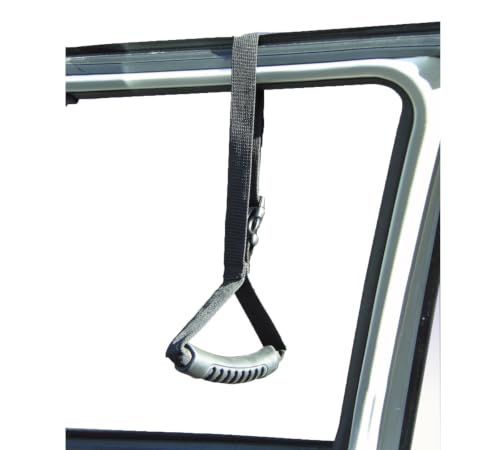
The CarCaddie is the daily-use pick because it solves a different problem from latch bars. Instead of giving a low push point at the door striker, it creates a higher handle from the window frame. That can be easier for some people, especially in lower sedans where they want to pull themselves more upright as they scoot toward the edge. It also helps when a latch bar angle simply does not match the way the person moves.
This is a good fit for households that use the same vehicle repeatedly and want something simple they can clip on and unclip after each trip. The adjustable strap lets you set the handle height, and people often describe it as helpful and confidence-boosting once it is dialed in. The tradeoff is that it is not as universal as it looks. Shorter people or people with limited arm reach may find the handle awkward, and if you leave it installed while driving it can swing, bump the passenger, or break the door seal.
Why It Helps:
- The higher pull point can feel easier than a latch bar in lower cars.
- Strap adjustment gives more freedom to place the handle where the person can reach it.
- It works well for repeat use in the same sedan or family vehicle.
What To Keep In Mind:
- It should be removed after use rather than left attached while driving.
- It is not ideal for people who cannot comfortably reach up for the handle.
5 / 5 Focus Gel memory foam swivel cushion for easier turning Fit 15.5 in round cushion for flatter seats Comfort Cooling gel memory foam with removable cover Use Case Reducing hip and back twisting during seat entry Tradeoff Does not work well on bucket seats or for larger usersSojoy iGelComfort Swivel Seat Cushion
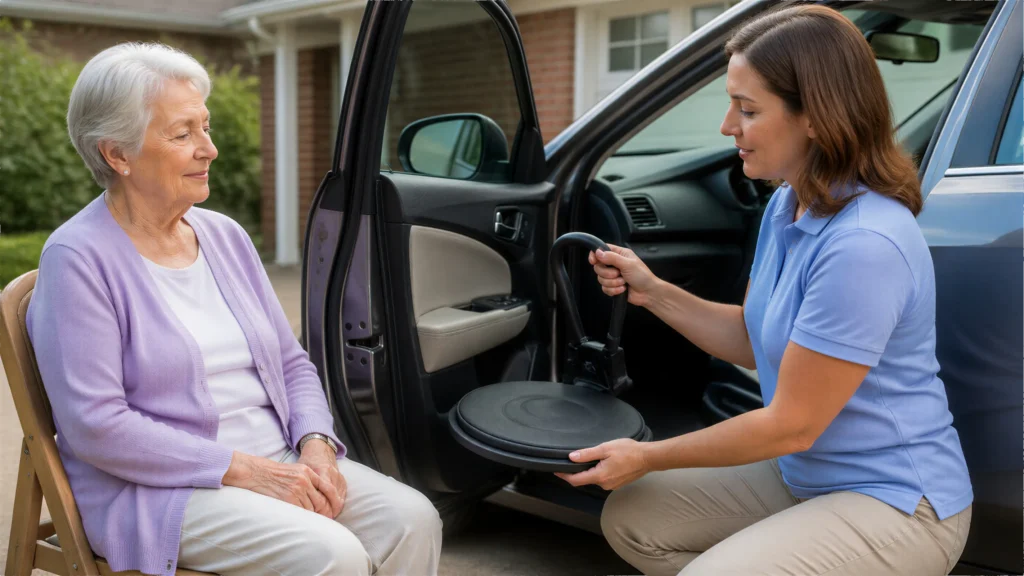
The Sojoy cushion is the best alternative because it helps with a different transfer phase altogether. Instead of giving you something to grab, it helps your body rotate once you are seated. That can reduce the twisting that bothers hips, knees, and lower backs during car entry and exit. On flatter seats, it can make the whole move feel smoother because the person can sit first and then turn, rather than trying to drop and twist at the same time.
This is the right choice only when the seat shape cooperates. The manufacturer clearly limits it to flatter car seats, and multiple owners confirmed that bucket seats are where swivel cushions fail. Larger people may also compress the seat too deeply for the swivel to work well. When it does fit, though, it can be genuinely helpful for arthritis and other painful hip-turning problems. Think of it as a rotation aid, not a standing aid.
Why It Helps:
- It reduces hip and back twisting when the hard part is turning into position.
- The gel memory foam adds comfort as well as movement help.
- It can stay in place for repeated errands if the seat shape is right.
What To Keep In Mind:
- It needs a flatter seat surface and is a poor match for most bucket seats.
- Larger users or deeper soft seats can reduce how smoothly it swivels.
How to Choose Car Transfer Aids
Start by deciding whether the hard part is sitting, turning, or standing. If the person can lower into the seat but struggles to rotate the legs in, a swivel cushion is the more natural tool. If the person can turn into position but then gets stuck trying to rise from the seat edge, a latch bar or strap handle makes more sense. If both parts are hard, you may need to fix the car setup first instead of stacking more accessories onto a bad seat.
Seat height and seat shape matter more than most people think. A lower sedan often needs a stronger push-off aid because standing up is the real challenge. A deeply contoured bucket seat may defeat a swivel cushion completely. That is why getting in and out of a car with limited mobility belongs in this conversation. If the seat is too low, too far back, or leaves poor leg room, the transfer aid ends up compensating for the wrong problem.
Then check vehicle compatibility. Latch-in bars need a proper U-shaped striker or latch and enough room to use it safely. Strap handles need a window frame that allows the strap to sit correctly and still lets the handle land where the person can reach it. Swivel cushions need a flat enough seating surface. This is also a good place to think about what happens after the transfer. If the person is transferring to a walker, rollator vs. standard walker may shape where the feet need to land. If the person is transferring to a chair, manual vs. transport wheelchair differences can matter just as much as the car aid.
Think about hand strength too. A hard metal bar can be fine for someone who can grip and press firmly. Someone with arthritis may do better with a more padded grip or a handle that does not require as much wrist extension. Swivel cushions help with twisting, but they do not help if the person still needs both hands free to push up. In those cases, a bar plus a calmer transfer sequence works better than a cushion alone.
Finally, remember that a car transfer aid should reduce caregiver lifting, not just move it around. If you still find yourself pulling on the person's arms, bracing the door frame, and doing most of the lift, the setup is not safe enough yet. The right aid should let the person contribute more to the move, even if only by pressing, turning, or scooting in a more controlled way.
Common Mistakes When Choosing Car Transfer Aids
- Buying a latch bar when the real problem is twisting into the seat, not standing up.
- Buying a swivel cushion without checking whether the seat is flat enough to let it rotate.
- Leaving a strap handle installed while driving instead of removing it after the transfer.
- Assuming "fits most vehicles" means it will feel right in every front seat and every body position.
- Using the door itself as the main support point instead of a stable transfer tool.
Another mistake is testing the aid only once in the driveway. Car transfers change when the person is tired, sore, rushed, parked uphill, or getting out on a curb. If possible, test the setup in the real situations that cause trouble. A tool that feels fine on a calm trial can still fail if it needs a better seat height, a better angle, or a second support device waiting outside the car.
Frequently Asked Questions About Car Transfer Aids
Are car assist handles safe for seniors?
Yes, when the handle matches the vehicle latch correctly and the person has enough grip and strength to use it the way it is intended. They are safest when they create a firm, predictable push-off point instead of replacing all good transfer technique.
Do latch-in car handles work in every car?
No. Many work in most vehicles with a U-shaped door striker, but fit and leverage still vary from one car to another. The handle may fit the latch and still not feel right for the person's body position.
Is a swivel cushion better than a support bar?
Only if the hard part is rotating into the seat. A swivel cushion helps with turning. A support bar helps with pushing up and down. They solve different parts of the transfer.
Can a swivel cushion work on bucket seats?
Usually not well. Most swivel cushions do best on flatter seats. Deeply contoured or bucket-style seats often prevent smooth rotation.
Should the transfer aid stay in the car all the time?
Portable latch bars usually can stay in the glove box or console. Strap handles and other temporary aids are better removed after use unless the instructions specifically support leaving them in place.
When is a car transfer aid not enough?
It is not enough when the person still cannot contribute to the move, still needs you to do most of the lifting, or still looks unsafe once standing. That is the point where you rethink the whole transfer setup, not just the accessory.
If car transfers are only one piece of a bigger mobility problem, compare manual and transport wheelchair options when the person tires out quickly, review best walkers for more support if the first few steps after standing feel shaky, look at pressure-relief cushions when the issue is pressure more than transfer mechanics, and keep the mobility aid guide nearby when the right answer may involve more than the car door.