As an affiliate, we may earn a commission from qualifying purchases. We get commissions for purchases made through links on this website from Amazon and other third parties.
A passive Hoyer-type lift can prevent dangerous manual lifting, but it does not make transfers automatic. The machine only works safely when the sling fits, the lift and sling are compatible, the room is set up, and the caregiver knows exactly what to check before the person leaves the bed or chair.
That is why this article focuses on setup, sling fit, and risk control rather than only the movement sequence. If you want the broader home-transfer picture first, start with the mobility and transfers master guide. If you want the exact lifting sequence after setup is correct, follow the Hoyer lift step-by-step guide.
When to Use This
A passive floor lift is usually the safer choice when the person cannot stand, cannot pivot safely, or cannot help enough to make a manual transfer reasonable.
That often includes people who:
- are fully dependent for transfers
- cannot bear weight reliably
- have poor upper-body control or cannot stay centered when upright
- are too weak, painful, or unpredictable for a gait-belt pivot
- would require the caregiver to lift too much weight by hand
A passive lift is not automatically the best answer for every hard transfer. If the person can still stand with help and has enough upper-body control to participate, a sit-to-stand lift or a standard bed-to-chair transfer may fit better.
The real goal is not to use the biggest device. The goal is to match the transfer method to the person's current ability. If that decision is still unclear, compare patient lift types and sling options before buying or renting equipment.
Before You Start
The most important passive-lift rule is simple: do not improvise.
The lift model, sling type, hook system, and loop pattern all matter. A caregiver who has not been trained on that exact setup is more likely to make the kind of small mistake that causes a big fall.
Get trained on the actual lift in the home
Hands-on instruction matters more than watching one generic video.
Before using the lift without supervision, the caregiver should know:
- how this specific lift raises and lowers
- how the emergency lowering feature works
- how the sling attaches to this spreader bar
- whether the transfer is safe with one caregiver or needs two
- how to tell when the sling angle is wrong
If training has not happened yet, delay the first unsupervised transfer and ask the supplier, nurse, PT, or OT to teach it in the home.
Choose the right sling for the person and the task
The sling is not an accessory. It is the part that actually holds the person.
That means sling choice has to match:
- the person's size and weight
- head and upper-body control
- the transfer task
- the lift's approved attachment system
Common examples include:
- full-body or universal slings for maximum support
- divided-leg or toileting slings for commode access
- high-back slings when extra head support is needed
- specialty slings for bariatric use or unusual body shape
A sling that is too small can pinch, bruise, or place too much pressure on the thighs and torso. A sling that is too large can let the person slide too low or sit in an unstable position. If sling selection is still the main question, compare transfer sling options for older adults.
Do not mix lift and sling systems casually
This is one of the highest-risk mistakes in home lifting.
Use only a sling that is approved for that lift or attachment style. Do not assume that similar hooks, clips, loops, or spreader bars are interchangeable just because they seem to fit. Brand and model compatibility matters.
When in doubt:
- check the label
- check the manual
- call the supplier
- do not lift until compatibility is confirmed
Inspect the sling before every use
Every transfer should start with a sling check.
Look for:
- frayed fabric
- damaged seams
- stretched loops
- torn stitching
- cracked clips
- a missing or unreadable label
If the label cannot be read, the size and safe working load cannot be confirmed. That sling should come out of service.
Inspect the lift and room setup too
Check the lift for:
- battery charge or hydraulic function
- smooth raising and lowering
- intact spreader bar and hooks
- working emergency lowering
- base legs that open fully
Check the room for:
- enough clearance around the bed, chair, or commode
- a stable and level floor
- no rugs, cords, or clutter in the route
- a receiving surface that is ready before the lift begins
Set the destination first:
- lock the wheelchair, recliner, or commode if it has brakes
- move wheelchair footrests away
- make sure the chair is not too low or too soft
- keep the lift base as wide as practical for stability
If the route includes thresholds or slick spots, fix those first with threshold ramp planning and non-slip surface basics.
Step-by-Step Technique
The exact sequence varies by model, but the safest passive-lift transfer usually follows the same structure.
1. Explain the transfer before touching the sling
Even if the person cannot assist physically, explain each step.
That helps reduce fear, grabbing, and sudden leaning. It also gives you a chance to notice if the person is too agitated, confused, or painful for the transfer to proceed safely.
2. Center the sling carefully
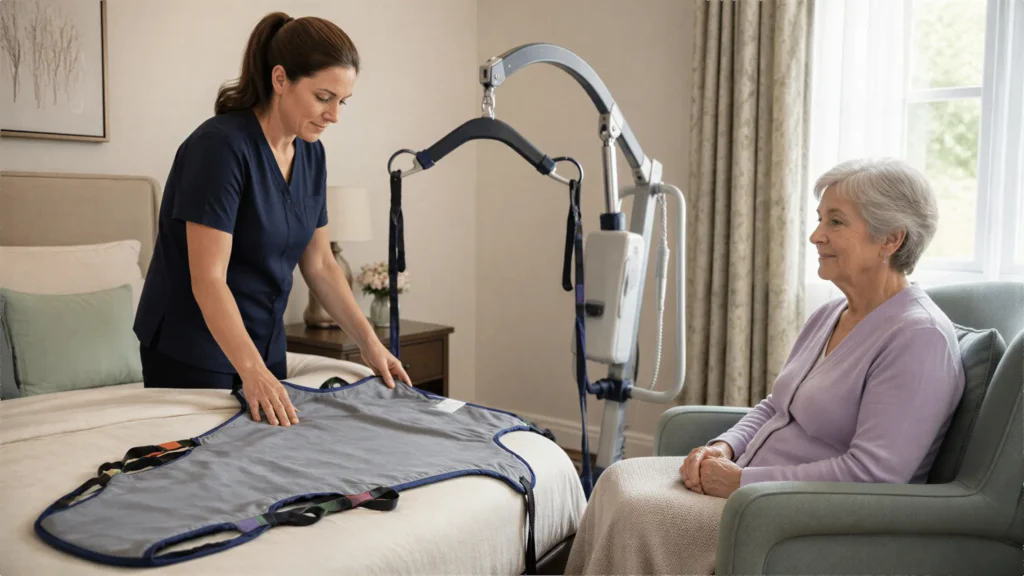
For bed use, roll the person enough to place the sling flat and centered. Smooth out folds under the back and thighs. Make sure the lower edge sits where the sling manufacturer expects and that head support is positioned correctly if the person needs it.
For seated use, lean the person forward just enough to center the back panel, then bring the leg sections under one thigh at a time.
The sling should support the body evenly. It should not be bunched, twisted, or offset to one side.
3. Widen the base and position the lift before attaching
Bring the lift in close enough that the person will be centered over the base. Open the base to its stable position before the lift takes weight.
Lower the boom or spreader bar to a working height so you are not yanking straps upward to make them reach.
4. Attach the sling the same way every time
Attach the top and leg sections according to the sling manual. Keep left and right loop settings matched unless the manufacturer or therapist has given a specific reason to change the angle.
Before lifting, confirm:
- loops are fully seated
- straps are not twisted
- the person's body is centered
- the leg sections are placed correctly
- the head is supported if needed
5. Do a short test lift first
Raise the person only an inch or two off the bed or chair at first.
This is the safest time to catch:
- sliding
- strong tilt to one side
- shoulder or thigh pain
- poor head control
- an obviously wrong loop choice
If anything looks wrong, lower the person and fix it. Do not keep going and hope it settles out.
6. Lift only as high as needed
The person should stay as low as practical while still clearing the surface.
Too much height increases sway and makes the transfer feel less stable. Guide the body gently with the sling or side handles if present. Do not pull on the person's arms. Do not drag on the boom.
If arm handling is a recurring problem in your home setup, review why lifting by the arms is unsafe.
7. Move slowly on a clear, level path
Push from the lift handles and take the smoothest route available. If the lift has to cross clutter, cords, narrow turns, or uneven flooring, stop and reset the environment first.
The person should not be suspended while the caregiver is trying to figure out where to turn next.
8. Lower with the destination ready
Before lowering:
- confirm the chair or wheelchair brakes are locked
- make sure footrests are out of the way
- line up the hips with the back of the seat
Lower slowly and guide the body into final position. If the person lands too far forward, do not drag them by the arms. Reposition with the sling or another approved method.
If transfers frequently end with the person perched at the edge, compare the setup to lift chair safety and fit basics and wheelchair sizing and fit.
Safety Checks and Common Errors
Most lift injuries do not come from the machine "failing on its own." They come from predictable setup mistakes.
The most common errors are:
- using a sling that is not approved for the lift
- using the wrong sling size
- lifting with a damaged sling
- leaving the base too narrow
- raising the person higher than needed
- starting before the destination is ready
- trying a transfer alone that really needs two caregivers
- using the lift when the person is physically aggressive, panicked, or sliding badly
- improvising with towels, sheets, or unapproved supports
Another common error is choosing a passive lift when the real problem is transfer planning, not total dependence. If the person still has some standing ability, compare portable standing aids, sit-to-stand lift options, and general mobility aids.
When to Stop or Get Help
Stop the transfer and get help if:
- the person starts sliding in the sling
- the sling fit is unclear
- the person has new pain, shortness of breath, or sudden distress
- the head or upper body is not supported well enough
- the lift is sticking, alarming, or losing power
- the room is too tight for the base to stay stable
- the transfer clearly needs a second trained helper
You should also stop if the same problem keeps happening, such as repeated tilting, repeated forward landing in the chair, or repeated skin rubbing from the sling. That usually means the sling choice, chair setup, or caregiver technique needs to change.
If a transfer fails partway through and the person is lowered safely but not in the right place, stop, reset, and walk back through the transfer safety checklist. If a fall has already happened, use safe floor-to-chair recovery steps instead of trying to muscle the person back up.
Frequently Asked Questions
What makes a lift "passive"?
A passive lift is designed for people who cannot safely stand and assist with the transfer. The lift does the lifting while the sling carries the body.
Can one caregiver use a passive Hoyer-type lift alone?
Sometimes, but not always. The answer depends on the person's size, behavior, upper-body control, and the exact transfer. Many home situations are safer with two trained helpers.
Does every sling work on every Hoyer-style lift?
No. Sling and lift compatibility must be confirmed. Similar-looking loops or hooks are not enough reason to assume the setup is safe.
How do I know if the sling is too small or too large?
A poor fit often shows up as pinching, thigh pressure, poor head support, sliding, or a body position that looks off-center and unstable.
Should the person be lifted high above the bed or chair?
No. Raise only high enough to clear the surface. More height usually means more sway and less control.
Is it okay to keep using a sling if the label is worn off?
No. If the label is unreadable, you cannot verify size, weight capacity, or model information.
What if the person gets anxious during the lift?
Pause, lower if needed, and reset. Agitation and grabbing can make even a technically correct lift unsafe.
When should a clinician or supplier reassess the setup?
Ask for reassessment when the person's weight, posture, head control, pain, skin condition, or transfer ability has changed, or when the current lift routine keeps producing problems.
For the broader planning piece, go back to the mobility and transfers master guide. If you need the movement sequence itself, use the Hoyer lift step-by-step guide. For equipment decisions, compare patient lift types and sling choices and transfer sling options for older adults.