As an affiliate, we may earn a commission from qualifying purchases. We get commissions for purchases made through links on this website from Amazon and other third parties.
Mobility aids help when walking is starting to feel less automatic, but the wrong aid can create almost as many problems as having no aid at all. A cane that is too little support can turn into more stumbles. A rollator that moves faster than the person can control can roll away. A walker that is the wrong height can pull the body into a bent, unsafe posture.
The main decision is not which aid looks least medical. It is which aid gives the person enough support to move safely at home without taking away control. That usually means matching the device to balance, leg strength, endurance, hand function, turning ability, and the rooms the person actually uses every day.
This guide gives the big-picture overview of canes, walkers, and rollators so you can stop guessing. If you want the broader overview first, start with the mobility and transfers master guide. If you already know the main question is not walking support but seated mobility, compare manual wheelchair vs. transport chair or mobility scooter vs. power wheelchair.
What This Guide Covers
This article focuses on the three mobility aids most families compare first:
- canes
- walkers
- rollators
They overlap, but they are not interchangeable.
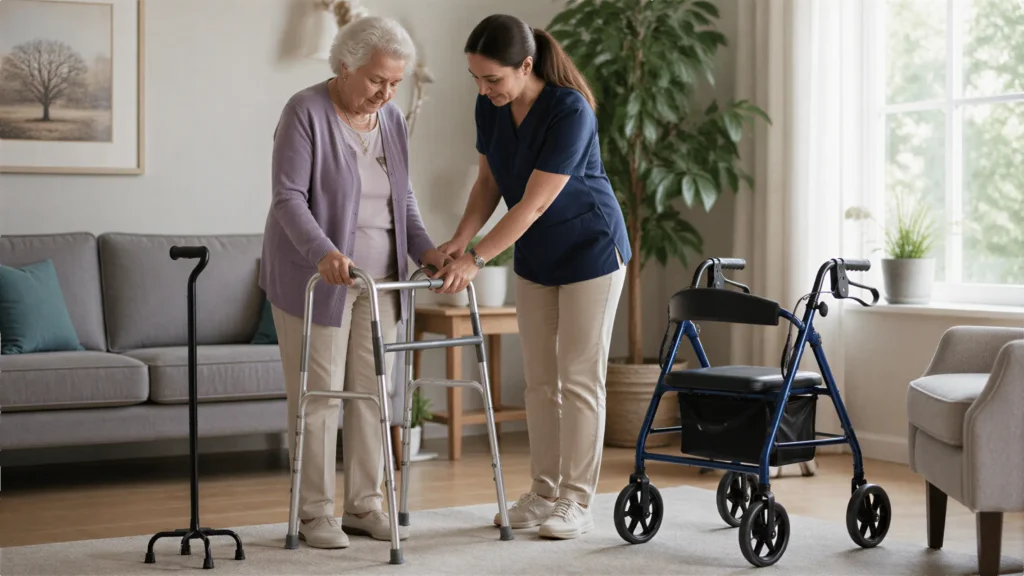
A cane gives one-sided support and is the lightest option. A walker gives the largest base of support and is usually the safest step up when stability is the real problem. A rollator is a wheeled walker with hand brakes and usually a seat, which can work well for people who need help with balance and endurance but still have enough control to manage moving wheels.
The big mistake is treating them like a simple ladder from least to most advanced. Real-life fit is more specific than that:
- some people do best with a quad cane, not a standard cane
- some do better with a two-wheel walker than a standard no-wheel walker
- some are not safe on a rollator even though they want the seat
- some are past all three and need a wheelchair or transfer device instead
This guide helps with the first-pass decision:
- Which aid fits the current level of support?
- What warning signs show the person has outgrown the current aid?
- What home setup details make one option safer than another?
- When should you stop changing equipment on your own and get PT or OT involved?
If you are dealing with a specific condition pattern, read the condition article too. For example, mobility after stroke with one-sided weakness changes the cane-versus-walker decision in ways this overview only touches lightly.
How to Assess Readiness and Risk
Before picking a device, ask what problem the person is really having.
Mild Support Need Usually Points Toward a Cane
A cane usually fits when the person:
- walks independently most of the time
- needs mild help with balance or taking some weight off a painful leg
- has enough hand control to place the cane correctly
- does not need frequent seated rest breaks
This is why a cane often helps one painful or weak leg, but is rarely enough for someone who is unstable on both sides.
If the person is deciding between cane types, do not treat them as identical. A quad cane gives more stability than a single-point cane, but also moves differently and can feel bulkier. If that is the real choice, read quad cane vs. single-point cane before buying.
Bigger Balance Problems Usually Point Toward a Walker
A walker usually fits when the person:
- needs more than one-sided support
- feels unsteady on both legs
- leans heavily on the device
- has had falls or near-falls
- is grabbing walls, counters, or furniture to get around
That last sign matters. "Furniture surfing" is one of the clearest warnings that the current level of support is too little. A walker gives a larger base of support than a cane and is often the safest move when stability is the main issue.
Endurance Plus Moderate Stability Needs May Point Toward a Rollator
A rollator works best when the person:
- still walks reasonably well
- needs help with balance, but not heavy weight-bearing support
- gets tired or short of breath and benefits from a seat
- can reliably squeeze and lock brakes
- can control a wheeled device without it getting away from them
This is the key point many people miss: a rollator is not automatically "better" because it has wheels and a seat. In many situations it is less stable than a standard or two-wheel walker because it can roll away if brakes are not controlled.
That is why rollator vs. standard walker is such an important comparison. If the person leans hard on the device, freezes on turns, or cannot manage hand brakes, the rollator may be the wrong choice even if it feels more modern.
Fit and Hand Function Matter More Than People Think
For canes and walkers, basic fit is usually measured around wrist-to-floor with a slight elbow bend. If the device is too low, the person hunches. If it is too high, shoulders rise and control gets worse.
As a simple check:
- the handle should usually sit near wrist-crease level when the arm hangs at the side
- the elbow should keep a slight bend instead of locking straight
- rubber tips and back tips should not be worn down
- rollator brakes should be easy for the person's hands to reach and control
If height is in question, review proper walker height and posture.
Environment Changes the Answer
The same person may need one device to be safe indoors and a different plan outdoors. Think about:
- narrow hallways
- bathroom turns
- thresholds
- carpet drag
- outdoor pavement
- uneven sidewalks
- the need to carry items while walking
This is why three common questions matter so much:
- Will the device fit through the home?
- Can the person use it in the places that matter most?
- Does the surface make it safer or worse?
If the person mainly uses the device inside the house, a giant outdoor rollator may solve the wrong problem. If the person must handle curbs, rough pavement, or longer outdoor routes, wheel size and stability matter more. For those details, compare indoor vs. outdoor walkers and curbs and ramps with a walker or rollator.
Core Techniques and Equipment
Cane Basics
A cane should be used with intention, not carried like a decoration. In most standard patterns, the cane goes in the hand opposite the weaker or painful leg. That lets the cane and weaker leg move together and gives a better base of support.
Canes are usually best for:
- mild balance loss
- one-sided leg pain
- early gait support
- short distances
- stairs with a handrail when the person has already been taught the technique
Canes are usually the wrong tool when:
- the person needs major weight-bearing support
- both legs are weak
- they keep reaching for furniture
- they are falling or nearly falling
- they need frequent rest breaks
Walker Basics
Walkers come in a few main patterns:
- standard walker with no wheels
- two-wheel walker
- four-wheel walker, often called a rollator when it has brakes and a seat
A standard walker is usually the most stable but also the most demanding because it has to be lifted and placed with each cycle. A two-wheel walker rolls more easily and can feel more natural, but it gives up some stability compared with a standard walker.
If the person is choosing between those two, 2-wheel vs. 4-wheel walkers is the more useful next read.
For basic walker use:
- place the walker only a step length ahead, not far out front
- make sure it is firmly down before stepping
- step into the walker, not behind it
- do not rush turns
- do not use a walker on stairs unless a clinician has trained a specific exception plan
Walkers are often the safest step up when stability is the main problem, but only when the person is willing to move at the slower, more deliberate speed that a walker requires.
Rollator Basics
A rollator helps when lifting a walker is too tiring and the person benefits from smooth rolling movement plus a place to rest. It can be useful for:
- mild to moderate balance issues
- reduced endurance
- chronic lung or heart conditions where pacing matters
- people who walk fairly well but need a seat during longer outings
But the safety rules matter more with a rollator:
- brakes must be used well
- the seat is for resting, not casual perching while it is still moving
- the person should not lean so hard that the device pulls away
- turns should stay controlled
- doorways and tight rooms should be tested before trusting the device daily
Three-wheel and four-wheel rollators also behave differently. Three-wheel models can turn tighter, but they are often less stable. Four-wheel models are usually steadier and better for longer outings, but they need more room. The closest practical next reads are indoor vs. outdoor walkers and rollator vs. standard walker.
When These Aids Are Not Enough
Sometimes the walking-aid debate is the wrong debate. A cane, walker, or rollator is not enough when:
- the person cannot safely bear weight
- transfers are the real danger
- fatigue collapses the walking pattern after a few steps
- severe dizziness or cognitive problems make steering unsafe
- the person needs two hands on a caregiver just to stand
In those cases, it may be time to think beyond these three aids:
- gait belt for guided standing and transfers
- wheelchair for safer seated mobility
- scooter or power wheelchair for longer-term seated mobility needs
- sit-to-stand or lift equipment when transfers are the real problem
If that is where things are heading, compare gait belt placement and fit, manual wheelchair vs. transport chair, and mobility scooter vs. power wheelchair instead of forcing a cane or walker to do a job it cannot do.
Room-by-Room and Scenario-Based Safety
Bedroom
Most bedroom trouble happens at the first stand, not the longest walk. If the person uses a cane, make sure it is already in reach before standing. If they use a walker or rollator, make sure it is positioned close enough to step into safely, not parked across the room.
If bed height is part of the problem, a mobility aid alone may not solve it. Combine walking aid decisions with bed height and bed rail safety for transfers.
Bathroom
Bathrooms expose the limits of every aid. Tight turns, rugs, wet floors, and toilet transfers all raise the stakes.
In the bathroom:
- keep the path clear
- remove loose rugs
- check whether the walker or rollator actually fits
- do not assume a seat on a rollator helps if the room is too tight to use the brakes well
- use grab bars when available instead of over-trusting the mobility aid alone
If the real problem is turning or toileting, toilet transfers safely is often more useful than changing to another walking device.
Kitchen and Carrying Items
Carrying items is where canes and walkers both get less safe. One reason rollators help some people is the basket or seat area gives them a place to carry light items without one-hand balancing tricks.
But that only helps if the added width still fits the home. Accessories like cup holders or cane holders can make a rollator wider than expected. Measure before buying, especially if the person already clips corners or catches door frames.
Doorways and Tight Turns
This is where device differences show up fast:
- canes handle tight spaces easily but provide the least stability
- standard walkers are stable but cumbersome
- two-wheel walkers often split the difference
- rollators turn smoothly when there is room, but can feel risky in cramped spaces
If the person keeps clipping doorways, backing up awkwardly, or freezing during turns, do not ignore it. That is often the first sign that the device-home match is wrong. Review training with a walker: turning, doorways, and tight spaces.
Outdoors, Curbs, and Ramps
A cane can work outdoors for people who need mild support. A walker can be steadier but more awkward. A rollator can be useful outdoors if it has enough wheel size and the person can control it well, but outdoor use is not automatic just because the device has four wheels.
For outdoor use, think about:
- wheel size
- brake reliability
- surface traction
- whether the person leans forward too much
- whether the person can handle ramps, curbs, and uneven pavement without panic
If those are real daily issues, read negotiating curbs and ramps with a walker or rollator before trusting a new device outside.
Nighttime
At night, many people downgrade themselves without realizing it. Poor lighting, urgency to get to the bathroom, slippers, and grogginess make even a normally safe device less safe.
For nighttime:
- keep the device parked in the same spot every night
- light the route well
- do not rely on memory in the dark
- do not leave a rollator unlocked and angled away from the bed
- think twice before telling someone to "just use the cane" if they are noticeably weaker at night
Common Failure Points and When to Get Help
The biggest failure point is choosing by pride. People often stay with a cane too long because it looks simpler, or jump to a rollator too early because it looks smoother and less clunky than a walker. Neither is a good reason.
Watch for these signs the current aid is no longer enough:
- falls or near-falls
- furniture surfing
- needing to sit after very short distances
- leaning hard on a cane
- walker placed too far out front because the person cannot step into it well
- rollator rolling away during turns or standing
- inability to use rollator brakes reliably
- visible hunching from poor device height
- fear of walking that is getting worse instead of better
Other red flags mean the issue may no longer be just device choice:
- sudden weakness
- new severe pain
- knee buckling
- dizziness
- shortness of breath beyond the usual pattern
- mental confusion
- new one-sided changes that could suggest stroke
Get PT or OT help when:
- you are not sure which aid fits the person's current pattern
- the same walking route keeps producing near-falls
- the person has a brain or nerve condition like stroke or Parkinson's
- the fit keeps being adjusted but still feels wrong
- you need hands-on training, not just a new device
Get medical help urgently for sudden new weakness, speech changes, facial droop, severe dizziness, chest pain, or major breathing trouble.
If all three common walking aids seem wrong, believe that signal. It may mean the person needs wheelchair-based mobility, transfer equipment, or a different care plan, not another retail mobility purchase.
Frequently Asked Questions
Which is more stable: a cane, walker, or rollator?
In general, a standard walker is the most stable, then a two-wheel walker, then a rollator, with a cane providing the least support.
When should someone switch from a cane to a walker?
Usually when there are falls or near-falls, two-sided weakness, heavy reliance on furniture, or a clear need for more than mild one-sided support.
Who should not use a rollator?
A rollator may be unsafe for someone who leans heavily on the device, has major balance loss, cannot use the brakes reliably, or becomes unsafe when the device rolls during turns.
Which hand should hold a cane?
Usually the hand opposite the weaker or painful leg, unless a clinician has taught a different pattern for a specific condition.
Can a walker be used on stairs?
Not as a general everyday method. Stair use needs a specific clinician-taught plan, and many people are safer with a different setup entirely.
How do I know if the device height is wrong?
Common signs are hunching, shrugged shoulders, locked elbows, awkward hand position, or feeling like the person is reaching down or up for the handles instead of standing naturally.
Is a rollator better than a walker because it has a seat?
Not always. The seat helps with endurance, but the wheels and brakes also require more control. For some people, the seat is helpful. For others, the rolling frame makes it less safe than a walker.
What if none of these aids feels safe anymore?
That usually means it is time for PT or OT reassessment and possibly a wheelchair, transfer device, or different home mobility plan instead of forcing another cane-or-walker purchase.
If your next question is fit, read proper walker height and posture, quad cane vs. single-point cane, and 2-wheel vs. 4-wheel walkers. If the real issue is turns, outdoor routes, or device control, continue with rollator vs. standard walker, indoor vs. outdoor walkers, and curbs and ramps with a walker or rollator.