As an affiliate, we may earn a commission from qualifying purchases. We get commissions for purchases made through links on this website from Amazon and other third parties.
No, lifting an older adult by the arms is not a safe transfer method.
It may feel like the fastest way to keep someone from falling, pull them up from a chair, or help them into bed, but the arms and shoulders are a poor place to take body weight. Pulling there can hurt the person, throw both of you off balance, and turn a difficult transfer into a shoulder injury or a floor fall. In home care, "I only grabbed the arms for a second" is often how unsafe habits start. For the broader transfer picture, begin with the bed-to-chair transfer step-by-step guide.
If arm-pulling has become part of a bigger transfer problem, the mobility and transfers master guide helps reconnect the safer overall plan.
Short Answer
For frail adults, post-surgical patients, and most home-care transfers, the answer is no.
Do not lift, pull, or drag someone by the arms, hands, wrists, or underarms to get them up. Do not let them hang from your neck either. Those strategies concentrate force in the wrong places and usually happen when the person is already unstable.
The main reasons it is unsafe are simple:
- shoulders are easy to strain or injure when body weight is pulled through the arms
- skin can tear, especially in thin or fragile older adults
- the person often loses balance because the support point is too high and too far from where the body's weight is centered
- the caregiver usually twists, reaches, or tries to "save" the transfer with the back instead of using a safer setup
Safer transfers support the person closer to the waist and trunk, let them push from the bed or chair when possible, and use the right device when manual help is no longer enough. If you are choosing equipment, start with best gait belts and patient lifts, Hoyer types, and slings.
When the Answer Changes
The answer does not change much for adult mobility help.
People sometimes ask this question because they are picturing a very small assist, not a full lift. There is a difference between lightly guiding an arm for direction and actually taking weight through the arms. Gentle guidance is one thing. Pulling someone up by the arms is another.
Light cueing is not the same as lifting
You may briefly guide an elbow or forearm to cue turning, line up a pivot, or help someone find the armrest. That is not the same as using the arms as handles.
The moment you are doing any of the following, it has become unsafe:
- pulling the person forward by both hands
- yanking from under the armpits
- lifting from the wrists to bring them to standing
- trying to stop a fall by hauling upward on one arm
- letting the person cling around your neck while you support their weight
Those moves are common because they happen fast, under stress, and without equipment. They still raise the risk of injury.
A stronger person does not make arm-lifting safe
Some caregivers think it is acceptable if the person is light or "still pretty strong." That is not a reliable rule.
Even lighter adults can have painful shoulders, osteoporosis, arthritis, old rotator cuff problems, skin fragility, or limited upper-body control. If the transfer starts badly, force gets applied quickly and awkwardly. A smaller person can still fall, and a stronger caregiver can still injure a shoulder or back by trying to rescue the motion manually.
Body mechanics alone are not enough
Good body mechanics matter, but they do not turn an unsafe lift into a safe one.
Using your legs, widening your stance, and keeping the person close are all helpful principles. They do not cancel out the problem of pulling body weight through the shoulders or trying to manually lift too much human weight. In many care settings, safe handling programs specifically moved away from routine manual lifting because it hurts both patients and staff.
If the person cannot participate enough for a controlled stand or pivot, the safer answer is usually not "better lifting technique." It is a different transfer method.
Main Risks, Tradeoffs, and Red Flags
The biggest risk is that lifting by the arms feels helpful right up until it goes wrong.
It can work once or twice by luck, especially if the person is cooperative and the distance is short. That false sense of success is part of the problem. Unsafe technique often survives because it does not fail every single time. It only has to fail once.
Shoulder injury and arm pain
The shoulder joint is mobile, not built to be a lifting handle. When someone is pulled upward by the arms or under the armpits, the shoulder can be forced into painful positions.
That can lead to:
- sudden shoulder pain during the transfer
- worsening rotator cuff symptoms
- arm weakness afterward
- bruising in the upper arms
- fear of future transfers because the person expects pain
This matters even more after stroke, arthritis, shoulder replacement, or long periods of weakness after illness or bed rest. A painful shoulder makes future dressing, toileting, and transfer work harder.
Skin tears and soft-tissue injury
Older skin can tear easily, especially around the upper arms and underarms. Pulling on sleeves, gowns, or the upper arm may seem gentler than taking hold of the waist, but it is often the opposite.
Thin skin, bruising medications, swelling, and poor nutrition all make this worse. If the person has already had skin tears, arm-lifting should be treated as a hard stop.
Falls from an unstable support point
Supporting at the arms usually puts your control point too high. Instead of steadying the body at the waist and hips, you are trying to manage balance from the arms.
That makes it easier for the person to:
- lean backward unexpectedly
- rotate away from you
- buckle at the knees
- slip their feet forward
- panic and grab at you
Once that happens, many caregivers pull harder with the arms to "save" the transfer. That usually increases the tilt and makes a fall more likely.
If a person is starting to drop, review what to do after a fall or near-floor event and build a safer plan instead of repeating the same rescue pattern.
Caregiver back, shoulder, and hand injuries
Unsafe manual lifting does not just injure the person being moved.
Caregivers get hurt when they:
- reach forward to grab an arm
- twist while pivoting
- try to catch the person mid-fall
- lift more than they can actually control
- hold awkward weight with bent wrists and rounded shoulders
This is one reason safe handling guidance moved toward transfer aids, gait belts, and mechanical lifts. Human bodies are unpredictable loads. Even if you are fit, a transfer can change in a second when the person freezes, knees buckle, or starts to sit too early.
The neck-grab trap
One of the most dangerous variations is letting the person place their arms around your neck.
Caregivers often allow this because it feels emotionally reassuring to the person. In practice it can pull you forward, choke your posture, and stop you from moving your feet correctly. It also makes it harder for the person to push from the bed or chair, which is what they should be doing if they are able.
If someone always reaches for your neck during transfers, that is a sign the routine needs to change. Often the fix is better cueing, a gait belt, a higher chair, or a different device.
Red flags that mean the current method is not safe enough
Stop relying on arm-lifting if any of these are happening:
- you have to "heave" the person upward to get them standing
- they cannot push from the armrests or bed with their own hands
- their knees buckle during the first second of standing
- they grab your neck or clothing
- you are holding more weight each week, not less
- you are starting transfers from low, soft, or narrow surfaces
- either of you has had pain, bruising, or a near-fall during transfers
These are not small form errors. They are signs that the transfer method no longer matches the person's ability.
What to Do Instead or Next
The safer alternative depends on how much help the person truly needs.
1. Support at the waist, not the arms
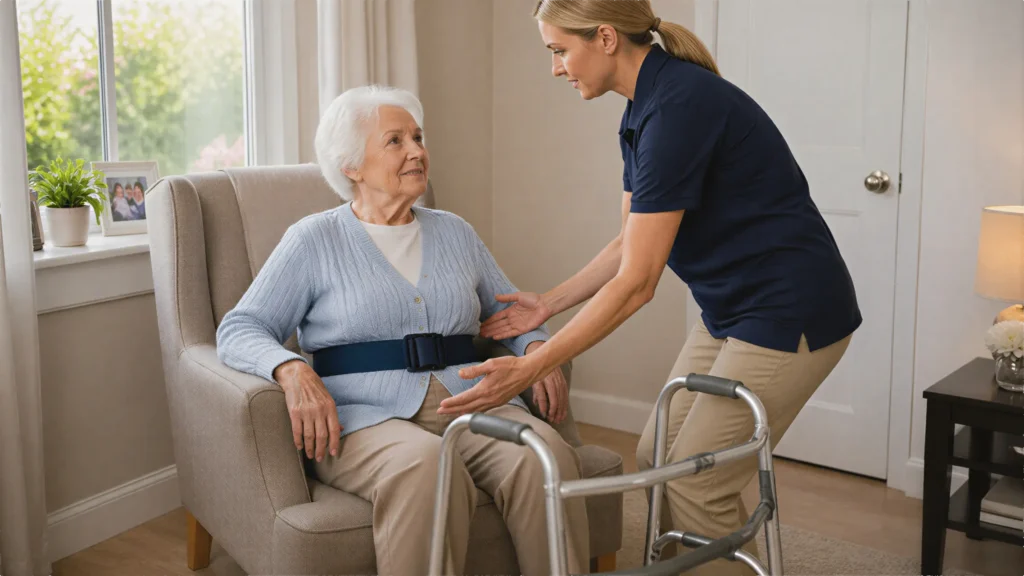
If the person can bear some weight and follow directions, support closer to the trunk. In practice that usually means a gait belt or a secure hold around the waist area, not under the armpits.
A gait belt helps because it:
- gives you a lower, more stable place to assist
- spreads force more evenly around the torso
- reduces the urge to grab clothing or limbs
- makes guarding and small balance corrections easier
It is not a magic fix, and it still requires proper use. But it is much safer than tugging on shoulders or wrists. If you are unsure about belt comfort or placement, read do gait belts hurt when they are placed correctly and compare options in best gait belts.
2. Let the person push from the surface
If the person is able, they should usually push from the bed, mattress edge, or chair armrests to come up. They should not pull on you to stand.
That sequence matters because pushing from the surface:
- keeps the shoulders in a safer role
- helps the person bring the nose and trunk forward
- allows the feet to stay better planted
- reduces the amount of force you need to provide
A common unsafe pattern is watching someone reach for the walker too early while you pull on their arms. The safer pattern is usually: feet set, nose over toes, push from the surface, come to standing, then get the hands to the device.
3. Fix the setup before blaming the person
Sometimes the real problem is not strength. It is setup.
Check:
- Is the chair too low or too soft?
- Is the bed height poor for standing?
- Are shoes or socks making the feet slide?
- Is the walker too far away?
- Is the wheelchair locked and close enough?
- Is the person dizzy after sitting up?
Many bad transfers improve when the environment improves. Related reads that often solve the real issue are bed height, bed rail safety, and transfers, house shoes versus socks indoors, and how to size and fit a cane correctly when a device is contributing to the problem.
4. Use a transfer board, standing aid, or lift when needed
If the person cannot safely stand and pivot with light help, stop trying to improvise manual lifts.
Safer next-step options may include:
- a transfer board for selected seated transfers
- a transfer pole or standing aid for people who can pull or push safely
- a sit-to-stand device when some weight-bearing is still present
- a full-body mechanical lift when standing transfers are no longer safe
The right choice depends on upper-body control, leg strength, cognition, space, and caregiver ability. Useful comparisons are best transfer boards for home, best transfer poles and floor-to-ceiling posts, and Hoyer lift step by step.
5. Have a plan for failed transfers
Do not wait until someone starts dropping to think about what happens next.
A safer routine includes:
- setting up the path before standing
- deciding who gives the cue and when
- knowing when to abort and sit back down
- knowing when to lower to a safe surface instead of trying to hold the person up
Caregivers often get injured in the "save it" moment. The better rule is to prevent that moment by using the right method from the start.
6. Get hands-on training if the task is becoming routine and risky
If you are helping with daily transfers, a short session with PT, OT, home health, or a trained clinician can change a lot. They can watch the exact chair, bed, walker, and caregiver technique and tell you what is realistic.
That matters because many families are not dealing with textbook transfers. They are dealing with narrow bathrooms, fatigue late in the day, mild dementia, painful shoulders, and small but important setup problems.
Training is especially important after:
- stroke
- hip fracture or joint replacement
- hospitalization with major weakness
- repeated near-falls
- a sudden increase in caregiver effort
Frequently Asked Questions
Is it ever okay to pull someone up by both hands?
Not for routine adult transfers. Pulling by both hands still places force through the arms and often pulls the person forward without giving stable control at the trunk.
Why is lifting under the armpits unsafe?
It can hurt the shoulders, pinch skin, and give you poor control over the person's weight and balance. It also encourages awkward caregiver posture.
Is a gait belt safer than holding the arms?
Usually yes, for a person who can participate in a standing transfer. A gait belt gives a better support point around the waist and reduces the urge to yank at the shoulders or clothing.
What if the person refuses a gait belt?
You may need to explain the reason, choose a padded or better-fitting belt, or get a clinician involved. If the only alternative is pulling by the arms, the transfer plan needs to be reassessed.
Can I hold someone by the forearms just to guide them?
Light guidance is different from taking weight. If you are only cueing direction and not bearing body weight through the arms, that is a different situation. The moment weight is hanging on the arms, stop.
What should the person do with their hands during a transfer?
If they are able, they should usually push from the bed or chair armrests to stand and then reach for the walker or other device once balanced.
When is a mechanical lift the better choice?
It is usually the better choice when the person cannot stand safely, cannot follow the sequence, needs substantial weight support, or is causing repeated near-falls during manual transfers.
If the main problem is how to assist standing without hurting either person, read bed-to-chair transfer basics, best gait belts, and do gait belts hurt when placed correctly. If manual help is no longer enough, the next step is usually transfer boards, transfer poles, or a Hoyer-style lift, not a harder pull on the arms.