As an affiliate, we may earn a commission from qualifying purchases. We get commissions for purchases made through links on this website from Amazon and other third parties.
If the order says non-weight-bearing, treat that as zero weight through the affected leg until the prescriber changes it. That sounds simple, but it changes almost every transfer choice at home. A routine stand-pivot that felt easy before can become a one-leg balance task with all the load going through the good leg, the arms, and the helper's timing.
That is why so many non-weight-bearing transfers fail in the same places. The person tries to "just touch down for a second." The helper rushes the stand before balance is set. Crutches get tangled with the chair. A hop turns into a twist. Or the move should have been a seated board transfer from the start, but everyone keeps trying to force a pivot because it looks faster. For the bigger framework first, start with the mobility and transfers master guide and pivot vs. sliding transfer.
Why This Condition Changes the Task
Non-weight-bearing does not just mean "be careful with that leg." It means the affected leg is no longer part of the support base during the transfer. That changes:
- balance
- turning ability
- how much the arms must do
- how much the good leg must absorb
- how quickly fatigue shows up
A normal stand-pivot transfer usually spreads the work between both legs, the trunk, and the hands. With one leg kept fully off the floor, the margin for error gets smaller. The good leg has to support the rise. The arms have to help more. The person has less room to recover if they wobble.
This is why non-weight-bearing transfers often feel hardest during:
- the initial stand
- the first hop or turn step
- backing up to the seat
- the final lowering down
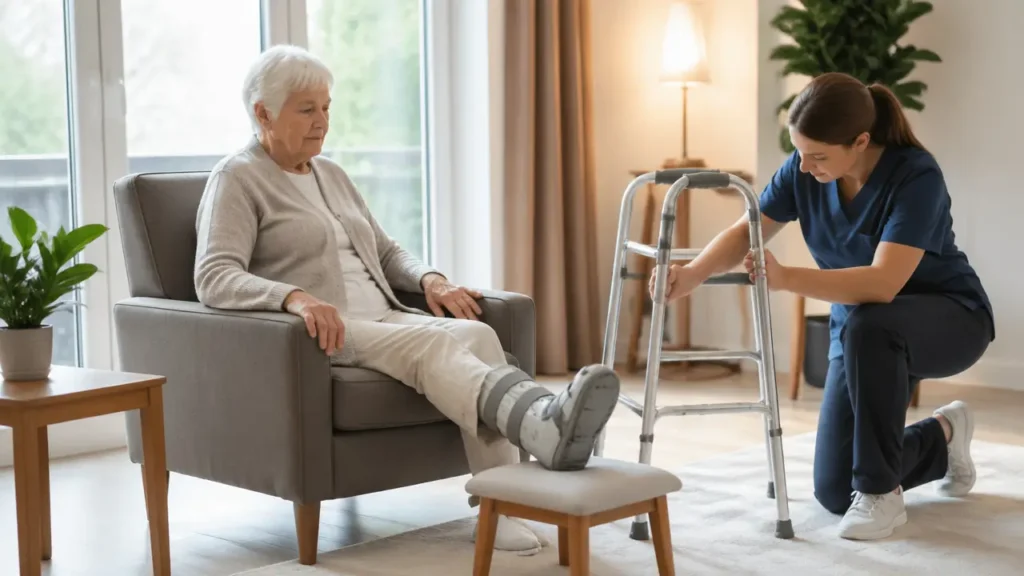
The injured leg itself can also get in the way. A cast, brace, boot, swelling, or pain can make the leg harder to keep clear of the floor. If it swings late, catches on the bed frame, or touches down during the turn, the whole transfer can break down.
Another big change is endurance. A person may technically be able to stand on the good leg once, but not repeat that safely for toilet transfers, nighttime transfers, or bathroom setups with little space. That is why non-weight-bearing status is not just a walking issue. It often changes bed, chair, toilet, and tub strategy too.
If the person already has trouble choosing the safest method, review assessing transfer readiness and mobility levels before defaulting to a one-leg pivot.
Safest Setup Before You Start
Confirm the order and do not improvise around it
The first check is simple: make sure the restriction really is non-weight-bearing, not toe-touch or partial weight-bearing. Those are different rules. If the written plan says non-weight-bearing, do not build a transfer around "just a little pressure" through the injured leg.
If the person keeps touching the foot down to steady themselves, that is not a minor form problem. It means the transfer setup may be wrong for their current ability.
Decide whether the move should be standing or seated
Not every non-weight-bearing transfer should be a stand-pivot.
A one-leg standing transfer is more realistic when the person:
- can fully unload the injured leg
- can stand on the good leg with control
- has enough arm strength to push from the surface or walking aid
- can follow cues
- can take tiny controlled turn steps without rushing
A seated or board-based transfer is often safer when the person:
- cannot reliably hold all weight on the good leg
- tires quickly in standing
- has poor balance once upright
- has a painful cast or heavy brace that is hard to control
- keeps touching the injured foot down during pivots
This is where sliding board transfer basics and best transfer boards for home become more useful than repeating a failing stand-and-hop method.
Set up the room before the person moves
Non-weight-bearing transfers go badly when the room demands extra hopping, turning, or reaching.
Before you start:
- clear rugs, cords, shoes, and clutter
- lock wheelchair brakes
- swing away or remove footrests
- move the destination surface as close as possible
- aim for surfaces of similar height when using a board
- make sure lighting is good enough to see the target clearly
- keep the transfer path dry
If the transfer is from bed to chair or wheelchair, placing the target at about a 45- to 90-degree angle to the person's stronger side is often the safer setup. With a non-weight-bearing leg, that usually means setting the move up so the good leg leads as much of the pivot as possible.
Get the footwear and walking aid right
The good foot needs grip. Use a stable shoe on the good foot and stay off wet floors. Check the rubber tips on crutches or walker legs too. Worn tips, dirt-packed tips, and bad fit matter more than people expect.
If the person uses crutches:
- make sure the height is correct
- keep the grips forward
- keep a little space between armpit and crutch top
- check that the person is pushing through the hands, not hanging through the armpits
If the person is much steadier with a walker or frame than with crutches, use that information. For some people, a frame is slower but safer for the short standing phase of a transfer. If day-to-day mobility is part of the problem too, compare best knee walkers for older adults and lightweight transport chairs instead of forcing endless hopping.
Prepare the legs and hands for the exact move
For most sit-to-stand and sit-to-sit transfers:
- bring the person close to the edge of the seat
- place the good foot flat and ready to push
- keep the injured leg off the floor and slightly forward when lowering to sit
- keep the hands free to push from the bed, chair arm, or bench
That hand position matters. A common non-weight-bearing error is trying to stand or sit while both arms are still in the crutches. That is unstable and awkward. The safer pattern is usually to manage both crutches together on the injured-leg side and use the free hand on the armrest or seat during the rise and descent.
Bathroom setup needs even more respect
Bathrooms are where many non-weight-bearing transfers stop being realistic. Wet floors, narrow approach angles, low toilets, and tub thresholds make hopping more dangerous.
For bathroom setups:
- use non-slip flooring or mats that will not slide
- use grab bars or a stable support surface
- raise the toilet if needed
- avoid improvising with folding chairs
- do not plan on hopping into a tub or shower
If bathing is part of the problem, a seated setup is usually safer than any one-leg hop. That means thinking ahead about toilet transfers safely, grab bar placement, and tub or shower transfers with a bench or board.
Technique Adjustments That Matter
Use a one-leg pivot only when it is truly controlled
Some people can still do a standing transfer with one non-weight-bearing leg, but the technique has to be stricter than usual.
For an assisted stand-pivot:
- Bring the person to the edge of the bed or chair.
- Plant the good foot well.
- Keep the injured leg fully off the floor.
- Use a gait belt if manual help is needed.
- Count the move so both of you rise together.
- Stand first, then pause.
- Pivot in small controlled steps toward the destination.
- Back up until the good leg and thighs feel the seat.
- Lower slowly with the injured leg still protected.
The pause after standing matters. With non-weight-bearing status, that one second tells you whether the person truly has balance or whether the move is already turning into a rescue.
If you are helping, guide from the trunk or gait belt. Do not pull under the arms. Do not let the person hang on your neck. Do not try to spin the move faster than the person's good leg can control it.
For crutch users, change how the stand and sit happen
Crutches help with movement, but they usually make the rise and sit harder if handled badly.
For standing up from a chair:
- hold both crutches in one hand on the injured-leg side
- put the free hand on the armrest or seat
- keep the good foot flat
- lean forward and push through the hands
- come to standing on the good leg
- only after balance is steady, put one crutch under each arm
For sitting down:
- back up until the back of the thighs touch the chair
- hold both crutches in one hand on the injured-leg side
- reach back with the free hand
- keep the injured leg raised or clearly forward
- lower slowly and do not drop into the seat
One of the clearest non-weight-bearing mobility rules is worth repeating: do not stand up or sit down with your arms still resting in the crutches.
Use the good leg and the arms, not a long hop
A bad non-weight-bearing transfer often involves a dramatic hop. That is usually where the turn, the landing, or the caregiver's back gets lost.
Instead:
- think "small controlled movement"
- place the aid first
- push through the hands
- bring the good leg only as far as needed
- reset balance before the next movement
If the person is using a frame or walker-style aid, they should move into the middle of the device rather than past it. If they are using crutches, do not let them hop far beyond the crutch tips.
Move to a board transfer sooner, not later
A transfer board often makes more sense than a standing pivot when the person can sit and help with the arms but cannot safely manage a one-leg turn.
A board transfer is often the safer adjustment when:
- bed to wheelchair keeps failing at the turn
- the good leg is strong enough to help but not to hop and pivot
- the person can follow instructions and shift the hips in short moves
- the surfaces can be brought close and fairly level
Key board-transfer adjustments for a non-weight-bearing leg:
- lock both surfaces
- move armrests or footrests out of the way
- place about one-third of the board under the upper thigh or buttock
- angle the board securely toward the destination
- use short lift-and-scoot movements
- reposition the legs as needed instead of dragging them
- protect skin from rubbing and pinching
This lets the move happen without asking the injured leg to help. If you need the full board method, go straight to sliding board transfer and slide sheets and transfer mats.
Bathroom and tub transfers usually need a seated plan
Many people with a non-weight-bearing leg assume they can just hop into the shower once or twice. That is usually the wrong call.
A safer pattern is:
- sit first
- keep the injured leg supported and off the floor
- use the arms to control descent
- use a bench, board, or secure seated surface
- keep supplies ready before entering the wet area
Do not force a one-leg hop over the tub wall when a bench or board would remove the riskiest part of the move.
The caregiver's role changes too
When a person is non-weight-bearing, the transfer can become a lift very fast if the good leg fails or the person touches down and panics. That is one of the biggest injury risks for helpers.
Protect yourself by:
- keeping a wide base
- staying close enough to guard, not to drag
- using your legs instead of your back
- pivoting your feet instead of twisting
- stopping if you feel you are starting to dead-lift
If the helper is doing most of the physical work, it is no longer the right manual transfer.
Red Flags and Common Errors
Common mistakes with a non-weight-bearing leg include:
- letting the injured foot touch the floor "just for balance"
- attempting a fast hop-turn instead of short controlled steps
- standing or sitting with arms still in the crutches
- using a low soft chair without arms
- trying to hop into a tub or shower
- forgetting wheelchair brakes or footrests
- putting the destination too far away
- assuming the person can repeat the move just because they did it once earlier
Watch for red flags that make the transfer unsafe:
- the good knee buckles
- the person cannot keep the injured leg clear
- the person loses balance before the pivot even starts
- the helper feels the move turning into a lift
- pain, dizziness, or fear makes the person freeze
- the person's hands are too weak to manage crutches, walker, or push-off
- the person cannot lower with control and drops into the chair
Another major red flag is fatigue. Non-weight-bearing transfers are hard on the good leg, the shoulders, the wrists, and the hands. The second or third transfer of the day is often worse than the first. If quality drops as the day goes on, build that into the plan instead of pretending every transfer is the same.
The bathroom deserves its own warning. Wet floors, low toilets, tight turns, and urgency make people rush. A rushed one-leg transfer is exactly how small mistakes become falls. If the setup is cramped enough that the person must twist, hop farther than planned, or grab unstable fixtures, stop and change the method.
If you need a backup plan for failed transfers, review what to do if a transfer starts to fail and safe lift-and-transfer rules at home before the next near-miss.
When to Get Clinical Help
Get PT, OT, nursing, or prescriber input when:
- the person cannot keep the leg non-weight-bearing during transfers
- the good leg cannot hold the pivot safely
- the person keeps nearly falling during the turn or descent
- the home needs a board, bench, or lift plan and nobody is sure which one
- stairs, an upstairs bathroom, or narrow rooms are forcing unsafe workarounds
- swelling, pain, or the cast/brace size is changing the transfer more than expected
- caregiver strain is becoming part of the story
Clinical help matters most when the method decision is unclear. A therapist can tell quickly whether the safest next step is:
- a better one-leg pivot setup
- a walker instead of crutches for transfers
- a slide board
- a bath bench or commode change
- a wheelchair-based plan
- a second helper
- a mechanical lift
That is also the point to review whether the home layout itself is the problem. If the transfer depends on a long bathroom hop, low furniture, or awkward door clearance, the answer may be an equipment and room change rather than tougher technique.
Frequently Asked Questions
Does non-weight-bearing mean the foot cannot touch the floor at all?
Treat it as no weight through the affected leg unless the clinician gives a different instruction. If the order says non-weight-bearing, do not plan around "just a little pressure."
Can someone do a pivot transfer with one non-weight-bearing leg?
Sometimes, but only if they can fully unload the injured leg, stand on the good leg with control, and turn in tiny steps without losing balance.
Is hopping the usual way to transfer with a non-weight-bearing leg?
Not for most home transfers. Short controlled movements are safer than a big hop, and many bathroom or bed-to-chair transfers are better with a seated setup.
Should the injured leg be in front when sitting down?
Usually yes. Keeping it slightly forward helps protect it during the descent and makes accidental weight-bearing less likely.
Is a walker safer than crutches for transfers?
Often yes for people who need more stability during the short standing phase, but it still has to be properly fitted and used within the weight-bearing restriction.
When should I switch from a pivot to a transfer board?
Switch sooner when the person can sit and help with the arms but cannot safely manage the one-leg stand, turn, and lower sequence.
Do I need a gait belt for these transfers?
It often helps when hands-on guarding is needed, but it does not make an unsafe one-leg pivot safe by itself.
When is a lift or second helper the better choice?
When the transfer keeps turning into a lift, the good leg cannot manage the load, or the person is too unpredictable, weak, or painful for one helper to control.
If the transfer method is still the main question, continue with pivot vs. sliding transfer, sliding board transfer basics, and best transfer boards for home. If the hardest moments are bathroom related, pair this with toilet transfers safely and grab bar placement for toilet and tub transfers. If daily mobility between transfers is the bigger issue, compare best knee walkers and lightweight transport chairs.