As an affiliate, we may earn a commission from qualifying purchases. We get commissions for purchases made through links on this website from Amazon and other third parties.
Toilet transfers are one of the most common fall points in the home. The space is small, the floor may be wet, clothing gets in the way, and people often rush because they do not want an accident.
That is why a toilet transfer needs a real setup, not improvising in the moment. If you want the wider transfer picture first, start with the mobility and transfers master guide. If the bathroom itself is the weak link, review grab bar placement for toilet and tub transfers before the next attempt.
When to Use This
This guide fits the common home situation where a person can do some part of the move but still needs setup, guarding, or hands-on help to sit and stand safely at the toilet.
That might include:
- a stand-step or pivot transfer with a walker nearby
- a wheelchair-to-toilet transfer with one helper
- a transfer that needs a raised seat, toilet frame, or grab bar
- a situation where bathroom urgency is making the move rushed and unsafe
The first decision is simple: can the person bear enough weight and follow directions well enough for a manual transfer? If yes, a manual setup may work. If no, do not force a pivot just because it used to work. That is when a sliding board transfer or a sit-to-stand lift may be the safer plan.
Before You Start
Match the transfer to the support level
Do not start with the bathroom equipment. Start with the person.
Ask:
- Can they stand with at least some leg help from their own body?
- Can they hold a rail, frame, or walker handle?
- Can they take small pivot steps?
- Can they follow short step-by-step cues?
If the helper is doing most of the lifting, it is already the wrong plan.
Set up the room first
The floor should be dry, well lit, and free of clutter. Loose rugs are a bad idea here. The person should have stable shoes on, not socks. If clothing is hard to manage, simplify it before the transfer starts.
Proper supports help a lot:
- a raised toilet seat to reduce how far the person has to lower
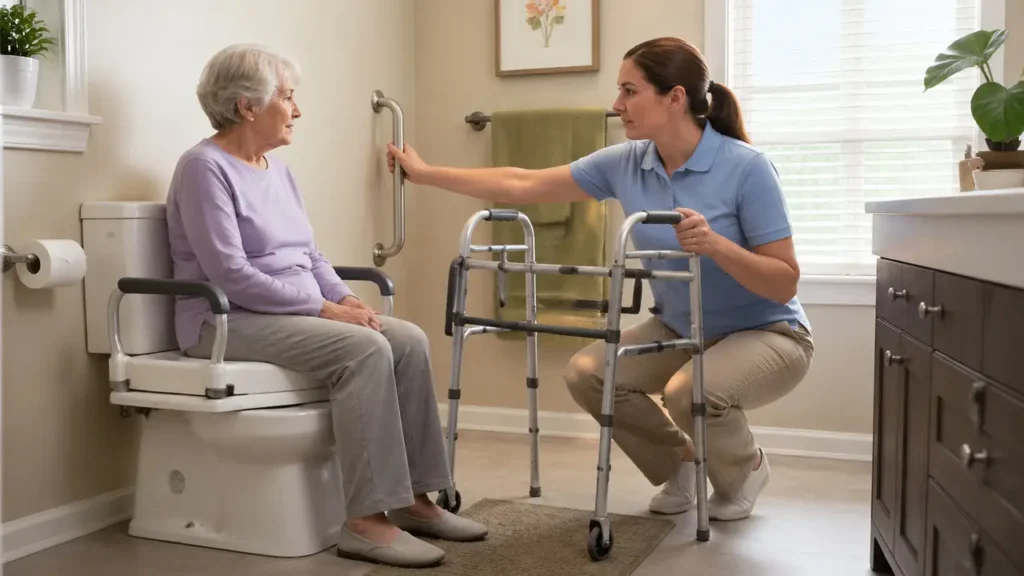
- a toilet safety frame or properly installed grab bar for push-off support
- enough room to position the walker or wheelchair close to the toilet
- a bedside commode if the bathroom is too tight to move safely
Never use a towel bar as a grab bar. It is not built for body weight.
Position the device before the person stands
For a wheelchair transfer, place the chair as close as possible, often at a slight angle to the toilet. Lock the brakes. Move footrests and the near armrest out of the way if possible.
For a person using a walker, bring the walker close enough that it will be ready after standing, but do not let the person pull on it to rise. If guarding is needed, a gait belt setup makes the move safer for both people.
Step-by-Step Technique
1. Explain the plan before moving
Use short cues. Good toilet transfer help usually sounds like this:
- "Scoot forward."
- "Feet flat."
- "Lean forward."
- "Stand."
- "Take small steps."
- "Reach back."
- "Sit slow."
Too much talking during the move can be as unhelpful as no cueing at all.
2. Get lined up for the stand
Bring the person to the front edge of the seat or wheelchair. Their feet should be flat and tucked under enough to help with the rise. If clothing needs to come down before the transfer, do that at the point where it is safest and most realistic for the person. Many families do better when the setup is practiced the same way every time.
3. Stand first, then move
Have the person push from the chair armrest, toilet frame, or another stable surface. Do not let them pull on the helper's neck or shoulders. Do not let the helper lift under the arms.
Once upright, pause for a second. If balance is not there, the transfer is not ready to continue.
4. Pivot in small steps
Turn with short steps until the backs of the legs touch the toilet. Do not twist the trunk while the feet stay planted. Small steps are safer than one big swing turn.
If the bathroom is especially cramped, the movement pattern may look more like public restroom and tight space transfers than an open-room pivot. Tight spaces need slower pacing, not faster pacing.
5. Reach back and lower with control
Once the person feels the toilet behind their legs, have them reach for the frame, grab bar, or seat support before sitting. Then lower slowly. A raised seat often helps because it reduces the drop and makes the next stand easier too.
6. If a pivot is not safe, change methods
A person who cannot take safe steps to turn may do better with bed-to-chair transfer basics or a board-assisted transfer approach adapted for the toilet. A person who can bear some weight but not enough for a reliable manual rise may be moving into portable standing aid or lift territory.
Safety Checks and Common Errors
Common errors:
- starting the transfer on a wet or cluttered floor
- leaving wheelchair brakes unlocked
- forgetting to move footrests out of the way
- using a towel rack or sink edge that is not meant for body support
- trying to turn too fast because of urgency
- sitting before the person is fully lined up with the toilet
- letting the helper do a dead lift instead of a guided transfer
- keeping a raised seat that wiggles or shifts
Safety checks that matter:
- both feet are planted before the stand
- the helper can stay close without twisting
- the support surface is stable
- the toilet height is realistic for the person's strength
- the exit plan is clear before the person sits down
If the transfer starts to go wrong, do not yank upward and hope for the best. Review what to do if a transfer starts to fail so the response is calmer and safer.
When to Stop or Get Help
Get more help when:
- the person cannot bear enough weight for a safe stand
- knees buckle during the move
- the helper is doing most of the lifting
- the bathroom is too small for the needed equipment
- the person cannot follow the steps because of confusion, fear, or agitation
- pain, surgery precautions, or weakness keep changing the transfer plan
This is also the point to get OT or PT involved for a home setup review. A small change like a better rail, a locking raised seat, or a bedside commode can do more than repeated unsafe practice.
Frequently Asked Questions
Is a raised toilet seat enough by itself?
Sometimes, yes. It helps most when the main problem is standing up from a seat that is too low. If balance and hand support are also poor, a frame or grab bar may still be needed.
Where should the walker be during a toilet transfer?
Close enough to use after standing, but not so close that the person pulls on it to get up.
Can I use a towel bar for support?
No. Use only a properly installed grab bar or toilet frame made to hold body weight.
What if the bathroom is too small for safe transfers?
A bedside commode or a different transfer method may be safer than forcing the move in a cramped space.
Should clothing come down before or after standing?
That depends on the person's balance, urgency, and setup. The safest answer is the one that can be done the same way every time without rushing or losing balance.
When do I need a slide board or lift instead of a pivot?
You need a different method when the person cannot take safe pivot steps, cannot bear enough weight, or the helper is doing too much of the lift.
What kind of shoes are best for toilet transfers?
Low, stable, non-slip shoes are usually best. Socks and slick slippers raise the slip risk.
If the bathroom setup is still the problem, compare grab bar placement for toilet and tub transfers and public restroom and tight space transfers. If the person is moving out of manual-transfer range, review sit-to-stand lift setup and what to do if a transfer starts to fail.