As an affiliate, we may earn a commission from qualifying purchases. We get commissions for purchases made through links on this website from Amazon and other third parties.
Grab bars help only when they are where the person can actually reach them before balance is lost.
That is why grab bar placement matters more than buying the thickest bar or the nicest finish. A good setup gives the person a stable handhold while sitting down, standing up, stepping over a tub wall, or sliding to a transfer bench. A bad setup forces awkward reaching, twisting, or grabbing at the last second. For the bigger transfer picture, start with the mobility and transfers master guide.
What Good Grab Bar Placement Really Does
Grab bars are there to support a movement, not just to decorate a wall beside the toilet.
In real life, people use them to:
- steady before they sit
- push or pull during sit-to-stand
- control the last part of the descent to the seat
- hold balance while pivoting
- brace while stepping into or out of a tub or shower
That means placement should match the actual transfer pattern. A person who pivots from a walker uses the space differently than someone who slides over from a wheelchair. A person with one weak leg needs the bar reachable on the helpful side. A person after surgery may need the bar placed so the trunk stays more upright and the hips do not twist.
If the bathroom transfer itself is still the hardest part, the related guides to toilet transfers and tub or shower bench transfers are the next useful reads.
Use Standards as a Starting Point, Not the Only Answer
Public accessibility standards are a strong starting point because they are built around safe grip height and reachable support zones.
For many toilet setups, horizontal grab bars are commonly placed about 33 to 36 inches above the finished floor. That range works for many adults because it supports pushing up without having to reach too high or stoop too low.
A common reference layout includes:
- a rear wall bar that is at least 36 inches long
- a side wall bar that is at least 42 inches long
- the side bar beginning no more than 12 inches from the rear wall
- the side bar extending at least 54 inches from the rear wall
Wall clearance matters too. About 1.5 inches between the wall and the grab bar usually gives enough room for a secure hand grip. If shelves, toilet paper holders, or other hardware crowd the bar, the setup gets much less useful.
Those dimensions are helpful, but a home bathroom is not a public restroom. In a private home, the best placement still has to match the person’s height, reach, chair height, toilet height, walker approach, and side of weakness. If you install bars by a chart without testing the actual movement, you can end up with code-like placement that still feels wrong in real use.
Best Placement for Toilet Transfers
The side wall bar usually does the most work.
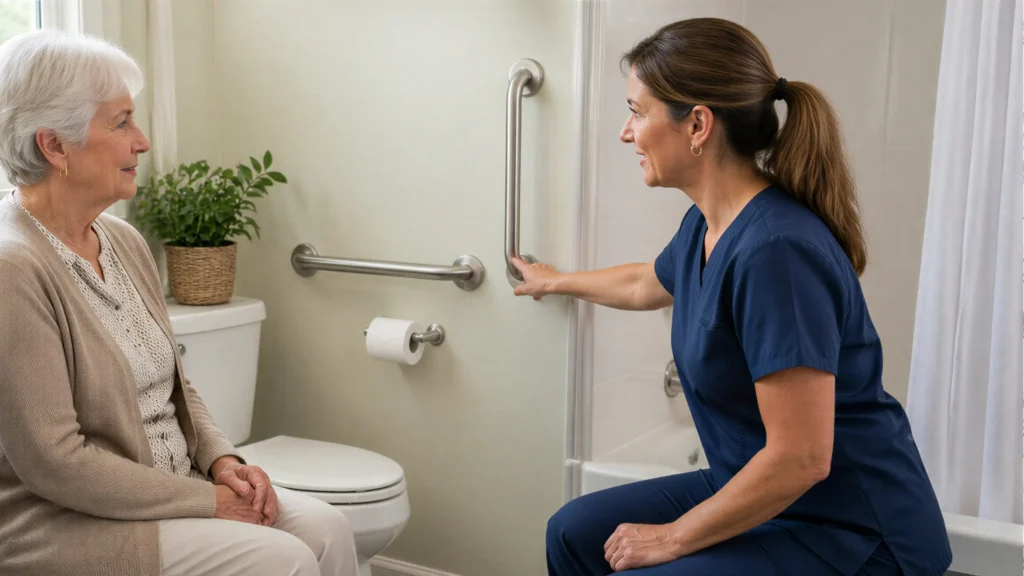
For many toilet transfers, the most useful main bar is a horizontal bar on the side wall next to the toilet. It gives support for lowering to sit and leverage for standing back up. If the person turns and sits from a walker, they can often reach back with one hand to the toilet or seat and use the other hand on the bar.
The rear wall bar helps too, but it is usually secondary in daily home use. It gives extra support, especially for balance and repositioning, but it is not always the first bar the person grabs during a stand-pivot transfer.
A practical toilet setup often looks like this:
- horizontal side bar within easy reach from standing and seated positions
- rear bar for extra stability
- enough open wall area that the hand can close fully around the bar
- toilet paper holder moved far enough away that it does not block grip
Some people also benefit from a vertical bar near the front edge of the toilet zone, especially if they need a handhold while stepping in, turning, or beginning to stand. This is not always necessary, but it can be helpful in tight spaces or for people who do better with a more upright pull.
What matters most during the move
The bar needs to be reachable before the person “drops” into the last part of the transfer.
If they have to lean far, twist the trunk, or let go of stable support to find the bar, the placement is late. The safest arrangement lets them keep one stable point of contact while the hips rotate and the knees bend.
If transfers are already rushed or unsteady, fix the surrounding setup too:
- raise a low toilet if needed
- make sure lighting is strong for night trips
- keep the floor dry
- remove rugs and clutter
- check footwear or traction problems
Those issues often matter as much as the bar itself. The related guides to house shoes vs. socks indoors and handrails, edge guards, and raised lip safety help with the non-bar side of the problem.
Best Placement for Tub and Shower Transfers
Tub entries need a grab bar where the hand naturally goes before the first leg crosses the tub wall.
That is the key point many home setups miss. People often install one bar deep inside the shower and none where the entry actually starts. The result is that the person steps over the tub edge first and only then tries to find support.
A safer tub or transfer-bench setup often includes:
- an entry bar near the tub opening
- a horizontal bar on the wall where the person lowers to the bench
- a bar positioned so the hand can stay supported while the legs swing in
For transfer showers and roll-in showers, horizontal bars on more than one wall are common because the person may need support during both entry and turning. Some transfer shower layouts also use a vertical bar on the control or showerhead wall because it helps with the first hand placement when stepping in.
Tub bench and lateral transfer setups
When someone uses a transfer bench, bar placement should support the seated parts of the move, not only the standing parts.
That means thinking about where the hand goes while:
- reaching back to sit on the outer bench edge
- sliding across the bench
- lifting the legs over the tub wall
- pushing up to stand after bathing
A bar too far forward or too far inside the tub may be useless during the actual seated slide. If the person transfers laterally from a wheelchair, it may help to test the bar position with the chair in place before final mounting.
If the tub transfer is still awkward even with bars, the main problem may be bench height, slide path, or body mechanics rather than grab bar position alone. In that case, review tub and shower transfers with a bench or board and safe patient handling at home.
Installation Rules That Matter More Than Style
The grab bar has to be mounted into framing or solid backing. Drywall anchors by themselves are not enough for a true load-bearing transfer bar.
That is the first non-negotiable rule.
Use a bar that is rated for grab-bar duty and mount it according to the manufacturer instructions into studs, blocking, or another approved reinforced surface. If there is tile, the installer still has to hit a structural support behind it. A pretty bar with weak mounting is worse than no bar because it gives false confidence.
A few other rules matter too:
- keep enough space above, below, and at the ends so the hand can grip cleanly
- keep the bar away from shelves, soap dishes, and oversized paper dispensers
- use slip-resistant finishes if wet hands are likely
- do not substitute a towel bar for a grab bar
Suction grab bars deserve special caution. Some can help with wayfinding or a light touch reminder, but they should not be treated as a primary weight-bearing support for toilet or tub transfers.
What About Fold-Down Bars, Poles, and Tight Bathrooms?
Some bathrooms do not have a usable side wall exactly where the person needs support.
That is when a fold-down support bar or a transfer pole may be worth discussing. A fold-down bar can help beside a toilet when the wall layout is awkward or the person needs support closer to the front of the transfer. A floor-to-ceiling transfer pole can also help in some bathrooms, especially if there is no strong wall in the right place.
Those options can be excellent, but they still have to match the movement. A fold-down bar that blocks wheelchair approach is not a win. A transfer pole that is one step too far away from the pivot point is not a real answer either. If a standard wall bar does not fit the room, compare transfer pole placement and use and what to do if a transfer starts to fail before guessing at a workaround.
Common Placement Mistakes
The most common mistake is placing the bar where it “looks right” instead of where the hand actually lands.
Other frequent mistakes include:
- placing the toilet bar too far behind the person
- putting one short bar on the rear wall and skipping the side wall
- installing a tub bar only after the step-over point
- mounting bars where a shower curtain, door, or seat blocks the hand
- crowding the bar with toilet paper holders, shelves, or shampoo racks
- choosing decorative hardware that is not a real support bar
- relying on one bar to solve a transfer that really needs a raised seat, bench, or different technique
Another mistake is assuming every bathroom needs the same bar layout. It does not. A person with right-sided weakness may need a different approach than someone with left-sided weakness. A person who backs up with a walker uses the space differently than someone who parks a wheelchair at an angle.
If the person is already having trouble in tight public bathrooms, it also helps to think ahead about how they manage unfamiliar layouts. The guides to hotel room mobility checks and public restroom transfers in tight spaces can help with that part.
When to Get an OT, PT, or Installer Involved
Bring in skilled help if:
- the person has had falls or near-falls in the bathroom
- you are unsure which wall and height match the transfer
- the person has one-sided weakness, a recent surgery, or a complex condition
- the wall structure is unclear
- the toilet, tub, and wheelchair approach leave very little room
An OT or PT can watch one real transfer and usually spot the placement issue fast. A qualified installer or aging-in-place contractor can then mount the bar where it actually supports the move.
Frequently Asked Questions
How high should a toilet grab bar usually be?
For many adults, a horizontal toilet grab bar works well around 33 to 36 inches from the floor.
Is the side wall bar or rear wall bar more important?
In many home toilet transfers, the side wall bar does more of the real work. The rear wall bar is often helpful support, but it is usually not the main push-up bar.
Can I use ADA measurements in a private home?
Yes. They are strong reference points. Just make sure the final placement still matches the person’s real transfer pattern and reach.
Are suction grab bars safe for standing up?
Not as a primary weight-bearing support. Use a properly mounted grab bar for that.
Where should a tub grab bar go?
Usually where the hand naturally reaches before the person steps over or slides in, plus support where they lower onto the bench or seat.
Do I need a vertical grab bar?
Sometimes. A vertical bar can help with entry, turning, or the first pull to stand, but not every bathroom needs one.
What if there is no stud where I want the bar?
You may need added blocking or another reinforced mounting solution. Do not rely on standard drywall anchors for a load-bearing transfer bar.
If your bathroom problem is really the full transfer setup, not just the bar location, the next useful reads are toilet transfer technique and common errors, tub and shower transfers with a bench or board, and the broader mobility and transfers master guide. If the person is still struggling at the last second of a move, also review what to do if a transfer starts to fail.