As an affiliate, we may earn a commission from qualifying purchases. We get commissions for purchases made through links on this website from Amazon and other third parties.
A tub transfer bench or bath board can make bathing much safer, but only when the device matches the person and the bathroom. The wrong setup still leaves the hardest part in place: clearing the tub wall, turning on a wet surface, and standing back up in a cramped room. That is why some bathroom "solutions" feel safer in the catalog than they do on the first real shower day.
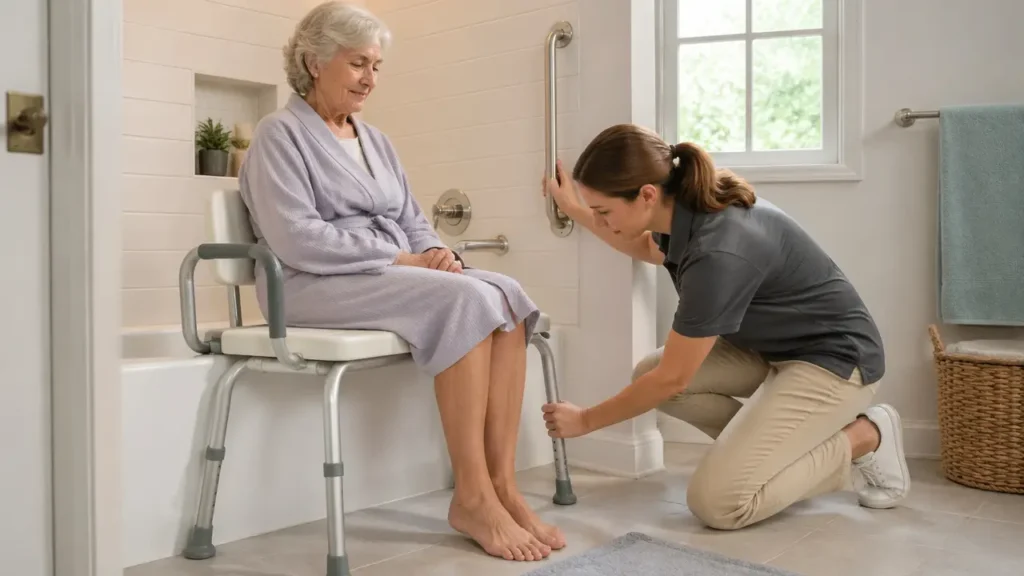
The good news is that the right seated setup can remove the single riskiest part of many tub transfers: stepping over the tub edge. Instead of balancing on one leg in a slippery room, the person sits first, brings the legs over one at a time, and stays supported for the whole entry. If you want the broader transfer framework first, start with the mobility and transfers master guide and grab bar placement for toilet and tub transfers.
Why This Matters
Bathrooms punish bad transfer plans fast.
The usual problems stack on top of each other:
- wet floors
- low seats
- narrow layouts
- awkward reaching
- poor lighting at night
- a high tub wall that interrupts the path
For many people, the real danger is not once they are already seated in the shower. It is the moment before that, when they try to:
- step over the tub edge
- turn and sit at the same time
- hold onto the wrong surface
- lift both legs while already off balance
A transfer bench or bath board helps by changing the task from a step-over problem to a seated-transfer problem. That can be a major improvement for people with arthritis, stroke, one-leg restrictions, poor balance, or simply not enough confidence to trust a wet one-leg stand anymore.
But bench and board setups are not interchangeable. Some still require more sitting balance, more arm strength, or more leg lifting than families expect. If the person already has a condition-specific transfer problem, pair this article with transfers with a non-weight-bearing leg or transfers with hemiparesis after stroke instead of trying to force a generic bathroom routine.
Key Factors That Change the Decision
Whether the person can still step over the tub edge
This is the first fork in the road.
A simple bath seat or shower chair inside the tub can help only if the person can still safely step over the tub wall first. That is a very different task from using a transfer bench or bath board.
If the step-over is the part that feels unsafe, a transfer bench or bath board is usually the better starting point because it allows a seated entry. That means:
- sit first outside the tub
- lift the legs over one at a time
- slide or scoot into position
If stepping over is still easy and safe, a standard bath seat may be enough. If not, do not keep buying more bathroom chairs that leave the hardest part unchanged.
Sitting balance and arm strength
A bench or board works only if the person can stay upright and move the hips across with enough control.
That means the person usually needs to be able to:
- follow directions
- sit without tipping
- lift the legs into the tub with little or only minimal help
- push through the arms enough to scoot or slide
That is especially important for a bath board. A bath board has no legs to the floor, no built-in back support, and less forgiveness if the person leans too far.
If sitting balance is poor, do not confuse a bath board with a true transfer board used for bed or wheelchair transfers. Those are different tools for different tasks. If seated transfer mechanics are the bigger problem, compare transfer boards for home before assuming a tub board will solve it.
Bathroom size and tub shape
The bathroom itself may make the decision for you.
Check:
- Is there enough exposed tub edge for a bath board?
- Is there enough floor space for the outside part of a transfer bench?
- Will the bench block the toilet or the main path through the room?
- Do sliding shower doors get in the way?
- Is the tub especially deep or high?
Transfer benches stick out into the bathroom. That is part of what makes them useful, but it can also turn a small bathroom into a tighter obstacle course. Some bathrooms need the bench removed between showers so it does not become a trip hazard for the rest of the day.
Bath boards need enough solid tub edge on both sides. Some tubs simply do not give enough safe support area.
Bench versus board
The main equipment differences matter:
A transfer bench:
- has legs, usually two inside the tub and two outside
- creates a bridge over the tub wall
- is height adjustable
- often has a backrest
- usually feels more stable for daily use
A bath board:
- spans the tub edge
- has no floor legs
- is easier to remove and store
- usually gives less support
- can be too low or too tippy for some people
A sliding transfer bench:
- reduces the amount of scooting effort
- can be a better fit when a fixed bench requires too much lift-and-shift work
- still needs careful setup and enough room
This is the key rule: the less stable or more minimal the device, the more sitting control and transfer skill the person usually needs.
How much help the caregiver is really giving
Families often underestimate this part. A fixed transfer bench can remove the tub step, but it can still leave the caregiver doing a daily lift-and-shift across a wet bench if the person cannot scoot well.
That is not a small detail. Repetitive bathroom lifting is one of the fastest ways to strain a caregiver's back, shoulders, and patience.
If the person needs more than minimal physical help just to get across the bench, it is time to ask whether the bathroom routine has already outgrown a simple bench-or-board solution. That is when safe patient handling at home and patient lifts and slings become more relevant than another "slightly better" shower bench.
How to Use, Choose, or Set It Up Safely
1. Choose the right equipment for the actual problem
Use a transfer bench when:
- the person should not step over the tub wall
- they can sit and scoot
- they need more support than a bath board gives
- the bathroom has room for the outside bench legs
Use a bath board when:
- the person has good sitting balance
- the tub has enough exposed edge to support the board
- a removable setup matters
- the board height still allows a safe sit and stand
Move to a sliding bench or a more advanced bathroom transfer system when:
- the scoot across a fixed bench is too hard
- the caregiver is doing repeated lift-and-shift help
- leg clearance over the tub wall is a major problem
- daily privacy and fatigue are becoming major issues
Avoid a bath seat alone when the person cannot safely step over the tub edge first.
2. Make the setup level and stable before anyone sits
This is one of the most important technical details in the whole topic: transfer benches must be level across the tub wall.
That often means:
- the inside legs need a different height than the outside legs
- all feet must contact the surface firmly
- suction feet must be fully attached if the model uses them
- the device must not rock or slide
Many tubs sit higher inside than the bathroom floor outside. If you ignore that difference, the bench can tilt, the person will feel it immediately, and the whole transfer gets less safe.
Before each use:
- check that the bench or board is positioned correctly
- inspect for damage, looseness, or wear
- confirm the safe working limit is not exceeded
- make sure the floor is dry
Some transfer benches have a little movement in the joints even when they are set up correctly. Mild wiggle is not the same as instability. The key is whether the bench stays level, planted, and predictable under load.
3. Add the supports that make seated bathing easier
A bench or board works better when the rest of the setup helps it.
Useful add-ons often include:
- properly mounted grab bars
- a handheld shower head with a long hose
- non-slip treads or a stable non-slip surface
- a long-handled sponge
- soap and supplies within easy reach
Grab bars matter because the person should hold real support surfaces during the transfer, not towel bars, shower doors, faucet hardware, or your neck.
If the person uses a wheelchair or walker to get to the bathroom, have that positioned before the transfer begins. Do not build the plan around standing up at the end and then realizing the device is across the room.
4. Use the seated transfer sequence in the right order
For a tub transfer bench, a safe seated entry usually looks like this:
- Approach the outside portion of the bench and feel the seat behind the legs.
- Sit down fully on the outside part of the bench.
- Stabilize with the hands on the bench or grab bar.
- Scoot or slide the hips inward.
- Lift the legs over the tub wall one at a time while staying seated.
- Continue scooting until fully in bathing position.
The exit is the reverse:
- Slide the hips back toward the outside portion first.
- Bring the legs over one at a time.
- Square the feet under the body.
- Push from the bench or use the grab bar to stand.
The order matters. Bottom first, legs second. Not the other way around.
For a bath board, the seated sequence is similar, but the person has less support and less room for errors. That is why boards are more demanding. The person sits on the board from outside the tub, slides or turns the hips toward the center, then brings the legs over one at a time. Because there is no backrest or floor-leg support, upper-body control has to be good enough to avoid tipping or excessive leaning.
5. Respect the standing demands that remain
A transfer bench removes the tub-wall step, but it does not remove every standing demand.
The person may still need to:
- stand to back up to the bench
- stand to push up at the end
- stand briefly for hygiene
- maintain balance while the caregiver adjusts clothing or equipment
That is why grab bars, seat height, and outside-floor traction still matter. If the hardest part is actually getting up from the bench at the end, you may need a different standing support strategy or a different bathing plan.
6. Keep the caregiver from overreaching
Many caregiver injuries happen after the transfer, during the shower itself.
To reduce that strain:
- wash hard-to-reach areas before or after the tub transfer when possible
- use a handheld shower
- let the person wash easy-to-reach areas if they can
- ask them to straighten a knee or lift a leg to reduce your bending
- kneel briefly on padding instead of bending from the waist for a long time
If you are leaning over a tub wall for the whole bath, the setup is still wrong for the caregiver even if the person feels stable.
7. Maintain the bench or board like real equipment
A tub transfer device is not a one-time installation that you ignore forever.
After use:
- wipe off soap and mineral buildup
- inspect feet, rails, and locks
- clean the seat opening if the model has one
- keep sliding rails moving smoothly if the model has them
If the equipment is difficult to slide, hard to lock, or looks worn, fix that before the next shower. Bathroom equipment degrades quietly until it suddenly matters.
Common Mistakes and Red Flags
Common mistakes include:
- choosing a bath seat for someone who cannot step over the tub wall
- choosing a bath board for someone with poor sitting balance
- setting the bench unlevel
- trusting suction or feet without testing them
- leaving the floor wet during the transfer
- letting the person grab a towel bar or shower door
- placing the bench so far into the room that it becomes a daily trip hazard
- assuming a rigid bench will be easy to scoot across just because it looks simple
Another major mistake is confusing minimal leg help with a full assisted lift. If the person needs a little help lifting one leg over the tub edge, that can still fit a bench setup. If the caregiver is hoisting both legs and then dragging the hips across every day, that is no longer a simple bench transfer.
Red flags that should change the plan include:
- the person cannot sit steadily on the bench or board
- the person cannot follow the sequence
- the hips cannot scoot without heavy lifting help
- the person cannot clear the legs over the tub wall
- the bench or board tips, slides, or feels unstable
- the seat is too low to stand from
- the person leans far forward or backward on a bath board
- the caregiver is straining every shower
A fixed transfer bench can also become the wrong tool as mobility changes. If the person now needs more trunk support, more leg lifting help, or a full seated system from bedroom to bathroom, stop treating the bench as the last stop in the equipment ladder.
When to Get More Help
Get OT, PT, nursing, or equipment-specialist help when:
- you are not sure whether the person fits a board, bench, or larger transfer system
- sitting balance is questionable
- a stroke, amputation, or one-leg restriction makes the sequence more complex
- the bathroom is too small for the equipment to fit cleanly
- shower doors, tub height, or floor levels are making installation awkward
- the caregiver is giving more than minimal physical assistance
- standing up from the bench is the part that keeps failing
Professional help matters even more when the bathing problem is part of a bigger bathroom-transfer problem. Some people do not just need a better tub entry. They need a different path for toilet, shower, dressing, and exit without repeated manual lifting. That is when the best answer may be a more integrated commode-shower transfer system or a lift-based plan rather than another bench adjustment.
If the whole bathroom routine is breaking down, also review toilet transfer technique and common errors and safe patient handling policies at home instead of treating bathing as an isolated issue.
Frequently Asked Questions
What is the difference between a bath seat, a transfer bench, and a bath board?
A bath seat sits fully inside the tub or shower and usually still requires stepping over the tub wall. A transfer bench bridges the tub wall with legs inside and outside the tub. A bath board spans the tub edge without floor legs and needs better sitting balance.
When is a transfer bench safer than a bath seat?
It is usually safer when the person should not step over the tub wall and needs a seated transfer into the tub.
When is a bath board a bad idea?
It is a poor fit when sitting balance is weak, the board sits too low, the tub edge does not support it well, or the person tends to lean far forward or back.
Do transfer benches need different leg heights inside and outside the tub?
Often yes. Many tubs are higher inside than the bathroom floor outside, so the legs may need different settings to keep the bench level.
Can a caregiver lift both legs over the tub for the person?
Only minimal leg assistance should be built into a simple bench routine. If the move regularly needs heavy lifting, the setup probably needs to change.
Are suction grab bars good enough with a tub bench?
No. Use properly installed grab bars for weight-bearing support. Suction bars can slip.
What if water keeps spilling out around the bench?
That is a setup issue, not just an annoyance. Handheld shower use, better curtain management, and floor protection all matter because wet floors make the exit much riskier.
When has the person outgrown a bench or board setup?
Usually when sitting balance is poor, scooting requires heavy help, standing from the seat is failing, or the caregiver is doing repeated manual lift-and-shift work.
If you are still deciding between seated transfer tools, compare grab bar placement for tub transfers, toilet transfer setup and common errors, and patient lifts and slings for heavier care needs. If the hardest part is the condition behind the bathroom problem, continue with non-weight-bearing leg transfers or transfers with hemiparesis after stroke.