As an affiliate, we may earn a commission from qualifying purchases. We get commissions for purchases made through links on this website from Amazon and other third parties.
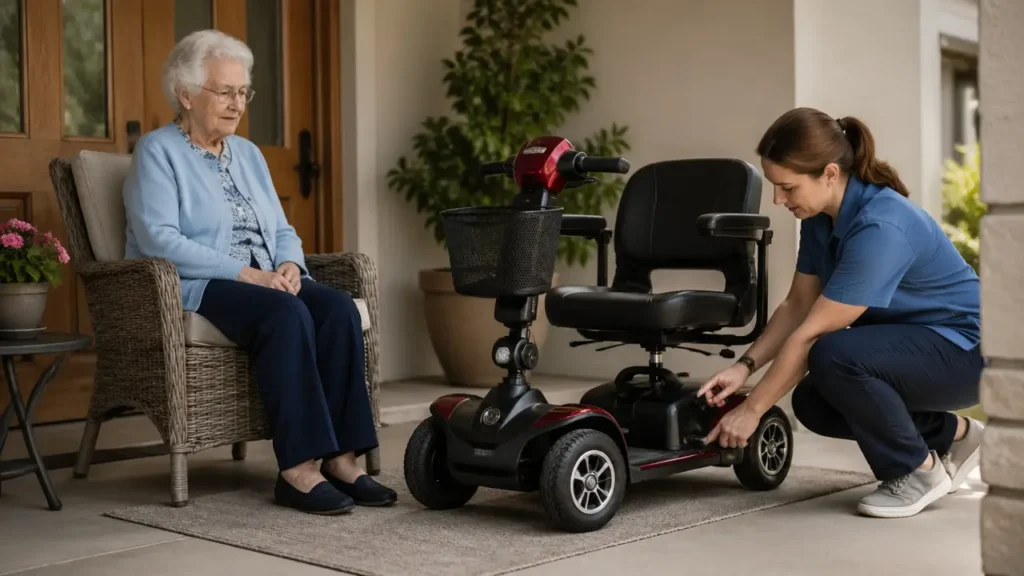
Getting on and off a scooter is often harder than driving it. The risky part is not the controls. It is the stand, turn, and sit sequence around the seat, foot platform, and nearby obstacles. If that sequence is rushed, the scooter can roll, the tiller can block the body, or the person can miss the seat and fall.
A safer scooter routine starts before anyone moves. You need the scooter parked on the right surface, the seat set up the right way, and a transfer method that matches the person's strength and balance. If you want the broader framework first, start with the mobility and transfers master guide. If you are still deciding whether a scooter is even the right device, compare mobility scooters and power wheelchairs.
Why This Matters
A scooter can work well for community mobility and still be a poor fit for transfers.
That mismatch shows up when the person can drive once seated but struggles to:
- get turned around the tiller
- bring both feet to solid ground
- rise without pulling on unsafe parts
- lower with control onto the seat
- swing the legs onto or off the platform
Risk goes up even more when the transfer happens:
- on a slope, driveway, or soft ground
- in a crowded restaurant or clinic
- after a long outing when the legs are tired
- in low light or wet weather
- while carrying a bag, cane, or walker
If transfers are already shaky on simpler surfaces, review bed-to-chair transfer steps for caregivers and assessing transfer readiness before assuming the scooter will be easier just because it moves by itself.
Key Factors That Change the Decision
Whether the seat gives you room to turn
A swivel seat can make scooter transfers much easier because it turns the body away from the tiller, the steering column in front of the seat, and the floorboard. That creates a clearer stand-and-sit path. Some travel scooters do not have this feature, so they ask for more turning space and more upper-body balance and control during the transfer.
How much standing ability is really there
A scooter transfer is still a sit-to-stand transfer. The person usually needs enough leg strength to rise, enough balance to pause, and enough control to lower onto the seat without dropping. If the person needs hands-on guarding, gait belt placement and fit may help. If the move is getting too heavy for a manual assist, powered sit-to-stand lifts or hands-on sit-to-stand lift setup may fit better.
Whether the scooter itself is still the right device
Scooter use depends on more than standing. It also depends on upper-body balance and control, hand control, judgment, and the ability to manage real-world surfaces. If hand weakness, poor turning, or repeated transfer near-falls are the main problem, the safer answer may be a different device category, not more practice on the same one.
What the transfer surface looks like
Even a good scooter setup can fail on bad ground. Watch for:
- sloped pavement
- wet concrete
- gravel
- doorway lips
- rugs or mats near the parking spot
If the route includes entry lips or small height changes, pair this article with ramps and thresholds and best threshold ramps for doorways.
How to Use, Choose, or Set It Up Safely
Park the scooter before you think about standing
The transfer should start with the scooter fully settled:
- stop on level, dry ground whenever possible
- power the scooter off
- make sure the scooter will not roll
- straighten or move the tiller out of the way as the model allows
- keep bags, cane holders, and baskets from blocking the transfer side
Do not treat the tiller, basket, or plastic body panels like grab bars. Use stable armrests, a trained helper, or another planned handhold instead.
Use the swivel seat if the scooter has one
If the seat swivels, use it on purpose. Turn it out so the body faces the transfer side before trying to stand. That reduces the twist and gives a clearer path to the ground. On the return transfer, back up until the legs touch the seat, reach for the armrests, sit with control, then bring the legs onto the platform one at a time and rotate back toward the tiller.
That simple seat turn can be the difference between a smooth transfer and a half-twist with the knees buckling under the body.
Keep the standing sequence simple and repeatable
A safer manual transfer usually looks like this:
- scoot to the front edge of the seat
- place both feet on solid ground under the knees
- lean forward
- push from the armrests or other stable support
- stand and pause before turning or stepping
- sit slowly on the destination
If a caregiver is assisting, the helper should stay close, use a wide stance, and guide at the trunk or belt rather than pulling on the arms or shoulders.
Match the scooter to the transfer plan
Ask practical questions before choosing or keeping a scooter:
- Is the parking area wide enough for the transfer side?
- Is a swivel seat available?
- Can the rider manage the seat height and armrests?
- Is there enough hand strength for the tiller and brakes?
- Does the route include hills, ramps, or uneven outdoor surfaces?
If the scooter is mostly being used for short community errands and the person still walks at home, a scooter may make sense. If the chair needs to serve as the main daily seat and transfer base, a power wheelchair may fit better.
Fix the path, not just the person
The transfer will be safer when the approach is safer. That often means:
- shoes with real tread instead of slick slippers
- a dry parking spot
- enough light to see the seat edge and foot platform
- a clear route for a cane or walker nearby
- no loose mats under the first standing step
If poor traction is part of the problem, compare non-slip shoes for seniors and rain and wet floor traction strategy.
Common Mistakes and Red Flags
Common mistakes:
- transferring with the scooter parked on a slope
- leaving the scooter live or free to roll
- using the tiller as the main pull point
- trying to step off with one foot still tangled at the platform
- rushing because the destination is crowded
- attempting the transfer after fatigue, dizziness, or knee buckling has already started
Red flags that should change the plan:
- repeated missed seats or near-falls
- the person cannot clear the foot platform safely
- the person needs more than light help to rise
- upper-body control is poor once upright
- confusion or poor judgment makes setup unreliable
- the helper feels like they are lifting instead of guiding
Those are signs to step back, not push through. A scooter is not safer just because it looks familiar.
When to Get More Help
Get PT, OT, or equipment-specialist help when:
- the person can no longer transfer without major guarding
- a sit-to-stand lift, transfer pole, or different seat setup may be needed
- hand weakness makes tiller control unreliable
- home entry surfaces keep causing unsafe exits from the scooter
- the same transfer problem shows up at restaurants, clinics, or public restrooms
If the bigger issue is managing the scooter around vehicles and outings, continue with loading mobility devices into vans and cars and public restroom and tight space transfers.
Frequently Asked Questions
Is a swivel seat really that important on a scooter?
For many people, yes. It clears the body away from the tiller and reduces how much twisting is needed during the transfer.
Should the scooter be turned off before transferring?
Yes. The scooter should be fully stopped and secured before anyone starts to stand or sit.
Can a gait belt help with scooter transfers?
It can help when the person can still bear some weight and a trained helper is only guiding, not lifting.
When is a sit-to-stand lift a better option than manual help?
Usually when the person can still participate and bear some weight, but manual stand-and-turn transfers are no longer reliable or safe.
When should someone switch from a scooter to a power wheelchair?
When transfers, trunk support, or tiller control are becoming the limiting problems instead of the driving distance.
Is it safe to transfer on a driveway or slope?
It is less safe. A level, dry surface is the better choice whenever possible.
What kind of shoes are best for scooter transfers?
Shoes with closed heels and dependable rubber tread are usually safer than socks, slick slippers, or worn soles.
If the next issue is whether the scooter itself still fits the person's needs, continue with mobility scooter vs. power wheelchair. If the real problem is the transfer sequence, keep bed-to-chair transfer steps, gait belt placement and fit, and sit-to-stand lift setup nearby.