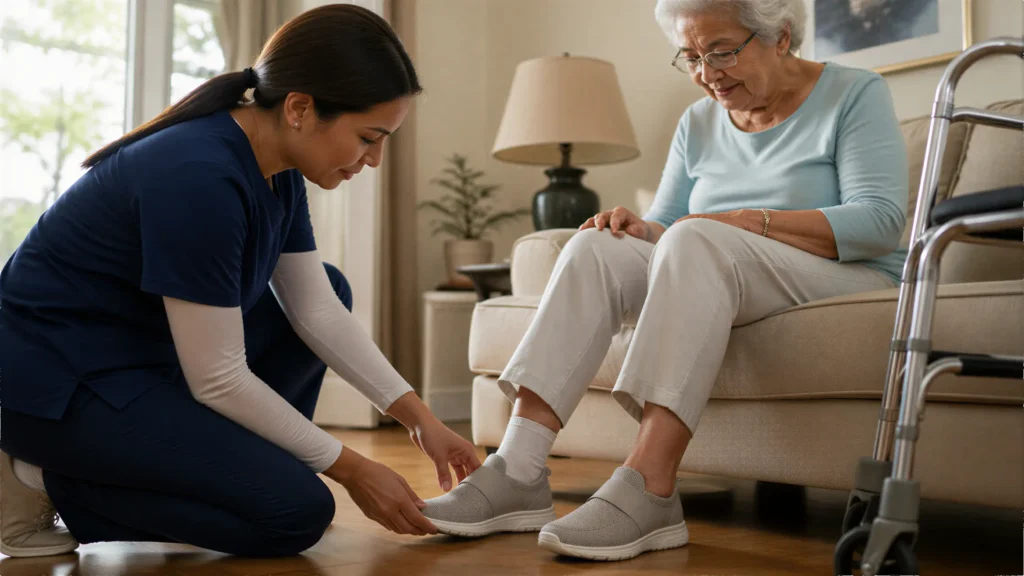
As an affiliate, we may earn a commission from qualifying purchases. We get commissions for purchases made through links on this website from Amazon and other third parties.
Non-slip shoes help only when they do three jobs at the same time: grip the floor, stay secure on the foot, and feel stable enough to walk in without extra effort. That is why the safest shoe is not always the softest one on the shelf. A shoe can feel comfortable in your hand and still be too heavy, too loose, or too slick once it is on the foot.
For older adults, that difference matters. The wrong shoe can increase slips on wet floors, make turning harder, or create foot fatigue that shows up later in the day. This guide focuses on the three checks that matter most: fit, grip, and weight. If you want the larger mobility picture first, start with the mobility and transfers master guide.
Why This Matters
Falls often come from small things stacking up:
- worn tread
- loose heel fit
- slippery house shoes
- heavy footwear
- swelling that changes fit by evening
- shoes that feel soft but unstable
That is why "non-slip" is not enough by itself. The outsole matters, but so do the upper, the closure, and how the shoe feels during turning, standing, and short indoor walks.
Good shoes can help with:
- better traction on smooth floors
- more stable turning and pivoting
- less foot fatigue
- easier use with canes, walkers, and rollators
- safer movement indoors and outdoors
The wrong pair can do the opposite. A heavy shoe can make the feet drag. A loose slip-on can turn into a trip risk. An overly soft sole can reduce ground feel and make balance worse. If indoor footwear is still part of the question, compare house shoes vs. socks indoors instead of assuming any slipper is safe enough.
Key Factors That Change the Decision
The best non-slip shoe depends on the person's foot shape, walking pattern, and daily environment.
Grip starts with the outsole, not the insole
When people hear "non-slip," they often think about cushioning. But traction comes from the outsole.
Look for:
- rubber or other grippy sole material
- visible tread pattern
- grooves that still have depth
- a sole that is not worn smooth
Avoid shoes with polished, flat, or hardened-out bottoms. Even a good shoe can become unsafe once the tread wears down. If the household also deals with wet entries or slick threshold areas, pair the shoe decision with non-slip surfaces for ramps and thresholds.
Fit matters as much as traction
A grippy sole cannot make up for a shoe that slides on the foot.
Poor fit can look like:
- heel slipping up
- toes cramped in front
- the foot shifting side to side
- the top of the foot getting squeezed
- straps or closures that no longer reach comfortably
A secure fit helps the person feel planted when stepping, turning, and standing up from a chair. If swelling changes through the day, fit should be checked later in the day too, not just in the morning.
Weight changes how tiring the shoe feels
Many older adults do better in shoes that are lighter without feeling flimsy.
Heavy shoes can:
- increase leg fatigue
- slow foot clearance
- make it harder to recover from a stumble
- feel clumsy during short indoor turns
But ultralight shoes are not always the answer either. Some are so soft and flexible that they lose structure. The goal is light enough to reduce effort, but stable enough to hold the foot well.
Closure style affects safety
Laces, hook-and-loop straps, zippers, and slip-on styles all change how secure the shoe feels.
Closures should:
- hold the heel down
- keep the foot from sliding
- be easy enough for the person or caregiver to manage
- allow some adjustment for swelling
If hand weakness, arthritis, or limited bending makes shoe fastening difficult, a less precise but easier closure may be safer than a perfect lace-up that never gets tightened properly.
Foot conditions can change what "best" means
Some people need more than a basic stable walking shoe.
Extra caution is needed when the person has:
- swelling
- bunions or hammer toes
- diabetes or numbness
- arthritis
- very flat feet or high arches
- foot drop or brace use
In those cases, room in the toe box, removable liners, and orthotic space matter more. If the shoe has to work with inserts too, read orthotic insoles: cushion vs. support vs. hybrid before buying around the wrong insole.
How to Use, Choose, or Set It Up Safely
The easiest way to choose a safer shoe is to test it like a walking tool, not like a fashion item.
Step 1: Start with the foot and the day pattern
Ask:
- Does the foot swell by afternoon?
- Is the person using orthotics?
- Do they mainly walk indoors, outdoors, or both?
- Are they using a cane, walker, or rollator?
- Is the main problem slipping, foot pain, or fatigue?
Those answers change the right pick. A person who mostly walks on indoor tile may need something different from someone who uses a rollator outdoors and crosses wet sidewalks.
Step 2: Check the outsole first
Turn the shoe over before checking anything else.
Look for:
- tread that is easy to see
- grooves that are not shallow and smooth
- rubber that feels grippy, not slick and plastic-like
- a sole shape that sits flat and stable
If the outsole is weak, skip the shoe. Everything else is secondary after that.
Step 3: Check the heel and midfoot hold
Once the shoe is on, the heel should stay reasonably secure. The foot should not slide forward or roll around inside the shoe.
A better hold usually comes from:
- a firm heel area
- adjustable laces or straps
- enough midfoot structure
- the correct width, not just the correct length
This is especially important if the person also uses walking aids like canes, walkers, or rollators. A poorly held foot can make every step less predictable.
Step 4: Check toe room and depth
Non-slip does not help much if the shoe crowds the front of the foot.
There should be enough room for:
- the toes to lie flat
- mild swelling
- socks or inserts when needed
- safe fit without rubbing
If the person has edema or difficult-to-fit feet, go next to managing swollen feet, stretch panels, and closures before choosing a narrower shoe for looks.
Step 5: Pay attention to weight and flexibility
Hold the shoe, then walk in it.
Ask:
- Does it feel heavy by the end of a short test?
- Does it bend only where the foot naturally bends?
- Does it feel too floppy in the middle?
- Does it feel so soft that the foot sinks?
Many older adults do best with moderate flexibility and moderate cushioning, not extremes.
Step 6: Test it in real movements
Do more than walk in a straight line.
Test:
- standing up from a chair
- turning around
- stepping sideways once or twice
- walking on the smoothest floor in the home
- walking with the usual walking aid, if one is used
This matters because some shoes feel fine going forward but feel awkward during pivots or quick corrections.
Step 7: Maintain and replace them on time
Even a good shoe stops being safe once it wears out.
Check regularly for:
- smooth tread
- leaning or warped midsoles
- collapsed heel area
- loose seams
- reduced grip on damp floors
If the shoes are being used at night too, combine this with nighttime visibility and lights and night transfer lighting setup.
Common Mistakes and Red Flags
The most common mistake is choosing by softness or style alone.
Other frequent mistakes include:
- buying shoes without checking the outsole tread
- choosing shoes that are too loose because swollen feet are expected later
- choosing very heavy shoes for someone who already shuffles or tires easily
- assuming all slip-ons are unsafe or all lace-ups are best
- trying to fix a bad shoe with an insert alone
- wearing worn-out shoes because they still feel "comfortable"
Red flags that should change the plan:
- the heel keeps slipping
- the person catches the toe more often
- the foot rolls inside the shoe during turns
- the shoe feels much heavier than the old pair
- the tread already looks shallow
- the person avoids wearing the shoe because it feels hard to put on
If turns, thresholds, or ramps are still the main trouble spots even with better footwear, the issue may be more about mobility mechanics and environment than shoes alone. That is when training with a walker in doorways and tight spaces or curbs and ramps with a walker or rollator becomes more useful.
When to Get More Help
Home shoe shopping stops being enough when the problem is partly medical or partly structural.
Get more help if:
- the person has diabetes, numbness, or open skin
- swelling changes shoe fit every day
- the foot shape makes regular shoes hard to wear
- the person keeps falling or shuffling despite better shoes
- pain increases after short walks
- the person needs braces, custom inserts, or therapeutic footwear
A podiatrist, therapist, or orthotist may be needed when the right shoe is not obvious from normal store choices.
Frequently Asked Questions
What makes a shoe truly non-slip?
The outsole matters most. Look for grippy material, visible tread, and a sole that is not worn smooth.
Are heavier shoes more stable?
Not necessarily. Some heavier shoes feel more substantial, but too much weight can increase fatigue and make foot clearance worse.
Are slip-on shoes always unsafe for seniors?
No. Some are secure and stable, but many become unsafe if the heel slips or the foot moves around inside the shoe.
Should seniors buy shoes later in the day?
Often yes. Feet are commonly a bit larger later in the day, which makes it easier to judge fit if swelling is part of the routine.
Can I use orthotic insoles in non-slip shoes?
Often yes, but the shoe needs enough depth and stable structure to handle the insert without crowding the foot.
How often should non-slip shoes be replaced?
Replace them when the tread wears down, the sole starts leaning or collapsing, or the shoe no longer feels stable and supportive.
Are slippers with rubber bottoms good enough indoors?
Sometimes, but many slippers still lack heel hold and overall support. Indoor safety depends on the full fit, not just a rubber sole.
What if the shoe grips well but still feels unsafe?
That usually means fit, weight, stability, or walking mechanics still need attention. Grip alone is not enough.
For the full footwear picture, compare orthotic insoles, house shoes vs. socks indoors, and swollen feet fit strategies. If the bigger problem is mobility setup, go next to the mobility and transfers master guide, walking aids overview, and nighttime visibility and lighting.