As an affiliate, we may earn a commission from qualifying purchases. We get commissions for purchases made through links on this website from Amazon and other third parties.
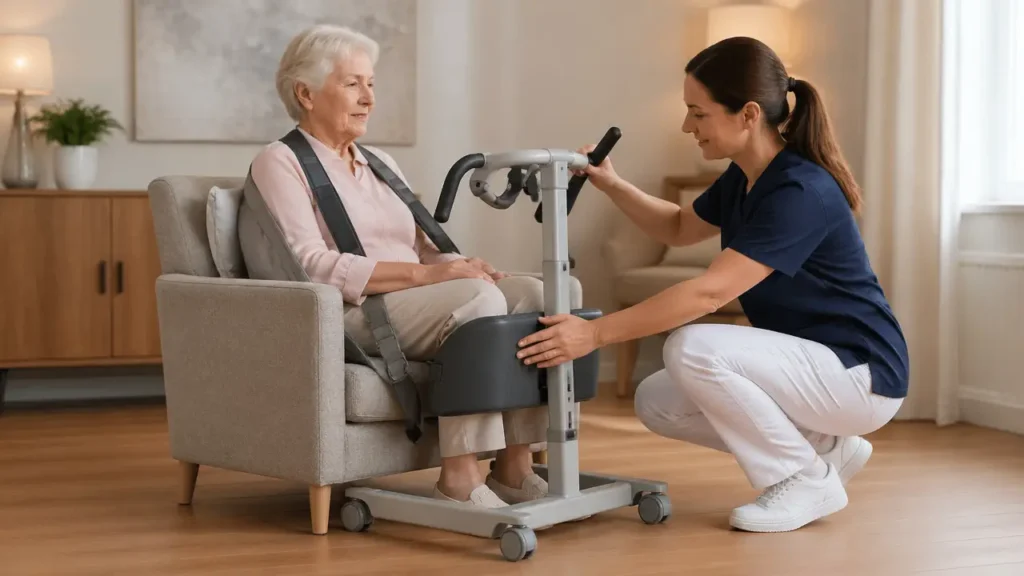
A sit-to-stand lift can make a hard transfer much safer, but only when the lift matches the person. It is designed for someone who can still do part of the work. The machine supports the rise and the move. It does not replace judgment, setup, or training.
That is why this device sits in the middle of the transfer spectrum. It is more support than a gait-belt stand assist, but less total support than a full-body lift. If you want the wider overview first, read powered sit-to-stand lifts: when and how to use and compare it with passive Hoyer-type lifts.
If this lift is only one part of the transfer plan, the mobility and transfers master guide connects the wider room-setup and equipment picture.
When to Use This
A sit-to-stand lift usually fits when the person:
- can bear some weight through the legs
- can hold at least one handgrip
- has enough head and upper-body control to stay aligned
- can sit without falling over
- can follow simple directions during the move
These lifts are commonly used for:
- bed to chair transfers
- chair to commode transfers
- dressing and hygiene
- short supported standing tasks
They are often a good option when manual sit-to-stand with a gait belt is getting too hard, but a total-body lift still is not necessary.
They are usually a poor fit when the person:
- is fully non-weight-bearing
- cannot cooperate with the process
- has severe agitation or fear with the device
- cannot stay upright in sitting
- is too fatigued to help with the stand
When those problems are present, move up to patient lifts and slings or a full-body lift approach instead of forcing a stand-assist device to do the wrong job.
Before You Start
Choose the right harness and lift
The sling or harness must match both the lift and the person's size. It should fit snugly but comfortably and be placed where the manufacturer expects it to sit. A poorly sized harness can shift the person unevenly, ride up painfully, or make the lift feel unstable.
Also confirm:
- the lift's weight rating
- the sling's weight rating
- compatibility between the lift and sling
- whether the room has enough space for the base to open fully
Inspect the equipment every time
Before any transfer, check:
- sling fabric, seams, loops, and fasteners
- footplate stability
- knee pad position and condition
- battery charge or power supply
- controller, power cord, and emergency stop
- wheels and base movement
Do not use the lift if fabric is torn, loops are stretched, the controller looks damaged, or the battery is unreliable.
Set up the room before the person rises
The destination surface should be ready first:
- wheelchair or commode brakes on
- footrests and any removable armrest out of the way if needed
- enough clearance for the base and mast
- cords and clutter off the floor
- no walls or door frames close enough to catch the person's body
On some models, casters may be locked while attaching the sling. Once the person is actually being raised, many models are safer with casters unlocked so the base can settle naturally instead of tipping. Follow the device instructions and training for your model.
Set up the person
A common starting position is seated at the edge of the bed or chair with feet ready for the footplate. Explain the steps before you begin. Make sure the person is wearing secure footwear and is not sitting on extra pads or cushions that interfere with sling placement.
Step-by-Step Technique
Every model has details that matter, but the usual sequence is:
- Bring the person to the edge of the bed or chair.
- Place the sit-to-stand sling behind the back as directed for that sling style.
- Bring the support sections around the body or thighs if the sling requires it.
- Attach the sling loops evenly on both sides.
- Open the base wide enough for stability.
- Position the feet on the footplate.
- Adjust the knee pad so it rests just below the kneecaps.
- Ask the person to hold the handgrips and stay upright.
- Raise slowly while watching knee contact, trunk alignment, and sling position.
- Move only after the person is stable in the lift.
- Lower toward the destination until the backs of the legs touch, then guide into sitting.
The move should feel controlled, not rushed. If the sling starts creeping into the armpits or the knees lose contact with the pad, stop and fix the setup before continuing.
If the destination is a toilet or commode, this is also the stage where toilet transfer setup and technique matters. A lift can help, but only if the bathroom space and toilet height work with it.
Safety Checks and Common Errors
Common errors include:
- using the wrong sling style or size
- attaching the loops unevenly
- skipping the weight-capacity check
- placing the knee pad too high or too low
- trying to use the lift in a room that is too tight
- moving before the person is fully stable
- using the device for someone who cannot really participate
Other important checks:
- never place extra cushions between the person and sling
- never ignore a damaged cord, controller, or battery
- never use the sling if the seams or loops are worn
- never keep doing a manual assist that feels like a heavy lift just because the machine is nearby
The sling can also ride up under the arms if the person is not helping enough with the stand. That is uncomfortable and it usually means the fit or lift choice needs review.
When to Stop or Get Help
Stop the transfer and reassess if:
- the person suddenly cannot bear weight
- the knees slide off the pad
- the sling shifts painfully or unevenly
- the person cannot follow the cues
- dizziness, chest pain, or severe pain begins during the lift
- the room is too small to finish safely
Get PT, OT, or supplier help when there are special issues such as:
- spinal fracture precautions
- rib or arm fractures
- amputation
- upper-limb weight-bearing limits
- feeding tubes or other lines that complicate fit
- progressive weakness that is making sit-to-stand lifts less appropriate over time
If the question is more about what to buy than how to use it, go next to best sit-to-stand lifts for home use and lift and battery care.
Frequently Asked Questions
Who is a sit-to-stand lift best for?
Someone who can still bear some weight, hold at least one handgrip, and follow the transfer sequence.
Is a sit-to-stand lift the same as a Hoyer lift?
No. A sit-to-stand lift requires participation. A Hoyer-type full-body lift supports the whole body and is used when standing participation is not realistic.
Where should the knee pad sit?
Usually just below the kneecaps, so the lower legs are supported during the rise without forcing the knees backward.
Should the wheels be locked during the whole transfer?
Not always. Some models may be locked during setup but safer with casters unlocked during the lift itself. Follow the instructions for the specific model.
What if the sling rides up under the arms?
Stop and reassess. The sling may be the wrong size, the setup may be uneven, or the person may not be appropriate for this type of lift.
Can a sit-to-stand lift be used for toileting?
Often, yes. It is commonly used for commode and toilet transfers when the person can still participate in the rise.
When should we switch to a full-body lift?
When the person can no longer bear enough weight, cannot stay upright, cannot follow directions, or is too fatigued or unstable for a stand-assist transfer.
If the next comparison is manual versus mechanical support, continue with gait-belt sit-to-stand technique and passive Hoyer-type lift setup. If the harder question is the scooter or commode end point, pair this with safe scooter transfers and toilet transfers safely.