As an affiliate, we may earn a commission from qualifying purchases. We get commissions for purchases made through links on this website from Amazon and other third parties.
Osteoporosis changes mobility because the goal is not only to avoid falling. It is also to avoid movements that put too much force through fragile bones, especially the spine. That means a movement can feel small and still be risky if it involves rounded forward bending, sudden twisting, or fast, poorly controlled effort.
This is why fracture-aware mobility is different from general "move carefully" advice. The safest approach is usually slower, more organized, and more spine-aware. This guide explains how osteoporosis changes the task, what to set up before you start, and which movement changes matter most in day-to-day life. For the wider context first, start with the mobility and transfers master guide.
Why This Condition Changes the Task
With osteoporosis, bones are more likely to break under loads that would not injure someone else. That risk becomes especially important in the spine, hip, pelvis, wrist, and upper arm.
The problem is not only big accidents. Fractures can also happen during routine movements such as:
- bending forward quickly
- twisting while reaching
- lifting from the floor
- trying to catch yourself during a stumble
- rushing a transfer with poor posture
That does not mean the person should stop moving. In fact, staying active matters for balance, posture, strength, and fall prevention. The change is that movement needs to be more controlled and more aware of spinal loading.
Common mobility changes seen with osteoporosis include:
- fear of falling or breaking a bone
- stooped posture that shifts balance forward
- pain that makes walking shorter and slower
- hesitation during transfers
- reduced confidence on stairs, ramps, and uneven ground
The risk is even higher if the person has already had a vertebral fracture, sudden back pain, loss of height, or a more rounded upper back. In that situation, the safe-movement rules become more important, not less. If transfers are already part of the problem, pair this article with the transfer safety checklist and the home care plan template.
Safest Setup Before You Start
With osteoporosis, setup does a lot of injury prevention work before the first step happens.
Start with the environment
Clear the route first.
Check for:
- wet or slick floors
- loose rugs
- poor lighting
- crowded paths
- thresholds that catch toes or wheels
- unstable chairs or low soft seating
This matters because a person with fragile bones may not be able to recover safely from even a small slip or twisting correction. If nighttime is part of the problem, add lighting and night transfer safety rather than relying on memory and guesswork.
Use shoes and devices that help, not just feel soft
The safest footwear is usually supportive, well-fitted, and grippy instead of extra soft and floppy.
Good prep includes:
- secure shoes with traction
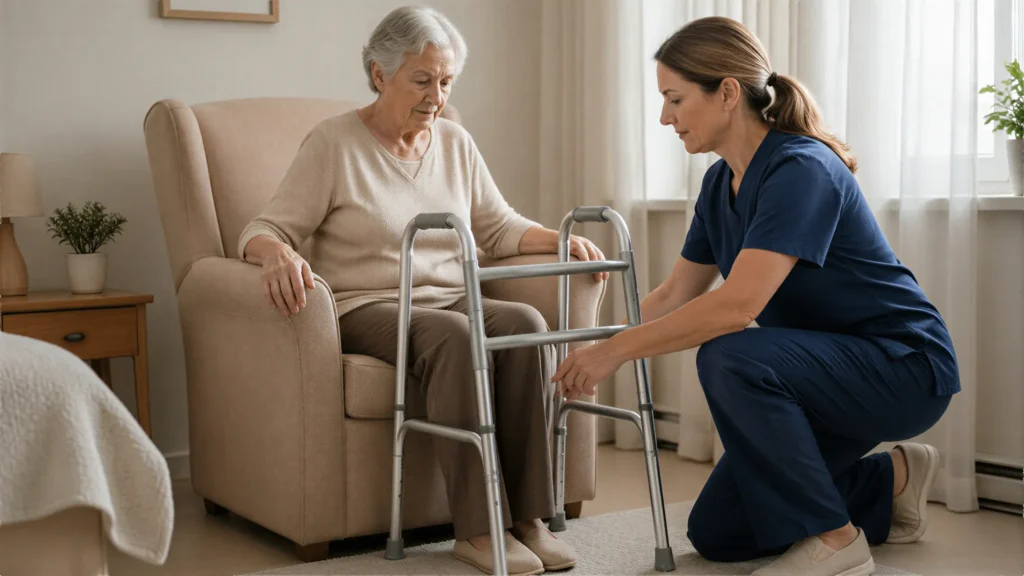
- walking aid at the right height
- wheelchair brakes locked before standing
- footrests moved out of the way
- reacher or grabber for light low items when bending is a problem
Start with non-slip shoes for seniors and proper walker height and posture if those basics are still uncertain.
Check pain, fatigue, and confidence before the task
Osteoporosis-safe movement is harder on bad days.
Pause if the person has:
- new or sharp back pain
- sudden rib, hip, or groin pain
- increased fatigue
- dizziness
- a strong fear response that makes them freeze or rush
Pain changes movement quality. People who are hurting often round their backs, twist without meaning to, or use quick jerky effort to get the task over with. That is exactly when technique starts to break down.
Use help early when needed
Do not wait until the movement becomes uncontrolled.
Get extra help sooner when:
- the person already needs hands-on transfer support
- the route includes stairs or long ramps
- there was a recent fracture
- the person cannot keep an upright posture during the movement
- lifting, pulling, or twisting is likely
If the person already needs transfer help, also review osteoporosis and fragility considerations in transfers because the movement rules overlap but the helper's role becomes bigger.
Technique Adjustments That Matter
The biggest technique changes in osteoporosis are about how the spine moves under load.
Keep the spine long instead of rounded
The safest goal is not a stiff robotic posture. It is a neutral, lengthened spine rather than a rounded, flexed one.
That matters when:
- getting out of bed
- standing from a chair
- brushing teeth at the sink
- reaching into a low cabinet
- turning to look behind
Rounded forward bending increases strain at the front of the spine. That is why repeated bending, deep toe-touch style reaching, and quick curling forward are common risk patterns.
Use a hip hinge instead of bending from the waist
This is one of the most useful changes a person can learn.
Instead of collapsing forward through the upper and mid back:
- keep the chest and back long
- soften the knees a little
- bend from the hips
- keep the object or task close to the body
This works for sink tasks, dressing, and reaching into low spaces. It also helps caregivers avoid giving bad cues like "just bend down and grab it."
Step to turn instead of twisting the trunk
Twisting under load is a common problem in osteoporosis. People do it while vacuuming, unloading groceries, getting out of a car, or pivoting during a transfer.
A safer pattern is:
- move the feet with the body
- keep nose, knees, and toes generally pointing the same way
- pivot the whole body instead of cranking the spine
This is especially important when carrying items, using a walker, or standing from a chair. If tight-space turning is already difficult, see turning, pivoting, and backing up safely.
Use log-roll style bed mobility when the spine is sensitive
For people with recent vertebral fracture pain or strong spinal pain, bed mobility often needs to be more controlled.
A safer bed exit usually looks like:
- roll the shoulders and hips together as one unit
- move onto the side
- lower the legs while pushing up sideways with the arms
- sit tall at the edge before standing
Trying to jackknife straight up from lying on the back puts much more strain through the spine. If bed mobility is already hard, review turn in bed and dangle to edge safely and bed-to-chair transfers step by step.
Keep lifting light, close, and optional when possible
With osteoporosis, routine household lifting needs to be rethought.
Safer habits include:
- keep loads small
- split groceries into lighter bags
- store often-used items between knee and shoulder height
- ask for help with bulky, awkward, or overhead items
- use a cart, bag on wheels, or second person instead of muscling through
The worst pattern is usually bend, twist, and lift all at once.
Slow the pace and use deliberate sequencing
Speed is often what turns a manageable move into an unsafe one.
Encourage:
- pause before standing
- one step at a time
- steady breathing
- no rushing to answer the phone or door
- a short stop after sitting up before walking
This is not "being overly careful." It is a practical way to protect a fragile spine and reduce fall risk.
Use balance and posture support, but keep the movement realistic
Evidence-based osteoporosis guidance supports balance and functional training because preventing falls helps prevent fractures. In day-to-day mobility, that means the person often benefits from:
- regular supported balance practice
- posture cues that lengthen the trunk
- a cane or walker when clinically appropriate
- safer route choices on bad days
If the person already has trouble with step length or base of support, add posture, step length, and base of support quick wins.
Red Flags and Common Errors
The most common mistake is focusing only on bone fragility and forgetting movement quality.
People often know they should "be careful," but then still:
- bend forward from the waist
- twist while carrying something
- lift from the floor in a rush
- sit in deep soft furniture that makes standing harder
- move too quickly after pain or fatigue starts
Red flags that should stop the attempt or change the plan:
- new sharp back pain
- sudden rib, hip, groin, or pelvic pain
- a recent fall or near-fall
- visible rounding that worsens during the movement
- loss of balance during turning
- inability to keep the task controlled
Another major error is using too much force during a helper-assisted movement. The person with osteoporosis is not the only one at risk. A rushed caregiver can also twist, pull, and lose footing while trying to help. If the movement starts breaking down, go to what to do if a transfer starts to fail instead of forcing it through.
When to Get Clinical Help
Get clinical help sooner rather than later when osteoporosis is no longer just a diagnosis in the background.
PT, OT, nursing, or the prescribing clinician should be involved when:
- there is a new fracture or strong suspicion of one
- the person develops sudden back pain, height loss, or posture change
- walking becomes shorter, more fearful, or more stooped
- the person needs new hands-on transfer help
- bed mobility becomes painful
- routine tasks now involve unsafe compensation
- you are not sure which movements should be modified
Clinical help is especially important after a vertebral fracture, because people often need hands-on retraining for bed mobility, sit-to-stand, posture, and safe bending strategies.
Frequently Asked Questions
Does osteoporosis mean a person should avoid movement?
No. Safe movement matters even more with osteoporosis because strength, posture, and balance help reduce falls and fractures.
What movement is usually the biggest problem with osteoporosis?
Rounded forward bending and twisting under load are two of the biggest risks, especially for the spine.
Is it safer to keep the back perfectly stiff all the time?
No. The goal is not rigid movement. The goal is a more neutral, lengthened spine with better control and better movement from the hips and knees.
Should someone with osteoporosis still use a walker or cane if recommended?
Yes. If a clinician recommends a walking aid, using it correctly can reduce fall risk. The device should fit properly and be used consistently where needed.
Can people with osteoporosis still carry groceries?
Sometimes, but lighter loads carried close to the body are usually safer than one heavy bag or awkward twisting lifts.
What if standing up from a chair causes back pain?
That is a sign to slow down, improve setup, and get clinical input if the pain is new or worsening. A recent fracture or spine pain should not be ignored.
Is getting out of bed differently really that important?
Yes. For people with spine fragility or recent vertebral fracture pain, rolling to the side and pushing up sideways can reduce spinal strain compared with curling straight forward.
When should a caregiver stop trying to handle it alone?
Stop and get help when pain changes suddenly, posture worsens, transfers become uncontrolled, or the person now needs more support than the current plan safely allows.
For the next step, pair this guide with osteoporosis fragility considerations in transfers, the transfer safety checklist, bed-to-chair transfer steps, and non-slip shoes for seniors. For broader daily movement support, return to the mobility and transfers master guide.