As an affiliate, we may earn a commission from qualifying purchases. We get commissions for purchases made through links on this website from Amazon and other third parties.
Night transfers are harder than daytime transfers even when the person and the route are exactly the same.
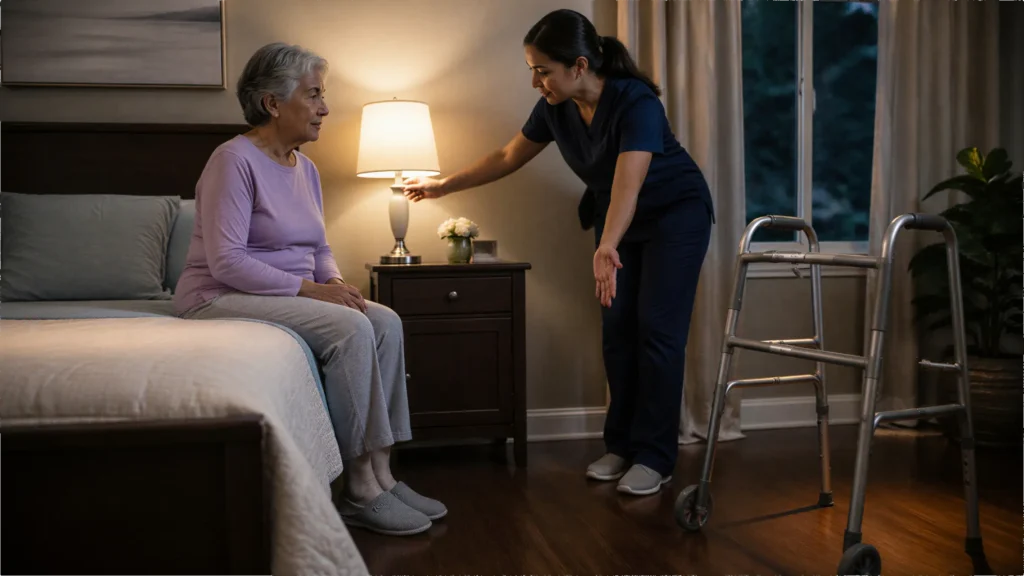
At night, people are groggy, vision adjusts more slowly, blood pressure may drop when they sit up or stand, and familiar rooms suddenly feel less predictable. Poor lighting adds one more problem on top of that. Good night lighting does not mean turning the whole room into a spotlight. It means making the transfer path readable, steady, and easy to use when someone wakes up half asleep. For the visual-contrast side of the bigger picture, see low vision, high-contrast markers, and lighting for mobility.
If lighting is only one part of night safety, the mobility and transfers master guide helps connect the wider transfer and room-setup plan.
Why This Matters
Many nighttime falls do not happen because the person forgot how to transfer. They happen because the conditions changed.
Common night-time factors include:
- eyes taking longer to adjust from dark to light
- sleepiness and slower reaction time
- urgency to reach the bathroom
- dizziness after lying down
- pain or stiffness that is worse first thing overnight
- clutter or furniture that is easy to avoid in daylight but easy to misjudge in dim light
The transfer itself might only take a few seconds, but those few seconds often include the highest-risk steps:
- sitting up at the bed edge
- finding the walker or cane
- standing before balance is really there
- turning toward the commode or bathroom
- stepping over thresholds, rugs, pet beds, or cords
Lighting helps by making the route visible and reducing hesitation. It cannot fix weakness, poor footwear, or a bad transfer method, but it can remove a major avoidable hazard.
This matters even more when the person has:
- low vision
- cataracts or glare sensitivity
- dementia or nighttime confusion
- Parkinson's symptoms or a shuffling gait
- urinary urgency
- neuropathy or poor foot sensation
If bathroom access is part of the problem, pair this article with grab bar placement for toilet and tub transfers. If stairs are involved anywhere on the route, add landings, railings, and visual markers for depth perception.
Key Factors That Change the Decision
The right night lighting depends on the person, the route, and how the transfer actually happens.
Vision and contrast sensitivity
Some people mainly need more light. Others need better contrast and less glare.
An older adult with cataracts or glare sensitivity may do worse with one bright exposed bulb than with softer layered light. A person with low vision may need the edge of the bed, bathroom door, walker, or grab bar to stand out clearly against the background. Someone with dementia may do better when the route looks simple and familiar every night instead of changing constantly.
That is why "just put in a brighter bulb" is not always the right answer.
Distance and destination
A one-step transfer to a bedside commode needs a different setup than a longer route to the bathroom.
Ask:
- Is the person transferring only from bed to a commode?
- Do they walk to the toilet?
- Do they use a walker?
- Do they need to turn through a doorway?
- Is there a threshold, rug edge, or carpet change on the route?
The longer and more complex the route, the more important it is to light the entire path instead of only the bed area.
Sleep and wake-up concerns
Night safety matters, but so does sleep.
Blasting bright overhead light into the room at 2 a.m. may make the route visible, but it can also fully wake the person, confuse them, or make it harder to go back to sleep. In some homes, lower-level pathway lighting, motion-activated floor-level light, or warm bedside controls are a better compromise than a harsh ceiling fixture.
The goal is usually enough light to move safely, not full daytime brightness.
Cognitive status
Night routines have to be simpler when the person is confused, impulsive, or forgetful.
For dementia, the safest setup often uses:
- the same route every night
- the same switch or automatic lighting pattern every night
- minimal clutter or visual noise
- fewer "choices" in the moment
If the person wanders, gets agitated, or resists help, lighting should support the routine, not complicate it. Related context lives in dementia-friendly transfer cues and routines and GPS trackers for wander-prone loved ones.
Device use
Canes, walkers, and wheelchairs all change the lighting plan.
A walker user needs to see not just the floor, but also where the device sits in relation to the bed and bathroom. A wheelchair user may need better lighting around footrests, brakes, and bed clearance. A person using a lift chair or bedside commode needs the transfer zone lit without creating sharp shadows around the chair base or foot platform.
If you are still optimizing the mobility tool itself, compare indoor versus outdoor walkers and manual wheelchairs versus transport chairs.
How to Use, Choose, or Set It Up Safely
The safest approach is layered, simple, and predictable.
1. Light the route, not just the room
This is the biggest night-lighting mistake: people illuminate the bedside table but leave the route itself patchy.
The person needs to see:
- the bed edge
- the floor where the feet land
- the mobility device
- the path to the toilet or commode
- the bathroom entrance
- the toilet or transfer target
If one section is bright and the next is dark, older eyes may struggle with the transition. More even light often matters more than a single bright source.
2. Keep the first steps visible
The first few seconds after sitting up and standing are often the most unstable.
Make sure the person can see:
- where their feet are going
- where the walker or cane is parked
- where the bed frame or chair legs are
- whether slippers or shoes are positioned correctly
This is especially important when socks, loose bedding, and bedside clutter are already working against the transfer. For traction questions, review house shoes versus socks indoors.
3. Prefer low-glare, shielded light over exposed bulbs
Older adults are often more sensitive to glare. Bright light aimed directly into the eyes can make it harder, not easier, to read depth and edges.
Safer choices usually include:
- shaded lamps instead of bare bulbs
- indirect or wall-bounced light
- floor-level or pathway light that does not shine straight into the eyes
- matte surfaces near the route instead of shiny reflective finishes
The wrong setup is a bright, visible bulb that leaves the person squinting while the floor still looks unclear.
4. Put light controls where the person can actually reach them
Lighting is not helpful if someone must cross a dark room to turn it on.
Useful options include:
- a bedside lamp within easy reach
- a large, obvious wall switch near the bed
- motion-activated pathway lights
- voice-controlled lighting if the person can use it reliably
- remote controls that are simple and kept in one consistent place
Motion sensors can work very well, but only if they trigger early enough and reliably enough. If a sensor turns on after the person is already halfway up and moving, it is too late to be the main safety plan.
5. Use contrast and landmarks at the destination
The toilet, commode, grab bar, and doorway should be easy to distinguish from the surrounding room.
This does not require a dramatic remodel. Often it means:
- making the path uncluttered and visually simple
- improving contrast around the grab bar or toilet area
- keeping towels, baskets, and storage from blending into the route
- avoiding dark shadows behind the toilet or beside the bed
If the person has trouble reading step edges or floor changes, visual markers for depth perception becomes part of the same night-safety plan.
6. Reduce the need to rush
Lighting works best when the routine itself is controlled.
Night transfer safety improves when you also:
- sit at the bed edge for a moment before standing
- allow time if the person tends to get dizzy
- keep the walker in the same spot every night
- use the bathroom route with fewer turns when possible
- place a bedside commode when the full walk is too risky
Sometimes the best lighting change is actually changing the destination. A person who repeatedly rushes to a far bathroom at night may be safer with a nearby commode plus better bedside lighting.
7. Keep the bathroom safer than the hallway, not darker than it
Some bathrooms are bright enough once you are inside, but the doorway and transition are the problem.
Make sure there is enough light at:
- the bathroom threshold
- the first place the walker enters
- the toilet transfer zone
- the sink area if the person tends to reorient there first
If the bathroom is very bright but the hall is dark, the person may still struggle on the approach. If the hall is bright and the toilet corner is shadowed, the last step remains risky.
8. Recheck the setup after changes in condition
Night lighting should be reassessed after:
- a new fall
- a hospitalization
- worsening vision
- new mobility equipment
- medication changes that increase dizziness or nighttime confusion
- a move to a guest room, hotel, or other temporary space
Temporary environments are especially easy to underestimate. If travel is involved, use hotel room mobility checks and requests to make before assuming the room is safe after dark.
Common Mistakes and Red Flags
Most unsafe night setups have one of two problems: too little usable light or too much bad light.
Common mistakes
- relying on one bright overhead bulb that wakes or dazzles the person
- leaving the bed area lit but the bathroom route dark
- using night-lights that are blocked by furniture, laundry, or bags
- placing motion lights where they activate too late
- keeping a walker, cane, or commode in a different place each night
- leaving reflective floors, glossy rugs, or confusing patterns in the route
- assuming the person can still manage the same setup after a fall or illness
Another common mistake is treating lighting as separate from transfer setup. It is not separate. A badly placed walker in dim light is a lighting problem. A low bed plus poor contrast at the floor is a lighting problem and a transfer problem at the same time.
Red flags that the current setup is not working
Pay attention if the person:
- reaches for furniture instead of the walker during night trips
- pauses at thresholds or doorways as if the surface is unclear
- turns on every light in the house because the route still feels unsafe
- misses the chair, commode, or toilet edge when sitting
- complains of glare, shadow, or "I can't tell where the floor is"
- has near-falls only at night, not in the daytime
Those patterns often tell you more than the bulb label.
Red flags that need medical or rehab follow-up
Lighting is not the whole story if the person has:
- repeated nighttime dizziness
- blackouts or faintness on standing
- sudden vision change
- repeated urinary urgency leading to rushed transfers
- new confusion or hallucinations at night
- new shuffling, freezing, or severe balance loss
In those cases, a home lighting tweak may help, but the bigger issue still needs evaluation.
When to Get More Help
Get more help when the route is improved but the person is still unsafe.
An OT, PT, home health clinician, or low-vision specialist can help when:
- there have been night falls or repeated near-falls
- vision problems are clearly affecting route finding
- the person has dementia and the night routine keeps breaking down
- a walker, wheelchair, commode, or lift chair is part of a complicated setup
- the home has multiple thresholds, steps, or tight bathroom turns
Professional input is especially useful if you need to decide between:
- bedside commode versus bathroom walk
- walker route versus wheelchair route
- transfer pole, grab bar, or bed-height changes
- sensor lighting versus manual bedside controls
If the larger problem is that the person cannot stand safely once awake, lighting is only one layer. Add bed height and bed rail safety, grab bar planning, and lift chair safety and fit if those surfaces are part of the sequence.
Frequently Asked Questions
What kind of light is best for night transfers?
Usually the best setup is low-glare, easy-to-activate lighting that clearly shows the bed edge, floor, mobility device, and route to the toilet or commode.
Should I use bright overhead light at night?
Not always. A harsh overhead light can create glare and fully wake the person. Many people do better with softer pathway lighting or controlled bedside light, as long as the route is still clearly visible.
Are motion-activated lights a good idea?
Often yes, if they activate reliably and early enough. They work best as part of a full route-lighting plan, not as the only light source if they turn on too late.
Where should night-lights go?
Place them where they make the floor path readable: near the bed exit, along the route, at the bathroom doorway, and near the toilet or commode transfer zone.
How can I reduce glare for an older adult?
Use shaded or indirect light, avoid bare bulbs in direct view, and watch for shiny floors or reflective surfaces that bounce light back into the eyes.
What if the person still falls only at night after lighting changes?
That suggests the problem is bigger than lighting alone. Check for dizziness, urgency, weakness, medication effects, vision changes, or a transfer method that no longer matches the person's ability.
When should I switch to a bedside commode?
Consider it when the bathroom route is too long, rushed, or unsafe at night even after you improve lighting, clear the path, and simplify the routine.
If the route is visually hard to read, pair this with low-vision contrast and lighting strategies and depth-perception markers for landings and edges. If the main issue is the transfer destination, add grab bar placement, bed height and bed rail safety, and hotel room mobility checks for temporary environments.