As an affiliate, we may earn a commission from qualifying purchases. We get commissions for purchases made through links on this website from Amazon and other third parties.
Choosing between a quad cane and a single-point cane is usually a tradeoff between extra stability and easier movement. A quad cane gives a wider base and often feels steadier at first. A single-point cane is lighter, quicker, and easier to place in tight spaces. The right answer depends on how much support the person actually needs, not which cane feels safer in the store aisle for ten seconds.
The wrong choice shows up quickly at home. A cane that gives too little support can leave the person swaying and grabbing furniture. A cane that gives more support than they can manage can catch on thresholds, feel slow on stairs, and turn every doorway into a frustration point. For the bigger mobility picture, start with mobility aids: walkers, canes, and rollators.
If the right answer may be more than a cane choice, the mobility and transfers master guide lays out the bigger transfer and equipment picture.
What Each Option Means
A single-point cane has one tip touching the floor. It usually works best for:
- mild balance support
- a little unloading of one painful leg
- people who can walk with fairly normal rhythm
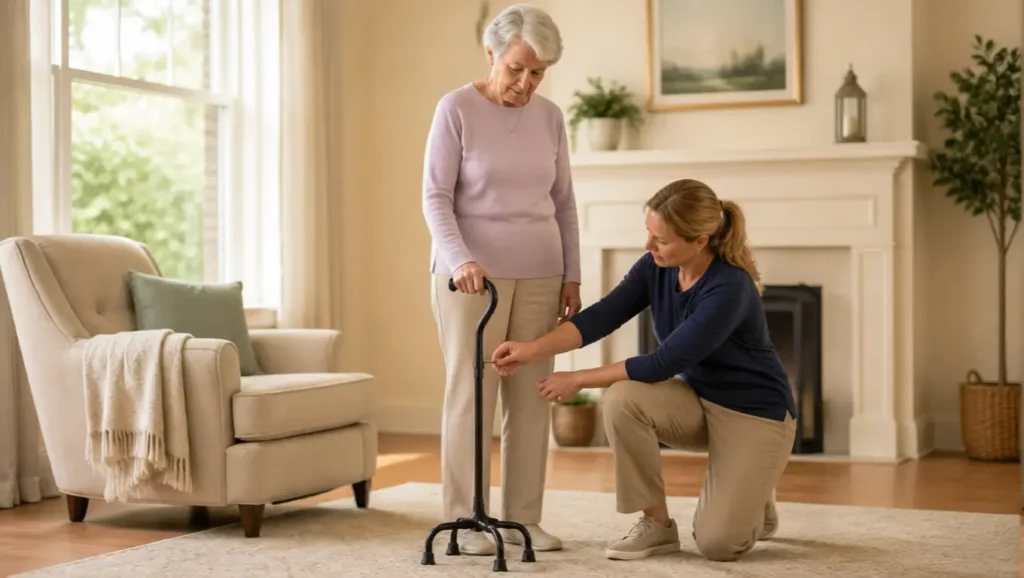
A quad cane has four small feet at the base. It usually gives:
- a wider contact area
- more side-to-side stability
- a more planted feel during standing and short walking
Some people do better with a small-base quad cane than a large one because it is easier to move and less likely to catch.
If you are still deciding whether a cane is enough support at all, compare walkers, canes, and rollators and how to size and fit a cane correctly.
The Biggest Safety and Use Differences
Quad canes usually feel steadier
For someone with mild to moderate balance trouble, a quad cane often gives a stronger sense of support during:
- first standing
- short household walking
- slow turns
- stopping and restarting
That is why quad canes are often considered after stroke or when one side feels less reliable.
Single-point canes are usually faster and easier to place
A single-point cane is simpler to move through:
- doorways
- narrow hallways
- stairs
- crowded rooms
- quick turns
It is also less likely to snag on thresholds or furniture.
Quad canes can be awkward in tight spaces
The same wide base that adds stability can also create problems. Quad canes are more likely to:
- catch on uneven edges
- feel clumsy on stairs
- be slower with fast turns
- get stuck in cramped bathroom layouts
If tight-space movement is already a problem, compare public restroom and tight space transfers and training with a walker in tight spaces.
Who Each Option Fits Best
A quad cane usually fits best when:
- the person needs more than light balance support
- one side is weaker
- standing still feels unsteady
- gait is slower and more deliberate anyway
- the person can manage the base without catching it
This often includes people with one-sided weakness after stroke or those moving down from a walker but not ready for a single tip yet.
A single-point cane usually fits best when:
- support needs are mild
- the person walks with better rhythm and speed
- turning, stairs, and community walking matter
- the person gets frustrated by a bulky base
It is often a better match for mild balance support and painful but still functional walking, not major instability.
Signs neither cane is enough
The person may need a walker instead when they:
- grab furniture even while using the cane
- cannot recover from a sideways sway
- need both hands for safety
- fatigue so quickly that gait falls apart after a short distance
Setup and Home Considerations
A cane choice has to fit the environment too.
Doorways and clutter
Single-point canes usually win in narrow homes. Quad canes do better in open flat spaces than cluttered ones.
Stairs and curbs
Single-point canes are usually easier on stairs and curbs because the base does not need as much flat landing surface. If curbs are part of daily life, compare how to size and fit a cane correctly and negotiating ramps and curbs with a rollator or walker.
Height and grip
Whichever cane you choose, fit still matters. A badly sized cane can undo the benefit of the right category. Use how to size and fit a cane correctly before judging whether the cane itself is wrong.
Common Mistakes
Common mistakes:
- choosing the quad cane just because it looks more supportive
- choosing the single-point cane just because it is lighter
- ignoring stairs, thresholds, and bathroom layout
- using a badly fitted cane
- keeping a cane when support needs have clearly outgrown it
The real test is not how the cane feels during a short stand. It is how the person moves through the actual places they live and use every day.
Frequently Asked Questions
Is a quad cane always safer than a single-point cane?
No. It gives more base support, but it can also be slower and clumsier in tight spaces.
Who usually benefits most from a quad cane?
People who need more side-to-side stability and a more planted feel than a single-point cane can provide.
Is a single-point cane better for stairs?
Usually yes. It is easier to place on narrow steps and less likely to catch than a quad base.
Can a quad cane be too much cane?
Yes. If the person moves well enough that the base keeps getting in the way, it may be more support than they really need.
What if the person still grabs furniture with the cane?
That usually means the cane is not enough support or the fit and technique need reassessment.
Does cane height matter as much as cane type?
Yes. Poor cane height can cause bad posture, awkward arm position, and worse balance no matter which cane type you choose.
When should someone move from a cane to a walker?
When one-hand support is no longer enough for standing, turning, or safe walking at home.
If you are between cane and walker categories, continue with how to size and fit a cane correctly, walkers, canes, and rollators overview, and best canes for seniors. If the person already struggles with turns and transfers, compare posture, step length, and base of support quick wins and bed-to-chair transfers.