As an affiliate, we may earn a commission from qualifying purchases. We get commissions for purchases made through links on this website from Amazon and other third parties.
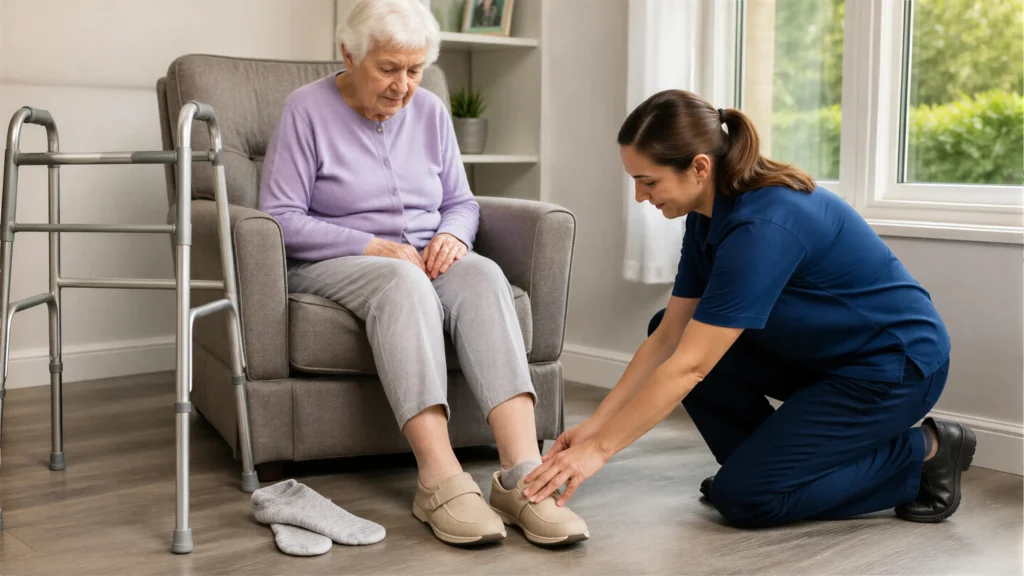
If you are trying to make indoor walking safer, house shoes usually beat socks.
That does not mean every slipper is safe or that grip socks are useless. It means most older adults do better with footwear that has a real sole, secure fit, and enough structure to keep the foot from sliding around. Socks can work as a short-distance backup, but for regular walking, turning, and transfers, they usually do less to protect balance. If you want the big-picture setup for safer movement at home, start with the mobility and transfers master guide.
What Each Option Means
The real choice is not just "shoes or socks." It is usually one of three things:
- regular socks with no traction
- grip socks with rubber or silicone dots
- house shoes or indoor shoes with a real sole
Plain socks are the least protective option. They feel easy and comfortable, but they give you almost no structure, no arch support, and no secure tread pattern. On smooth hardwood, laminate, or tile, that matters.
Grip socks are better than plain socks, but they still have limits. The dots can help on clean, dry indoor floors and low-pile carpet. But they do not give you the stable outsole, heel hold, or side-to-side support that a proper indoor shoe can give. If the grip pattern wears down, they become much less helpful. If the sock is loose, the foot can still slide inside it.
House shoes are safest when they act like supportive indoor footwear, not floppy slippers. The safer versions usually have:
- a closed or secure heel
- a sole that stays flat and does not twist easily
- enough grip for smooth floors
- a fit that keeps the foot from sliding forward
- a low profile that does not catch on the floor
That distinction matters. A loose open-back slipper may feel cozy, but it is not the same as a supportive house shoe. Proper fit, secure fastening, lower heel height, and slip-resistant soles are the details that usually make indoor footwear safer. Open slippers and loose shoes are where problems start. If you need a broader shoe-buying checklist, the practical fit rules in non-slip shoes for seniors and orthotic insoles carry over indoors too.
The Biggest Safety and Use Differences
The biggest difference is structure.
Socks, even non-slip socks, do not support the foot very much. They do not control heel movement, they do not reduce foot sliding inside the footwear, and they do not provide much help if your balance is already shaky. That is one reason non-slip socks have not proven to be the best fall-prevention answer on their own. They can add traction, but they do not solve the whole problem.
House shoes with a secure upper and real outsole do more. They give the foot a clearer platform, which can improve confidence when standing up, turning, or backing up to sit. That matters during everyday tasks like getting out of bed, walking to the bathroom, or stepping around furniture. If you already use a cane, walker, or rollator indoors, the extra foot control becomes even more important because the device only helps if your feet can still find the floor predictably.
The second difference is how each option behaves on hard indoor surfaces.
Hardwood, tile, vinyl, and even thin carpet do not absorb much shock. A supportive indoor shoe helps spread load better across the foot and may be more comfortable for people with heel pain, neuropathy, diabetes, or tender joints. Socks do not help with that. For some people, walking around in socks leads to more toe gripping, shorter steps, and a more cautious gait because the foot never feels fully settled.
The third difference is what happens during fast, imperfect real life.
Most falls do not happen during a careful test walk across an empty room. They happen when someone turns quickly, gets up half-awake, hurries to the bathroom, steps on a damp spot, or pivots with one hand on furniture. In those moments:
- plain socks slide most easily
- grip socks help only if the grips are intact and the floor is dry
- supportive house shoes usually give the most reliable traction and foot control
That does not mean house shoes are automatically safer. A bad pair can create its own problems. Open-back slippers, floppy memory-foam soles, overly thick fuzzy uppers, and worn tread can all make indoor walking less safe. Open slippers and shoes without secure fastening are higher-risk choices. Closed-heel footwear with better fastening and a stable outsole usually does better.
Who Each Option Fits Best
House shoes are the better default for most older adults who walk around the home regularly, especially if they:
- use a walker, cane, or furniture for support
- have neuropathy, foot pain, plantar fasciitis, arthritis, or diabetes
- feel unsteady when turning or backing up
- do sit-to-stand transfers several times a day
- have slick floors in the kitchen, bathroom, or hallway
They are also the stronger choice if you need orthotics or extra volume for swelling, because a proper indoor shoe can hold an insert and still keep the foot aligned.
Grip socks fit a narrower use case. They make more sense when someone:
- needs something easy for a very short trip from bed to chair
- cannot tolerate a shoe for part of the day because of swelling, skin issues, or dressing changes
- spends more time in bed or in a recliner than walking room to room
- needs a temporary indoor option while the safer shoe setup is being figured out
Even then, they work best as a backup, not as the main plan for daily walking. If someone is already struggling with balance, stopping them in slick socks is harder than setting up a shoe they can trust.
Plain socks are mostly a comfort item, not a safety strategy. For a person with fall risk, they are usually the weakest choice.
There are a few exceptions. Some people drag their feet badly, cannot get house shoes on without help, or have severe swelling that changes through the day. In those cases, the answer may be to keep both options available and use them at different times. But that choice should still be intentional. If the person now grabs furniture, rushes at night, or freezes during transfers, it is worth reviewing the full mobility setup, not just the footwear. Articles on neuropathy and balance changes, proper cane fit, and proper walker height and posture can help you spot whether the footwear problem is part of a bigger mismatch.
Setup and Home Considerations
The safest indoor setup usually looks boring, and that is a good thing.
Keep one dependable pair of house shoes in the places where transfers happen most often: by the bed, near the favorite chair, and close to the bathroom if needed. A safer pair usually has a closed heel or at least a very secure upper, a low heel, enough tread for smooth floors, and room for the toes without feeling loose. If the person has foot swelling, make sure the shoe still holds the heel well when adjusted.
Measure fit by function, not just by comfort in a chair. Watch what happens when the person:
- stands up
- takes the first three steps
- turns
- backs up to sit
- walks over tile, vinyl, and carpet transitions
If the heel lifts, the toes claw, or the shoe twists, it is not the right indoor shoe.
Grip socks need upkeep too. If you use them:
- choose a snug fit, not a baggy one
- replace them when the grip dots wear smooth
- wash them in a way that protects the traction surface
- use them only on clean, dry indoor floors
Floor setup matters just as much as the footwear. Even a good shoe will struggle on bad flooring. Clear cords, flatten rug edges, fix curled mats, and keep transition points easy to see. The environmental fixes in lighting and night transfer safety, rain and wet-floor traction strategies, and handrails, edge guards, and raised lip safety help the footwear do its job.
If the goal is safer night walking, do not rely on footwear alone. Set up the path, add light, and reduce urgency. Many nighttime falls start because someone wakes up, stands too fast, and hurries in poor lighting. Good shoes help, but a calmer route helps more.
Common Mistakes
One common mistake is choosing by warmth or appearance alone.
Soft, fluffy slippers can feel wonderful in the chair and still be a bad walking choice. If the back is open, the sole folds easily, or the foot slides inside, comfort is coming at the cost of control. Open slippers can also catch at the front if the person shuffles.
Another mistake is assuming grip socks are "safe enough" because they have dots. The dots do not add ankle support, foot support, or a structured tread pattern. If the floor is wet, dusty, or cluttered, or if the person is pivoting with a walker, that difference shows up quickly.
Families also run into trouble when they use socks to work around a fit problem instead of fixing the fit problem. Examples:
- the shoes are too hard to get on
- the house shoes are too loose at the heel
- the sole is worn smooth
- the person needs a wider, deeper, or more adjustable pair
In those cases, switching to socks may feel easier, but it usually lowers the safety margin.
The last mistake is ignoring the pattern of near-falls. Watch for clues that the current indoor footwear is not working:
- heel slipping out during transfers
- toe gripping or shuffling
- catching the front edge on thresholds
- slower, more fearful turning
- fresh slips in the kitchen or bathroom
- grabbing counters or walls more often
If those signs are showing up, treat the footwear as part of the fall-prevention plan, not a side detail.
Frequently Asked Questions
Are grip socks safer than regular socks?
Yes, but only by a little. They can add traction on clean, dry indoor floors, but they still do not provide the support and secure fit that a good house shoe provides.
Are slippers and house shoes the same thing?
No. Some slippers are supportive enough to work as house shoes, but many are open-backed, floppy, or too soft to be the safest choice for regular walking.
What is safest for an older adult with balance problems?
For most people, a supportive closed-heel house shoe with a slip-resistant sole is the safer default. If balance problems are significant, the footwear should be reviewed along with the mobility aid and the home setup.
Are socks ever the better option?
Sometimes for very short, supervised indoor use, or when swelling, skin sensitivity, or dressing changes make shoes hard to wear for a while. Even then, they are usually a temporary compromise rather than the best long-term answer.
Should someone wear shoes indoors if they use a walker?
Usually yes. A walker helps only if the feet are stable underneath the body. Indoors, supportive footwear often improves first-step control, turning, and backing up to sit.
When should I switch from house shoes to a more supportive shoe?
Switch if the heel keeps slipping, the sole folds easily, the person drags the front edge, or near-falls keep happening. That is often a sign the current "house shoe" is really just a slipper.
Do low heels matter indoors?
Yes. Lower, more stable heels generally support better balance than taller or squishier soles. Indoor shoes do not need height. They need grip, fit, and predictability.
If indoor walking still feels shaky, compare non-slip shoes for seniors with orthotic insole options and check whether walker height and posture are adding to the problem. For an overall room-by-room review, the transfer safety checklist is a practical next step.