As an affiliate, we may earn a commission from qualifying purchases. We get commissions for purchases made through links on this website from Amazon and other third parties.
Handrails, edge guards, and raised lips do not solve the same problem.
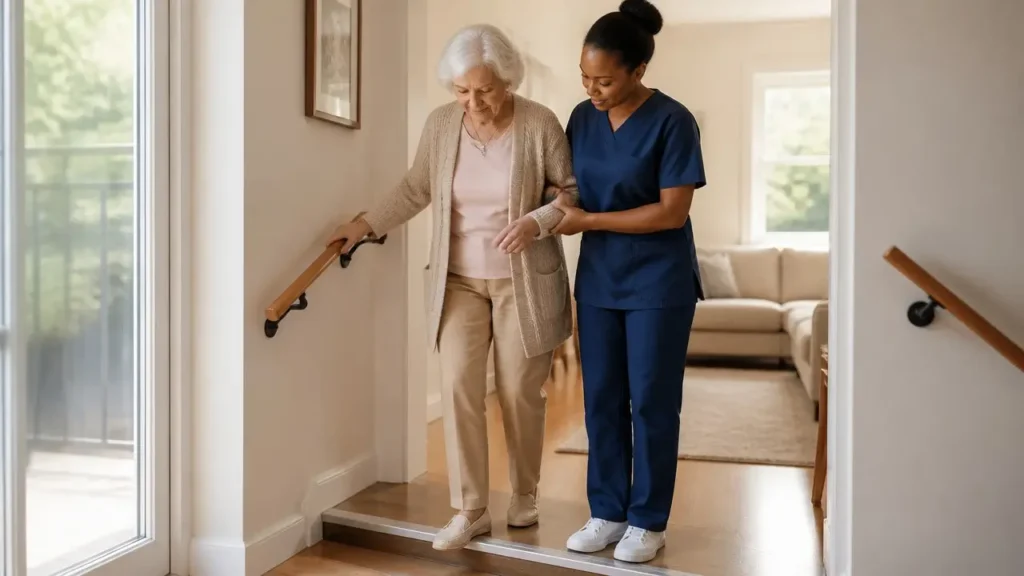
Handrails help a person control balance. Edge guards help stop a cane tip, walker wheel, or wheelchair wheel from slipping off an exposed side. Raised lips help only when they are placed where a boundary is needed and not where feet or wheels must cross cleanly. Mixing those jobs up is how a well-meant upgrade turns into a new hazard. For the larger home-safety picture, start with the mobility and transfers master guide.
Why This Matters
When someone loses balance near a stair, ramp, or landing edge, there are only a few ways the environment can help.
A handrail gives them something secure to hold. A guard or edge barrier keeps them from stepping or rolling off an exposed side. A small curb or raised edge can keep mobility equipment from drifting over the edge of a ramp. Each feature matters most at the moment someone is tired, distracted, dizzy, misjudges depth, or catches a foot on a transition.
That is why this topic belongs in transfer safety, not just home improvement. These details affect:
- getting in and out of the house
- moving on ramps and porch landings
- handling stair entries
- backing up with a walker
- judging edges in low light
A few basics matter here: handrails should be graspable, secure, and continuous. Stairs and ramps are safest when support exists on both sides where needed. Open edges need barriers, not just good intentions. And abrupt level changes bigger than a small threshold should be ramped instead of left as a sharp lip. Those ideas connect directly with ramp slope planning, ramp surface choices, and non-slip surfaces for ramps and thresholds.
Key Factors That Change the Decision
The first question is who is using the space.
A healthy adult carrying groceries needs something different from a person using a walker, cane, or wheelchair. Someone with vision loss or poor depth perception needs clearer edge definition than someone with strong vision and good balance. A family with both older adults and children may also need to think about climbability and sharp corners, not just adult grip support.
The second question is whether the main risk is balance loss or edge drop-off.
If the main risk is a person losing balance while walking, the priority is usually a secure handrail. If the main risk is a wheel or foot leaving the side of a ramp or landing, the priority is edge protection or a side curb. On an exposed porch, balcony, or raised landing, a guard is doing a different job than the handrail.
The third question is whether the safety feature will interfere with normal movement.
A raised lip along the open side of a ramp may help keep wheels from slipping off. A raised lip across a doorway or transfer path may catch toes, cane tips, walkers, and wheelchair casters. The same piece of material can help in one spot and create falls in another.
The fourth question is how visible the route is.
Even a strong handrail does not solve poor contrast, shadowed step edges, or confusing landings. If the person struggles with depth perception or low vision, combine rail and edge work with landings, railings, and visual markers for depth perception and high-contrast lighting cues for mobility.
How to Use, Choose, or Set It Up Safely
For stairs, start with the rail.
A safer stair handrail is:
- firmly anchored
- easy to grasp
- set at a practical height for the person using it
- continuous along the run
- extended enough to help at the top and bottom
In public-access design, handrails are commonly kept in the 34- to 38-inch range and continuous through the full stair or ramp run. In homes, the exact number matters less than whether the rail is comfortable to grip, solid under load, and present where the person actually needs it. Decorative rails that are too bulky, too sharp, or too interrupted to grasp well are a poor trade.
For ramps, think beyond the rail. A ramp is safer when it has:
- a surface with reliable traction
- enough width for the device being used
- a level landing where the person can pause and reset
- hand support where needed
- side protection if there is an exposed edge
That side protection may be an edge guard, curb, or barrier. The key is that it should help stop a wheel from drifting off without becoming a trip edge in the main travel line. If the route is steep, narrow, or exposed, the whole setup should be reviewed together rather than patched one piece at a time. That is where best threshold ramp choices and the broader ramp setup guide are useful.
Raised lips need the most caution.
Use them only where a small barrier is truly needed, such as:
- the open side of a ramp
- a shower or water-containment edge planned around wheelchair access
- a threshold design that has already accounted for foot and wheel clearance
Do not add a lip casually across a walking path just because it seems like a way to "keep things in." Across a doorway, bathroom entry, or transfer path, a lip may:
- catch a shuffling foot
- stop a walker wheel
- trip someone backing up
- make wheelchair approach harder
Corner guards and edge protectors belong in a different category. They are useful for cushioning sharp furniture corners, wall edges, and collision points in narrow halls. They are good secondary protection, especially where someone turns with a walker or bumps into furniture. But they are not a substitute for a missing handrail, a slippery ramp, or an exposed landing edge.
Common Mistakes and Red Flags
One common mistake is mistaking any horizontal bar for a handrail.
A towel bar, decorative trim rail, or loose wall grab point is not the same thing as a true support rail. If it rotates, flexes, or sits too far from where the person needs it, it should not be trusted for balance.
Another mistake is solving a drop-off problem with only a handrail. Handrails guide people. They do not stop wheels or cane tips from slipping off the side of a ramp. If the edge is exposed, you often need both guidance and edge protection.
Raised lips are often misused too. Families add them because they sound protective, but in the wrong place they create the very trip they were supposed to prevent. Be especially careful with lips at:
- porch entries
- bathroom doors
- landing transitions
- the top and bottom of short ramps
Other red flags include:
- a rail that moves when pulled
- only one usable rail on a stair used by an unsteady person
- exposed landing edges with no side protection
- clutter, rugs, or curled flooring near the edge
- poor lighting at the top or bottom step
- a route that forces a walker or wheelchair within inches of a drop
If someone has already caught a toe, scraped a wheel, or started hugging the wall instead of using the intended route, treat that as useful evidence that the setup is wrong.
When to Get More Help
Bring in more help when the route includes more than a simple rail swap.
That includes:
- building or modifying a ramp
- protecting an exposed side with a real drop
- combining walking and wheeled traffic on the same route
- repeated near-falls on stairs or landings
- low vision, depth-perception problems, or cognitive changes that make edge judgment unreliable
An OT or PT can show how the person actually approaches the route. A qualified contractor can make sure the rail, curb, or barrier is strong enough and placed where it will help instead of interfere.
Frequently Asked Questions
What is the difference between a handrail and an edge guard?
A handrail helps a person hold and control balance. An edge guard or curb helps stop feet, cane tips, walker wheels, or wheelchair wheels from slipping off an exposed edge.
Are raised lips always safer?
No. They help only in the right place. Across a main walking or transfer path, they can become a trip hazard.
Do I need both rails and edge protection on a ramp?
Sometimes yes. If the ramp has an exposed side, a handrail helps the person while edge protection helps the device stay on the ramp.
What makes a handrail safer?
It should be solid, easy to grasp, continuous where possible, and positioned where the person can actually reach it through the whole movement.
Can corner guards replace a handrail?
No. Corner guards help reduce injury from collisions with sharp edges. They do not provide balance support.
When should I worry about stair edges more than rails?
When the person misjudges depth, has low vision, shuffles, or catches toes at the front of steps. In that case, contrast, lighting, and tread condition matter as much as the rail.
Who should review a complex setup?
A therapist can assess how the person moves through the space, and a qualified installer can make sure the rail, guard, or curb is secure and placed correctly.
If the route includes ramps, compare ramp slope safety with surface and side-guard choices. If the problem is really step visibility, depth-perception markers and railings and high-contrast mobility lighting are often the missing pieces. For indoor traction problems near these edges, review non-slip ramp and threshold surfaces.