
As an affiliate, we may earn a commission from qualifying purchases. We get commissions for purchases made through links on this website from Amazon and other third parties.
The best walker for a senior is usually not the fanciest one. It is the one the person can control safely every day. That is why the real question is often 2-wheel versus 4-wheel, not simply “Which walker is best?” A 2-wheel walker is slower and more controlled. A 4-wheel rollator is faster, easier to push, and often more comfortable on outings, but it also asks more from the person. If you want the broader mobility picture first, start with the main mobility and transfers guide.
This roundup is built around that decision. Most of the picks here are 2-wheel walkers because that is still the safer category for many seniors who need strong control and simple handling. The 4-wheel option is included because some people have clearly outgrown the stop-and-lift feel of a standard walker and need the seat and speed of a rollator instead. Before you buy, it helps to read 2-wheel vs. 4-wheel walkers: stability, speed, and use cases and rollator vs. standard walker: which is safer.
Quick Picks
- Best Overall 2-Wheel Walker: Drive Medical Two-Button Folding Walker with Wheels for the best balance of control, strength, and daily usefulness.
- Budget Pick: Medline Lightweight Two-Button Folding Walker for a simple low-cost walker that still handles real daily use well.
- Best for Tight Spaces and Travel: Vive Mobility Lightweight Narrow Walker for narrow doorways, car loading, and smaller living spaces.
- Best Bariatric 2-Wheel Walker: Medline Heavy-Duty Bariatric Folding Walker for higher capacity and extra width without losing the control of a standard walker.
- Best 4-Wheel Option if a Rollator Fits Better: Drive Medical Rollator Walker with Seat for seniors who need more flow and more rest breaks than a 2-wheel walker can give.
Best Overall 2-Wheel Walker
Budget Pick
Best for Tight Spaces and Travel
Best Bariatric 2-Wheel Walker
Best 4-Wheel Option if a Rollator Fits Better
Comparison Table
| Product | Best For | Key Strength | Main Tradeoff |
|---|---|---|---|
| Drive Medical Two-Button Folding Walker with Wheels | Most seniors who need strong control and steady support | Reliable 2-wheel control, 350 lb capacity, and smooth everyday use | Less convenient than a rollator for longer outings or frequent rest breaks |
| Medline Lightweight Two-Button Folding Walker | Lower-cost daily home use | Very light frame, simple folding, and steady familiar handling | Lower feature ceiling and less refined fit than stronger top pick |
| Vive Mobility Lightweight Narrow Walker | Tight homes, travel, and car storage | Narrow frame, fast fold, and very easy transport | Smaller wheels and compact build make it less ideal for rough outdoor use |
| Medline Heavy-Duty Bariatric Folding Walker | Larger users who still need 2-wheel control | 500 lb capacity, extra width, and steady high-support feel | Wider frame can be harder indoors and heavier-duty support can feel bulky |
| Drive Medical Rollator Walker with Seat | Seniors ready for a 4-wheel option with seat and speed | Easier forward roll, built-in seat, and better long-outing comfort | Requires better brake control and usually less built-in stability than a 2-wheel walker |
Quick Decision Guide
- Pick the Drive 2-wheel walker if the person still needs the extra control and stop-start pacing of a standard walker.
- Pick the Medline lightweight walker if the budget matters and the goal is a dependable simple walker for daily home movement.
- Pick the Vive narrow walker if doorways, closets, travel, or trunk loading are the main stress points.
- Pick the Medline bariatric walker if the person needs higher capacity and more frame width without moving to a 4-wheel rollator.
- Pick the Drive rollator only if the person can safely manage a faster walker and truly needs the seat and easier rolling motion.
- If the main question is outdoor comfort or errands rather than maximum control, compare rollators for seniors indoor and outdoor next.
- If posture is the real issue, compare upright walkers for posture support before switching categories blindly.
Best Walkers for Seniors: 2-Wheel and 4-Wheel Picks
1 / 5 Type Two-wheel folding walker with rear glide caps Capacity About 350 lb Wheels 5 in front wheels Frame Adjustable aluminum frame with two-button fold Use Case Daily home walking, early recovery, and seniors who need more control than a rollator gives Tradeoff No built-in seat and slower movement than a 4-wheel rollatorDrive Medical Two-Button Folding Walker with Wheels
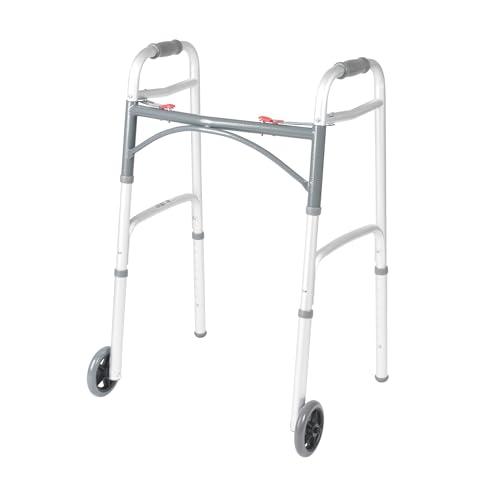
The Drive 2-wheel walker is the best overall pick because it sits right in the sweet spot for most seniors who need real support. It is sturdy, familiar, and easier to control than a 4-wheel rollator, but the front wheels still smooth out the forward motion enough that the person does not have to pick the whole frame up with every step. That balance is exactly why 2-wheel walkers remain the safest everyday choice for so many people.
It also handles ordinary home life well. The two-button fold is simple, the height adjustment is straightforward, and the frame is strong enough to feel reassuring without becoming too heavy to use. For hallway walking, room-to-room movement, recovery after surgery, or any situation where the person needs to move carefully and deliberately, this is the kind of walker that earns trust quickly.
Its main tradeoff is convenience, not safety. A 2-wheel walker is slower, offers no seat, and is not the best tool for long errands or waiting in lines. But if the person still needs strong control and a clear stop-start rhythm, that is exactly why this kind of walker works.
Why It Helps:
- It gives more control and less runaway feeling than a 4-wheel rollator.
- Front wheels reduce drag without taking away the steady feel many seniors need.
- Strong frame and familiar design make it easy to trust in daily use.
What To Keep In Mind:
- It is a support-first walker, not the best choice for long-distance outings.
- If the person is ready for more speed and a seat, a rollator may be the next category instead.
2 / 5 Type Two-wheel folding walker Weight About 6 lb frame Capacity About 300 lb Wheels 5 in front wheels Fit Height adjusts roughly from 32 to 38 in Tradeoff Basic design and lighter build give fewer refinements than stronger top pickMedline Lightweight Two-Button Folding Walker

The Medline lightweight walker is the budget pick because it handles the core 2-wheel job well without adding cost or complexity. It is very light, easy to fold, and simple to keep in the car or around the house. For a senior who needs steady daily support and does not want a device that feels heavy or overbuilt, that simplicity is a big plus.
This is also a strong fit for temporary use. It works well after surgery, during recovery, or for someone who needs dependable balance help without stepping into a more expensive category. The hand grips are comfortable enough, the wheels glide well on common floors, and the walker folds flat for transport. It does not try to be anything fancy, which is part of why it works.
Its limit is that it stays basic. If the person needs a narrower frame, higher capacity, or more refined folding and fit, another model is better. But for low-cost support that still behaves like a proper walker, this is the smart value pick.
Why It Helps:
- Extremely light weight makes transport and storage easier for many homes.
- Familiar handling keeps the learning curve low for first-time walker users.
- It works well for recovery periods and straightforward home use.
What To Keep In Mind:
- The lighter, simpler build means fewer refinements than the stronger top pick.
- It is a better home and short-appointment walker than an all-day errand device.
3 / 5 Type Narrow two-wheel folding walker Weight About 9.5 lb Capacity About 300 lb Wheels 6 in all-terrain style wheels Fit Height-adjustable grips and narrow frame for tighter spaces Travel One-step fold with fold-lock Tradeoff Smaller compact design is best for homes and travel, not rougher outdoor mileageVive Mobility Lightweight Narrow Walker

The Vive narrow walker is the pick for tight spaces because it addresses one of the most frustrating walker problems directly: a standard frame that feels too wide and awkward for the home. Narrow hallways, bathroom doors, apartment corners, and car trunks all punish a bulky walker. This one is built to move through those spaces with less trouble, and that changes daily life more than many people expect.
It is also an excellent travel choice. The one-step fold and lighter frame make it much easier to keep in the car, take to appointments, or stash in a closet. For seniors who need a walker only outside the house or who move between different care settings, that portability can matter just as much as the support itself. It is one of the few 2-wheel walkers that feels genuinely designed with storage and transport in mind.
The tradeoff is surface confidence. While the wheels are helpful, this is still a compact walker with a lighter feel, not a heavy-duty outdoor machine. It is strongest when the home is tight or travel is constant, not when the person spends all day on uneven sidewalks.
Why It Helps:
- Narrow design reduces the everyday frustration of doorways and cramped home layouts.
- Lighter travel-friendly folding makes appointments and car use easier.
- It keeps the controlled feel of a 2-wheel walker while fixing common bulk problems.
What To Keep In Mind:
- Compact design is not the same as rugged outdoor stability.
- Fit still matters, especially for shorter users and more confined handle ranges.
4 / 5 Type Extra-wide bariatric two-wheel folding walker Capacity About 500 lb Frame Heavy-duty wider frame with 20.5 in between grips Wheels 5 in front wheels Weight About 11 lb Tradeoff Extra width and heavier-duty feel can be harder in tighter homesMedline Heavy-Duty Bariatric Folding Walker

The Medline bariatric walker is the clear choice when the person needs higher capacity but still benefits from the controlled feel of a 2-wheel walker. Many higher-capacity users get pushed too quickly toward rollators or oversized equipment even when what they really need is a steadier standard walker with better weight support. This model fills that gap well.
It feels solid, roomy, and better matched to larger bodies than standard narrow frames. The extra width allows a more natural walking position, and the higher weight capacity brings peace of mind that many basic walkers cannot. For a larger senior who still needs a simple and stable walking aid at home, this kind of frame can feel much safer than trying to squeeze into a standard walker.
The cost of that support is space. The walker is wider, and that matters in bathrooms, narrow halls, and smaller bedrooms. But if the main priority is getting safe 2-wheel support for a bigger body, this is the right place to look.
Why It Helps:
- Higher capacity and wider frame provide real support without switching to a faster 4-wheel category.
- It preserves the control and pacing of a standard walker for larger users.
- Extra width can make walking feel more natural instead of cramped.
What To Keep In Mind:
- Wider frames are more demanding in tight homes and narrow doorways.
- It is support-focused, not a nimble errand walker or seat-based outing tool.
5 / 5 Type Four-wheel rollator with seat Capacity About 350 lb Wheels About 7.5 in wheels Comfort Padded seat, backrest, and under-seat pouch Use Case Seniors ready for easier rolling and rest breaks on outings Tradeoff Requires better brake control and less raw support than a 2-wheel walkerDrive Medical Rollator Walker with Seat

The Drive rollator is included here because sometimes the right answer really is four wheels. If the person has outgrown the stop-and-lift feel of a standard walker, tires quickly, or needs a built-in seat for errands and appointments, a rollator can make walking feel much more natural. This model is a good example of when that change makes sense: smoother forward motion, a usable seat, and more comfort outside the house.
That does not make it automatically better. A rollator rolls more freely, which means the person has to manage speed and braking more actively. For seniors who are already unsteady, impulsive, or poor at controlling momentum, that can be a problem. But when the person has enough control and simply needs easier movement plus a place to sit, the rollator category often feels like a major quality-of-life upgrade.
This particular model is a good “4-wheel if needed” choice because it is not overly fancy and it covers the basics well. It is a reminder that moving from 2-wheel to 4-wheel is less about status and more about control versus convenience.
Why It Helps:
- Forward rolling is easier and less tiring than with a 2-wheel walker.
- The built-in seat changes what longer outings feel like for many seniors.
- It can be the right next step when a standard walker feels too slow or too limiting.
What To Keep In Mind:
- More freedom of movement also means more responsibility for braking and control.
- A rollator is not the safer answer for everyone just because it feels smoother.
How to Choose Between a 2-Wheel and 4-Wheel Walker
Start with control. A 2-wheel walker is usually better when the person needs steady pacing, careful turns, and a more deliberate rhythm. A 4-wheel rollator is usually better when the person can manage brakes well, wants easier movement, and needs a seat during longer outings. That is the simplest version of the decision, and it is often the most important one.
Then look at the home. Small bathrooms, narrow hallways, and tight bedroom turns often favor a 2-wheel walker or a narrower frame. More open spaces and frequent outings may favor a rollator. That is why training with a walker in tight spaces and indoor vs. outdoor walker width and turning matter so much.
Fit matters too. Handle height, frame width, and even the person's stride pattern all change how safe the walker feels. Before buying, check proper walker height and posture so the decision is not based on a misadjusted walker that feels wrong only because it was never set correctly.
Think about use time. For simple home walking, a 2-wheel walker is often enough. For longer medical visits, waiting rooms, and errands, the convenience of a rollator seat becomes more important. If the senior mainly needs a seated backup rather than a faster rolling walker, lightweight transport chairs and wheelchairs for seniors manual and transport may also be worth comparing.
Finally, be honest about progression. Some seniors will move from a 2-wheel walker to a rollator. Others should not. The goal is not to “upgrade.” It is to choose the device that best matches the person's control, endurance, and home environment right now.
Common Mistakes When Choosing a Walker
- Assuming a 4-wheel rollator is automatically better because it looks more modern.
- Keeping a 2-wheel walker when the person is clearly being limited more by fatigue than by control.
- Ignoring doorway width, bathroom turns, and home layout.
- Choosing a walker before checking handle height and frame fit.
- Buying the strongest-looking frame instead of the one the person can actually manage safely.
The biggest mistake is choosing by image instead of behavior. The best walker is not the “highest level” one. It is the one the senior can steer, stop, turn, and trust without constant fear or extra caregiver correction.
Frequently Asked Questions About Walkers for Seniors
Is a 2-wheel walker safer than a 4-wheel rollator?
Often yes, especially for seniors who need slower movement and more control. A rollator can be easier to push, but it also moves more freely and requires better brake control.
Who should use a 4-wheel rollator instead of a 2-wheel walker?
A rollator is usually a better fit for someone who can manage the brakes safely, tires easily, and benefits from a built-in seat during outings or longer walks.
Are 2-wheel walkers only for indoor use?
No. Many work fine outdoors on common surfaces, especially on smoother paths. They are just slower and more controlled than rollators.
What if the walker feels too wide for the house?
That often points to the wrong frame width or the wrong category. Narrower walkers or compact designs may work better in tight homes.
Are bariatric walkers different from regular walkers?
Yes. They are usually wider, stronger, and higher-capacity. That extra support can be very helpful, but it also takes more room.
When should a senior move from a walker to a wheelchair or transport chair?
That usually happens when endurance drops so much that even a rollator is no longer practical for outings, or when safe walking is no longer consistent enough for the current level of support.
Can walker accessories make a 2-wheel walker more useful?
Yes. Bags and trays can improve daily independence a lot, as long as they fit properly and do not overload the frame.
If the person is still deciding between walker styles, compare rollators for indoor and outdoor use and upright walkers for posture support. If the bigger issue is endurance rather than walking control, compare lightweight transport chairs and wheelchairs for seniors manual and transport next.