As an affiliate, we may earn a commission from qualifying purchases. We get commissions for purchases made through links on this website from Amazon and other third parties.
External cues help some people with Parkinson's walk better because they give the brain a clear outside signal to follow when automatic movement has become less reliable. That signal might be a line on the floor, a laser target, a spoken count, a metronome beat, or even a short marching rhythm. The important point is not the gadget itself. It is whether the cue helps the person start, step, and turn more safely.
This matters because gait changes in Parkinson's are often not just slow walking. They can include freezing, short shuffling steps, hesitation at doorways, trouble turning, and loss of rhythm. External cueing can sometimes cut through that. But it only helps when it is matched to the right person, the right trigger, and the right setup. If you want the wider mobility picture first, start with the mobility and transfers master guide.
Why This Condition Changes the Task
Parkinson's can reduce the smooth, automatic timing that normally keeps walking going. The person may know where they want to go, but their step length, rhythm, and movement start can still break down.
This often shows up as:
- small shuffling steps
- slowed or hesitant starts
- freezing in doorways or narrow spaces
- difficulty turning
- reduced arm swing
- steps that get quicker and shorter under stress
External cues can help because they shift movement from "automatic" toward "attention-driven." In simple terms, the cue gives the person something specific to step to, step over, count to, or follow.
That is why cues often help most in situations where the gait gets disrupted by:
- turning
- approaching obstacles
- narrow spaces
- divided attention
- rushing
- anxiety
If freezing is already showing up during transfers, the more specific companion page is Parkinson's freezing during transfers.
Safest Setup Before You Start
Cueing works better when the environment is simple and the person is not fighting three other problems at once.
Reduce clutter and visual overload
Some cues help because they are clear. They stop helping when they are lost in visual noise.
Before practicing or using a cue:
- clear rugs and floor clutter
- improve lighting
- reduce distractions
- avoid carrying items in the hands
- choose a calmer route first
This is especially important in hallways, bathrooms, and near beds. If the space is hard to see at night, also fix night transfer lighting and visibility before judging whether the cue itself works.
Make sure the walking setup is sound
External cueing cannot rescue a poor basic setup.
Check:
- footwear with good grip
- walking aid height and stability
- brakes and frame condition on a rollator
- whether the person is in a medication "on" or "off" period
- whether fatigue or dizziness is already present
If the person uses a cane, walker, or rollator, review mobility aids: walkers, canes, and rollators and proper walker height and posture so the cue is not layered onto a bad device fit.
Know the trigger before choosing the cue
Different cues often help different problems.
Examples:
- a tape line or laser target may help with start hesitation
- a metronome may help with rhythm
- counting out loud may help with focus
- a wider turning strategy may help more than any cue if the main trigger is pivoting
If you do not know the trigger yet, start tracking:
- where freezing or slowing happens
- what the person was doing
- what time of day it was
- whether multitasking was involved
Technique Adjustments That Matter
The best cue is usually the one that is simple, repeatable, and easy to use under stress.
Visual cues: step to it or step over it
Visual cues work by giving the next step a visible target.
Common examples include:
- a strip of tape across a doorway
- a line on the floor in a problem area
- a laser line projected in front of the feet
- a mental image of stepping over a stick or crack
These cues often help when the person freezes at thresholds, corners, or narrow spaces. Instead of trying to "just walk," they aim the next step toward or over something specific.
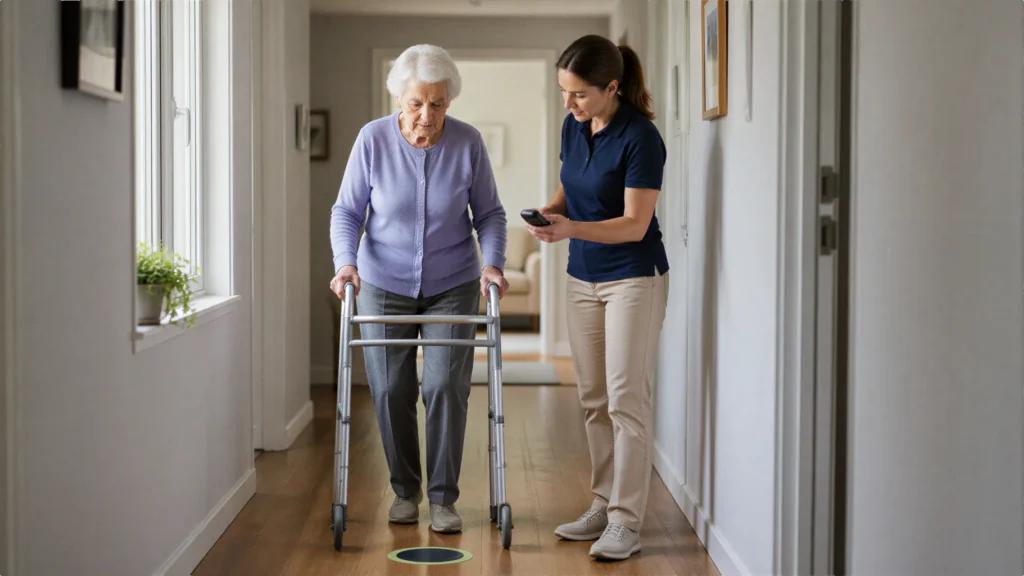
This is one reason some people do well with laser-equipped mobility aids or walkers, but the device is not the full answer. The cue still has to appear in the right place and at the right time.
Auditory cues: count, beat, or hum
Auditory cues can provide a simple rhythm when walking loses its internal timing.
Examples include:
- counting "one, two, three, step"
- saying "left, right, left, right"
- using a metronome
- humming or stepping to a familiar beat
- marching in place first, then moving forward
These cues often help people who respond to rhythm more than visual target lines. Some do best with a steady beat. Others do better when the rhythm is spoken by themselves or a caregiver.
Attentional cues: one simple focus at a time
Attentional strategies can be more powerful than people expect.
Good examples:
- "big step"
- "heel first"
- "head up"
- "walk to the chair"
- "stand tall, then step"
The goal is to give the brain one clear job, not three. Long instructions usually fail under pressure.
Turning needs its own strategy
Turning is one of the biggest gait trouble spots in Parkinson's.
Helpful changes include:
- avoid sharp pivots
- take wider turns
- use more small steps instead of one fast turn
- keep feet apart enough to shift weight
- pause and reset posture before turning if needed
This is where cueing and movement strategy overlap. A laser line may help the first step, but a U-turn may still be the real fix. For the movement side of that, see turning, pivoting, and backing up safely.
Use cues before the freeze becomes severe
Many people wait until they are fully stuck. That is often too late for the easiest restart.
Teach the person to notice early signs:
- step length getting smaller
- feet getting quicker and more choppy
- leaning forward
- approaching a doorway with tension
- feeling rushed
When those show up, it helps to:
- stop
- reset posture
- use the chosen cue
- restart with one deliberate step
Practice the cue when calm, not only in crisis
Cueing works best when it has already been practiced.
That means:
- try one cue at a time
- test it in the places where freezing happens
- repeat it during a calm practice session
- keep the cue method consistent
Changing from laser, to counting, to pushing harder, to talking fast in the same moment usually creates confusion instead of flow.
Keep the caregiver from becoming extra noise
Caregivers often help most by doing less.
The most useful caregiver actions are usually:
- give one agreed cue
- reduce distractions
- stay calm
- avoid pulling
- allow a pause before restarting
If gait trouble is crossing into transfer trouble, go back to the Parkinson's transfer freezing guide rather than using walking cues alone.
Red Flags and Common Errors
The biggest mistake is assuming that one cue should work in every situation.
Other common errors include:
- setting the metronome too fast
- giving too many verbal instructions
- trying a cue in a cluttered space first
- using a laser or tape line without changing the turn strategy
- letting the person talk, carry items, and cue at the same time
- treating a cue as a permanent fix instead of one tool
Red flags that should change the plan:
- freezing episodes are increasing
- cues that used to work no longer help
- the person is falling or nearly falling
- auditory cues increase anxiety instead of reducing it
- the person cannot divide attention enough to use the cue safely
- caregiver prompting is becoming more physical than verbal
If walking with a device is part of the challenge, also review training with a walker in doorways and tight spaces and indoor vs. outdoor walkers.
When to Get Clinical Help
External cueing is often most effective when a Parkinson's-aware PT or OT helps match the cue to the actual gait problem.
Get clinical help when:
- the person is falling
- freezing is frequent
- cues are no longer reliable
- medication timing seems tied to the gait breakdown
- turning, transfers, or doorways are becoming unsafe
- the person is unsure which cue to use and when
Clinical help matters because the wrong cue, wrong pace, or wrong device setup can make gait feel even more confusing.
Frequently Asked Questions
Do laser cues really help people with Parkinson's walk better?
They can help some people, especially when visual target stepping reduces hesitation or freezing. They are not universal, but they can be useful when matched well to the trigger.
Is a metronome better than a laser?
Not automatically. Some people respond better to rhythm, while others respond better to a visible step target. The best cue is the one that reliably helps the person's actual problem.
Can taping a line on the floor help?
Yes, sometimes. A visible line at a doorway or turn can act as a simple step-over target and may reduce freezing in that spot.
Should a caregiver talk continuously while the person walks?
Usually no. Too much talking can add to cognitive load. One short, agreed cue is often more useful than ongoing commentary.
Why does cueing work better some days than others?
Medication timing, anxiety, fatigue, sleep, attention, and environment all affect how well cues work on a given day.
Can people use music instead of a metronome?
Sometimes. A simple, steady rhythm or familiar beat may help some people more than a strict metronome sound.
What if the cue only works at home?
That is still useful. Many people need different cue plans for home, clinics, crowds, and outdoor environments.
When should cueing be taught by a therapist instead of trial and error?
Therapist help is best when freezing is frequent, falls are happening, or the person has several triggers and no clear strategy is working consistently.
To build a fuller Parkinson's safety plan, pair this guide with Parkinson's freezing during transfers, mobility aids overview, walker training in tight spaces, and the mobility and transfer care plan template. For the broader framework, return to the mobility and transfers master guide.