As an affiliate, we may earn a commission from qualifying purchases. We get commissions for purchases made through links on this website from Amazon and other third parties.
Poor depth perception makes ordinary stairs feel unreliable fast.
The problem is not always weak legs. Sometimes the real issue is that the person cannot judge where the first step starts, where the last step ends, or how far away a landing, rail, curb, or threshold really is. That uncertainty leads to hesitation, missteps, and dangerous grabbing at the wrong moment. For the bigger mobility picture, start with the mobility and transfers master guide.
Why This Matters
Depth-perception trouble can come from low vision, dementia-related visual processing changes, stroke, one-eye vision loss, or general age-related decline.
When distance is hard to judge, people often:
- pause too late at the edge of a step
- overstep or understep a stair
- miss the rail on the first grab
- mistake dark patterns or shadows for holes
- lose confidence on landings, ramps, and flooring changes
That is why safer stair and path design is not just about making things brighter. It is about making the route easier to read.
Three features matter most:
- a place to stop and reset
- a railing the hand can actually grip
- visual markers that make edges easier to see without adding confusion
If the main risk is already on stairs, pair this article with how to use a walker on stairs safely and handrails, edge guards, and raised lip safety.
Key Factors That Change the Decision
The right setup depends on what is making the environment hard to read.
Lighting quality
Poor lighting makes every other problem worse.
A dim stairwell, shadowy landing, or hallway with glare can make edges disappear. Even a well-marked step is harder to judge when the light creates confusing shadows or bright reflections.
The safest goal is even light, not a harsh spotlight. First and last steps need to be easy to see. So do transitions at a landing, doorway, or threshold. If nighttime movement is part of the problem, the next guide is lighting and night transfer safety.
Rail visibility and grip
A rail only helps if the person can find it and hold it securely.
For many homes, the most usable rail is:
- on both sides of the stairs if possible
- continuous through the stair run and across the landing
- easy to power-grip rather than pinch
- mounted at a reachable height
A graspable round or oval profile usually works better than a wide decorative shape. For many people, a diameter around 1.25 to 1.5 inches is easier to hold than a bulky rail. About 1.5 inches of wall clearance also helps the hand wrap around the rail cleanly.
Landings and pause points
A landing gives the person a chance to stop, regain balance, and reset visual orientation.
That matters more than many families realize. People with poor depth perception often do worse when they have to keep moving while also figuring out where the next change in level begins. A landing breaks that demand into smaller pieces.
At a landing, the person can:
- stop and get both feet stable
- re-find the rail
- look for the next run of steps
- turn in smaller, safer steps instead of rushing
Visual contrast
Contrast can help, but sloppy contrast can make things worse.
A clear edge marker on the first and last steps often helps with step detection. So can contrast between the rail and the wall. But busy patterns, checkerboard flooring, or decorative stripes in the wrong place can create false depth cues that make the surface harder to trust.
That is especially important for people with low vision or dementia-related visual processing trouble. If the broader low-vision setup still needs work, see high-contrast markers and lighting for mobility.
How to Use, Choose, or Set It Up Safely
The safest approach is to make the route simple to read and simple to recover on.
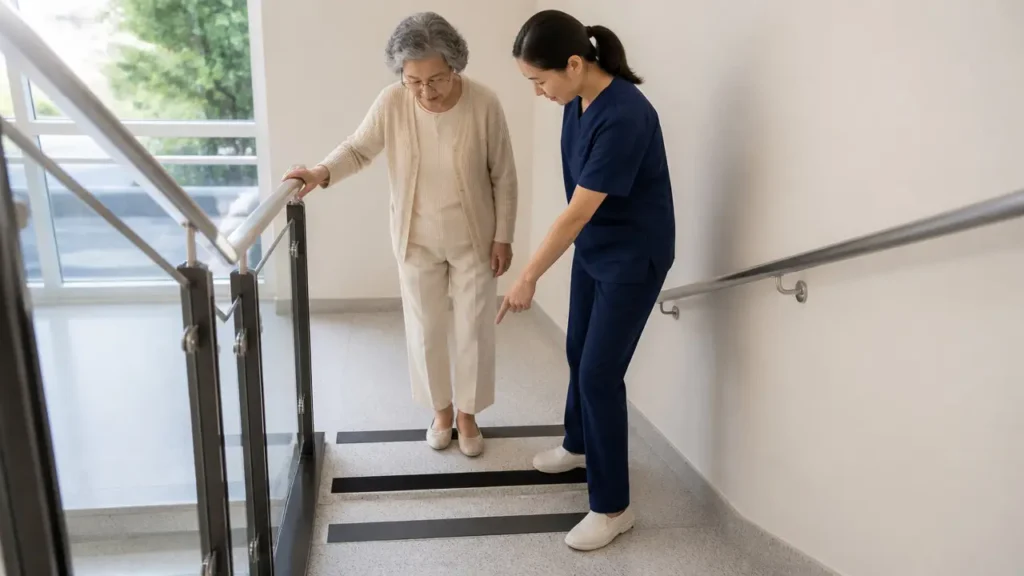
1. Make the first and last step obvious
The first and last steps are often the hardest to judge.
Use a high-contrast strip or edge marker that clearly shows where the foot should land. Keep it consistent. If every step edge is marked, mark them the same way. If only the first and last are marked, make that pattern obvious and intentional.
What matters most is clean contrast, not decoration. Avoid glossy tape or busy patterns that shimmer, reflect, or look like a change in height when there is none.
2. Install railings on both sides when possible
Two rails are better than one for many older adults.
People often have one side that is stronger, less painful, or easier to coordinate. Railings on both sides let them choose the better hand and give more options at a landing or turn.
A safer rail setup is:
- continuous along the full stair run
- present at both sides if space allows
- extended so the hand can find support before the first step and after the last
- sturdy enough to take real body weight
If the stairs only have one rail and the person already “wall walks” with the other hand, that is a strong sign the setup needs improvement.
3. Keep the railing easy to see
A rail that blends into the wall is slower to find.
Use color contrast between the rail and the background, especially if the wall and rail are similar tones. The hand should be able to locate the rail without searching.
This is also useful on hallways and ramps, not only on stairs. If hallway guidance is part of the issue, see low-vision markers and lighting for mobility.
4. Treat the landing like part of the safety system
Do not leave the landing dark, cluttered, or visually confusing.
A safer landing should have:
- enough room to stop without backing into clutter
- a clearly visible rail continuation or re-start
- a level, non-glare surface
- no baskets, stools, plants, or décor in the turn area
If the person uses a walker or cane, the landing also needs enough space for controlled turning. That is where training with a walker in tight spaces becomes relevant.
5. Use lighting that shows edges without glare
Soft, even lighting usually works better than strong overhead glare.
Night-lights, step lighting, or motion-activated lights can help, but they should not throw harsh shadows across step edges. Matte finishes on nearby surfaces can reduce glare better than shiny paint or polished metal.
The goal is for the person to see the step edge, the landing, and the rail at the same time.
6. Remove visual noise
Many homes accidentally create false cues.
Examples include:
- patterned rugs near the stairs
- striped carpet that hides the step edge
- glossy flooring that reflects windows
- décor or furniture that narrows the landing
- dark objects placed right where the foot needs to go
For some people, especially those with dementia, a bold pattern can look like a hole, a drop, or an object in the path. In that case, simpler is safer.
7. Check the route at the time it is actually used
A stairway that looks fine at noon may be unsafe at 9 p.m.
Test the route under real conditions:
- nighttime bathroom trips
- overcast mornings
- when the hall light is off
- when someone is carrying glasses, cane, or walker
That is usually when the real weak points show up.
Common Mistakes and Red Flags
The most common mistake is fixing only one piece of the problem.
A family adds brighter tape but leaves the rail hard to grip. Or they install a good rail but leave the landing dim and cluttered. Safety improves most when the route works as a system.
Other common mistakes include:
- using decorative railings that are hard to grasp
- relying on one short rail where two continuous rails are needed
- placing objects on the landing
- using shiny, reflective edge markers
- choosing patterns that look like steps, holes, or shadows
- skipping the first and last step when adding contrast
- assuming the problem is balance alone when it is really visual processing
Red flags that the current setup is not working:
- the person reaches for the wall instead of the rail
- they pause for a long time before the first step
- they shuffle or tap for the step edge with the foot
- they miss the landing turn or overstep it
- they avoid the stairs at night even when they can do them during the day
- they say the floor, stairs, or tub “looks deeper” than it really is
If that last one shows up in more than one place, the issue may be broader than the stairs alone. Compare hotel room mobility checks and night transfer lighting safety if unfamiliar spaces or nighttime routes are also causing trouble.
When to Get More Help
Home fixes are not always enough.
Bring in more help when:
- the person has had falls or near-falls on stairs
- depth-perception trouble is getting worse
- there is dementia, stroke, or major low vision in the picture
- the person cannot find or hold the rail reliably
- step-edge markings and better light still do not solve the problem
A PT, OT, low-vision specialist, or aging-in-place contractor can often see problems that families miss. Sometimes the safer answer is more than tape and bulbs. It may be a second rail, a better landing layout, a stair-free route, or a different mobility plan altogether.
If someone has already gotten stuck or fallen midway on the stairs, the next practical read is emergency plans for stairs.
Frequently Asked Questions
Why are the first and last steps so important?
They are usually the hardest to judge visually, so that is where many missteps start.
Is one railing enough?
Sometimes, but two rails are often safer because people may have one stronger side and need support at turns or landings.
What makes a handrail easier to grip?
A graspable round or oval shape with enough wall clearance usually works better than a wide decorative railing.
Do contrast strips really help?
Yes, when they clearly mark the step edge without glare or confusing patterns.
Can patterned flooring make depth perception worse?
Yes. Busy patterns can look like level changes, holes, or objects in the path.
Should the landing be lit too, or just the stairs?
The landing needs lighting too. It is a pause and turning point, not just an in-between space.
When is it time for professional help?
If the person keeps hesitating, grabbing at walls, misjudging steps, or falling despite basic home fixes, bring in professional help.
If the problem shows up mostly on stairs, pair this article with how to use a walker on stairs safely, handrails and edge safety, and emergency stair planning. If the problem is broader than the stairway, the next reads are high-contrast markers and lighting for mobility and lighting and night transfer safety.