As an affiliate, we may earn a commission from qualifying purchases. We get commissions for purchases made through links on this website from Amazon and other third parties.
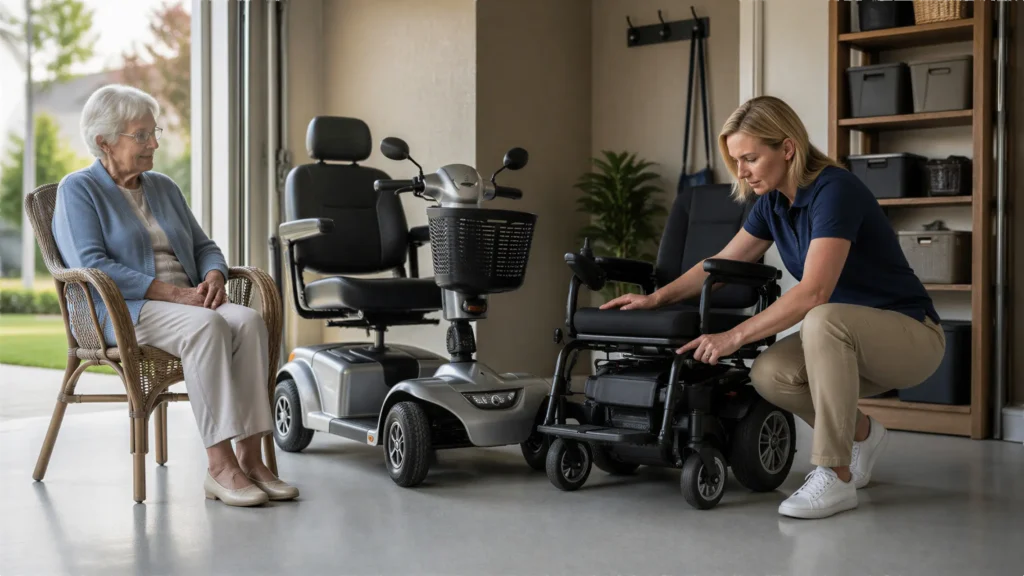
Choosing between a mobility scooter and a power wheelchair is really about how the person moves, sits, transfers, and lives day to day. Both are powered devices, but they solve different problems. One is often better for someone who can transfer on and off, sit upright with less support, and wants longer outdoor range. The other is often better for someone who needs tighter indoor control, more seating support, and a device that works as their main seat for much of the day.
This is why the wrong choice shows up fast. A scooter can look easier and less intimidating, but it may be a poor fit for someone with weak hands, poor upper-body balance and control, or hard transfers. A power wheelchair can solve those problems, but it is usually heavier, bulkier to transport, and more demanding on storage and charging setup. If you want the broader home-safety picture first, start with the mobility and transfers master guide.
What Each Option Means
A mobility scooter is usually built around a seat, handlebars, and a tiller, which is the front steering column. The rider gets on and off the seat, places their feet on a platform, and drives with hand controls.
Scooters often make sense when the person:
- can get on and off the seat with reasonable safety
- can sit upright without a lot of trunk support
- can steer with both hands or one reliable hand on a tiller
- wants more outdoor range for errands, stores, or longer paved trips
- values portability in smaller travel models
A power wheelchair is different. It is built more like a chair first and a vehicle second. Many people stay in it for much longer stretches, and the device is usually controlled with a joystick or other adapted control. The seating and base are often more supportive and more customizable.
Power wheelchairs often make sense when the person:
- needs the chair to be their main seated position for much of the day
- has limited balance, upper-body control, or endurance
- needs tighter turning indoors
- has difficulty with a tiller but can use a joystick or alternate control
- needs more positioning, pressure relief, or leg support
If you are still deciding whether the person even needs a powered device, step back and compare the simpler options in mobility aids: walkers, canes, and rollators. The right answer is not always more motorized equipment.
The Biggest Safety and Use Differences
The biggest safety difference is not speed. It is what the person has to do before and after driving.
Transfers are often easier to manage with a power wheelchair
A scooter usually asks more of the person before the ride starts. The person has to approach the seat, turn, sit safely, place both feet, and manage the tiller. For many people, that is fine. For others, that transfer becomes the hardest part of the whole device.
That is why scooters can become a problem for people who:
- need hands for support during sit-to-stand
- struggle to pivot safely
- fatigue quickly while turning and sitting
- cannot manage the foot platform setup easily
A power wheelchair can reduce some of that effort because the chair is already the seating system. The person often has more stable armrests, a fixed foot platform, and seating that matches their posture more closely. If transfers are already shaky, review bed-to-chair transfer safety before assuming a scooter will be easier.
Power wheelchairs usually win indoors
This is where many people are surprised. A scooter can look smaller, but it often needs a wider turning arc than a power wheelchair. That matters in bathrooms, apartment hallways, kitchens, elevators, and older homes.
In practical home use:
- scooters often need more room to turn
- scooters can be awkward in tight indoor corners
- power wheelchairs often handle indoor turns more cleanly
- power wheelchairs are usually easier for close positioning at tables, sinks, and beds
If doorway fit is still an open question, pair this article with wheelchair size and fit measurements and your narrowest doorway checks.
Scooters often win on outdoor comfort and some travel use cases
Many scooters are designed around outdoor errands, paved pathways, and longer community trips. They often offer more legroom, a more open seated feel, and easier front-basket carrying. Some travel scooters also break down into smaller pieces.
That does not mean every scooter is more practical overall. It means scooters can be a strong match for someone who still transfers fairly well, wants to get around stores or parks, and does not need the power chair's tighter turning and seating support.
Seating support is usually better in a power wheelchair
This is one of the most important differences for real daily use.
Power wheelchairs are often better when the person needs:
- longer sitting time
- better pressure management
- more trunk support
- steadier foot support
- more consistent posture throughout the day
Scooters usually offer less positioning support. That is fine if the rider mainly needs transportation and can sit well on a simpler seat. It becomes a problem if posture is already poor, sliding happens, or the person needs a more supportive setup. If comfort and pressure are already concerns, read wheelchair cushions for pressure relief.
Who Each Option Fits Best
The right match is less about age and more about function.
A mobility scooter often fits best when:
- the person can transfer on and off safely most of the time
- trunk balance is fairly good
- hand control for a tiller is realistic
- the main goal is errands, community trips, or outdoor paved use
- the person does not need complex seating support
- a travel or disassembly option matters
Scooters are often chosen by people who walk some at home but cannot manage longer distances in stores, airports, museums, or outdoor settings. In that situation, the scooter works like a community mobility tool rather than an all-day seating system.
This can also make a scooter a good rental choice for short-term travel or recovery. If that is the real use case, see how mobility equipment rental works near you.
A power wheelchair often fits best when:
- the person needs powered mobility inside the home
- transfers are harder and need stable setup
- endurance is low and longer sitting is common
- balance or upper-body control is limited
- the person needs a tighter turning radius
- joystick control is more manageable than scooter steering
- the device may become the main daily mobility system
Power wheelchairs are also more likely to fit when the person has progressive weakness or a condition where managing a scooter seat and tiller will probably get harder, not easier.
Signs the current device category may be wrong
You usually see the mismatch in daily routines:
Signs a scooter may be the wrong fit:
- the person struggles every time they transfer on or off
- they slide, lean, or look unstable in the seat
- indoor turning feels like a constant battle
- hand weakness makes tiller steering tiring or unsafe
- caregivers spend too much time lining up and rescuing poor setup
Signs a power wheelchair may be more than the person needs:
- it is used only for short outings
- storage and transport are a constant problem
- the person transfers easily and sits well with less support
- the home use case is limited and mostly outdoor community access
Some people also compare a scooter with a regular wheelchair when the real question is simpler. If the choice is between a chair the person can push on their own and a caregiver-pushed chair, review manual wheelchair vs. transport chair before jumping to powered options.
Setup and Home Considerations
This section is where families either confirm the choice or realize they were solving the wrong problem.
Measure the home before choosing
Do not buy by showroom feel alone. Check:
- narrowest doorways
- bathroom approach space
- kitchen turn space
- bedroom clearance beside the bed
- threshold height
- ramp or curb access
- storage location
- charging access
A scooter that feels comfortable in a large store may be miserable in a tight condo hallway. A power wheelchair that works beautifully indoors may become frustrating if the family has no workable transport plan for appointments.
Think about how the device gets in and out of the car
Travel scooters often have a real advantage here. Some can come apart into smaller pieces or fold more easily than a power wheelchair. Most power wheelchairs are heavier and harder to transport without a lift or van setup.
So the practical question is not just "Can this device ride well?" It is also:
- Who loads it?
- How often?
- Into what vehicle?
- With what lifting limit?
If the device has to go in and out of a trunk every few days, that transport burden may matter as much as the driving experience. Review loading mobility devices into vans and cars before deciding.
Charging and storage are part of safety
Both device types need a realistic charging routine. That means:
- a dry, accessible charging space
- enough room to plug in without creating trip hazards
- a habit for charging before batteries run too low
- a plan for weather, garage temperatures, and long periods of non-use
Heavy power equipment parked in the wrong place can create a blocking hazard in the home. A scooter stored where it cannot be safely mounted can create a daily transfer problem before the ride even begins.
Caregiver workload matters
A device should reduce caregiver strain, not move it from one step to another.
A scooter may reduce walking strain for the person but still leave the caregiver managing:
- repeated stand-pivot transfers
- upper-body support while getting on and off
- frequent repositioning indoors
- breakdown and loading for transport
A power wheelchair may reduce some of that transfer and positioning stress, but it may increase:
- vehicle transport complexity
- home storage demands
- setup costs
- maintenance needs
If caregivers are already getting hurt during transfers, the solution may involve more than the riding device itself. It may also include full-body lift options and sling systems.
Common Mistakes
The first mistake is choosing by appearance. Many families lean toward a scooter because it looks simpler and less intimidating. That can be reasonable, but it is a bad reason on its own. Function beats appearance every time.
The next mistake is focusing on riding and forgetting transferring. People compare turning radius, top speed, and baskets, then overlook the fact that the person still has to get on and off safely.
Other common mistakes include:
- picking a scooter without checking if the person can use a tiller comfortably
- picking a power wheelchair without a transport plan
- assuming outdoor range matters more than indoor turning
- ignoring posture and seating support needs
- failing to measure the home
- choosing around one good day instead of the person's usual weaker day
- assuming insurance or Medicare coverage will be identical between devices
Coverage is its own separate project. Device rules, documentation, home-use standards, and supplier requirements can change what is realistic. If coverage is part of your decision, read Medicare and DME coverage basics for mobility devices in the U.S. before you order anything.
Which One Is Usually Safer?
Neither one is automatically safer. The safer choice is the one that fits the person's transfers, posture, control method, and home layout.
A scooter is often safer when the person can transfer on and off well, steer reliably, and mainly needs powered mobility for longer community trips.
A power wheelchair is often safer when the person needs tighter indoor control, more supportive seating, harder transfers, or daily use that goes beyond simple transportation.
Problems start when a device is doing the wrong job. A scooter becomes risky when it keeps demanding transfers or upper-body control the person no longer has. A power wheelchair becomes a poor choice when it creates transport and storage problems that the household cannot actually manage.
Frequently Asked Questions
Is a mobility scooter easier to use than a power wheelchair?
Not always. A scooter may feel simpler for someone who transfers well and can steer a tiller easily, but a power wheelchair is often easier for people who need better seating support and tighter indoor control.
Which one usually turns better inside the home?
A power wheelchair often turns better indoors, especially in bathrooms, kitchens, and tight hallways. Scooters often need more room to turn.
Is a scooter better for outdoor errands?
Often yes, especially if the person can get on and off safely and wants longer paved community trips. That is one of the most common reasons people choose scooters.
Which one is better if transfers are hard?
A power wheelchair is often the better fit when transfers are already difficult, because scooters usually demand more from the person during mounting, positioning, and dismounting.
Can Medicare cover both scooters and power wheelchairs?
Coverage may be available for either category when medical rules are met, but the approval process depends on documented need, home-use criteria, and supplier requirements. The category that gets approved is not always the one the family expects.
Are scooters easier to transport in a car?
Many travel scooters are easier to transport because some can break down into smaller pieces. Most power wheelchairs are heavier and harder to move without a lift or accessible vehicle setup.
Should I choose based on speed or range?
No. Turning space, transfer safety, seating support, and control method matter more than top speed for most home users.
Can someone rent one before deciding?
Yes, sometimes. Rental availability depends on your area and the device type, but short-term rental can be a useful way to test real-life fit before buying.
If the next step is checking fit, use wheelchair measurement basics and home loading and transport planning. If you are still weighing broader device categories, compare manual and transport chairs, mobility equipment rental options, and Medicare coverage basics.