As an affiliate, we may earn a commission from qualifying purchases. We get commissions for purchases made through links on this website from Amazon and other third parties.
Portable ramps solve a simple problem badly when the wrong type is chosen. A ramp that is too steep, too narrow, too short, or too unstable can turn a doorway or curb into a fall, tip, or exhausting push. That is why the first question is not "Which ramp is easiest to carry?" It is "What height change, device width, and real-life setup are we working with?"
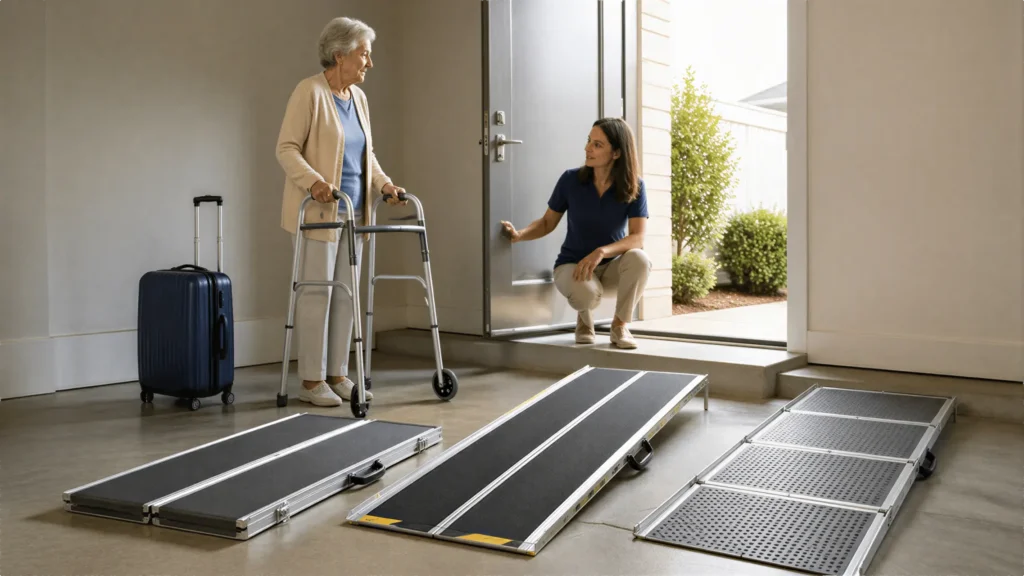
Suitcase ramps, telescoping ramps, and modular ramps all have a place, but they do different jobs. Some are better for quick temporary use. Some work better for travel. Some are much safer for repeated home use. For the bigger picture around thresholds and traction, pair this article with ramps and thresholds overview and non-slip surfaces for ramps and thresholds.
If a portable ramp is only one part of the access plan, the mobility and transfers master guide connects the bigger transfer and equipment picture.
Why This Matters
Ramp choice changes:
- how steep the climb feels
- how stable the device stays during use
- whether a caregiver can push safely
- whether the person can control the descent
- whether the ramp actually fits the doorway, car, or curb
The ADA and Access Board guidance for accessible routes is a useful frame: surfaces should be stable, firm, slip-resistant, and changes in level should not create surprise hazards. Even when you are using a portable ramp at home, those same ideas matter.
Key Factors That Change the Decision
Before you choose a ramp type, measure and check:
- the vertical rise you need to cover
- the narrowest clear width
- the total device width, including wheels and hand clearance
- whether the person pushes the chair on their own, walks, or is being pushed
- whether the ramp is for one doorway, one curb, or repeated travel
The biggest mistake is guessing the rise. Measure first. If the home setup is changing, compare ramp slope basics for home safety and wheelchair fit measurements before you buy anything.
How to Use, Choose, or Set It Up Safely
Suitcase ramps
Suitcase ramps are usually solid panels that fold in half. They often make sense when:
- you need one portable ramp for a small step or threshold
- you want a surface under all wheels, not two narrow tracks
- the person has a walker, transport chair, or wheelchair
They are usually easier to place than track ramps, but they can get heavy fast as length increases. Wider panel ramps also need more storage room in a car or closet.
Best fit:
- short rises
- repeated doorway use
- people who need a full walking or rolling surface
Less ideal when:
- the ramp would need to be very long
- one caregiver has to carry it often
Telescoping ramps
Telescoping ramps are usually two tracks that extend in length. They often work best when:
- storage space is tight
- the main need is loading a wheelchair or scooter into a vehicle
- the device wheels line up well with the tracks
They are lighter to store, but they demand more precision. If the wheel placement is off, or the person has a narrow-base walker or small front casters, the setup can become unsafe quickly.
Best fit:
- vehicle loading
- repeated use with the same chair or scooter
- users who do not need a full walking surface
Less ideal when:
- the person walks with a cane or walker
- different devices will use the same ramp
Modular ramps
Modular ramps are the least "grab and go" but often the safest for repeated use. They usually make sense when:
- the same rise is used daily
- a doorway or small porch needs a more stable answer
- frequent assembly and disassembly is not the goal
Modular systems are usually sturdier and easier to match to a specific rise and landing need, but they are far less convenient for travel.
Best fit:
- repeated home access
- bigger rises
- situations where stability matters more than portability
Less ideal when:
- the plan is short-term travel
- you need something to keep in the trunk
Common Mistakes and Red Flags
The ramp itself is often not the real problem. The setup is.
Common mistakes:
- choosing by folded size instead of safe slope
- forgetting total device width and hand clearance
- using a track ramp with equipment that does not line up well
- skipping checks on lip stability at the top and bottom
- using a ramp on wet, icy, or dirty surfaces without traction planning
- treating a temporary ramp like a permanent fix
Red flags that should change the plan:
- the caregiver has to strain hard to push up or hold back on descent
- the chair tips or feels twitchy at the lip
- the person drifts near the edge
- the walker or cane user does not have enough stable surface
- the rise requires such a short ramp that the slope feels more like a launch than a ramp
If curb and threshold technique is the sticking point, read negotiating curbs and ramps with a walker or rollator and ramps and thresholds overview.
When to Get More Help
Bring in a clinician, accessibility contractor, or equipment supplier when:
- the person is tipping, sliding, or fatiguing on the ramp
- the rise is used every day and temporary ramps keep failing
- there is not enough landing or turning space at the top or bottom
- you are mixing scooters, walkers, and wheelchairs in the same entry
- the home may need a true modular or permanent access solution
This matters even more in tight entries where public restroom and tight space transfers or loading mobility devices into cars and vans are already difficult.
Frequently Asked Questions
Which portable ramp type is best for a walker user?
Usually a full-panel suitcase style is safer than narrow tracks because it gives the walker a full surface.
Are telescoping ramps good for wheelchairs?
They can be, especially for vehicle loading, but only when the wheel spacing matches the tracks well.
Is a modular ramp still considered portable?
Some modular systems can be moved, but they are usually better thought of as semi-permanent access solutions.
What is the biggest safety mistake with portable ramps?
Choosing a ramp that is too short for the rise, which creates a slope that is too steep and hard to control.
Can I use the same ramp for a wheelchair and a scooter?
Sometimes, but only if the width, wheel track, and weight capacity work for both devices.
Why do some portable ramps feel unstable at the doorway?
Because the lip is not sitting flat, the rise was measured wrong, or the surface below is uneven.
When is a portable ramp no longer the right answer?
When the same entrance is used every day and the temporary ramp still feels steep, unstable, or too hard for the person and caregiver to manage safely.
If the slope itself is unclear, continue with ramp slope calculator basics, ramps: choosing slope, side guards, and surface, and handrails, edge guards, and raised-lip safety. If the issue is transport rather than home entry, compare loading mobility devices into cars and vans and mobility equipment rental near you.