As an affiliate, we may earn a commission from qualifying purchases. We get commissions for purchases made through links on this website from Amazon and other third parties.
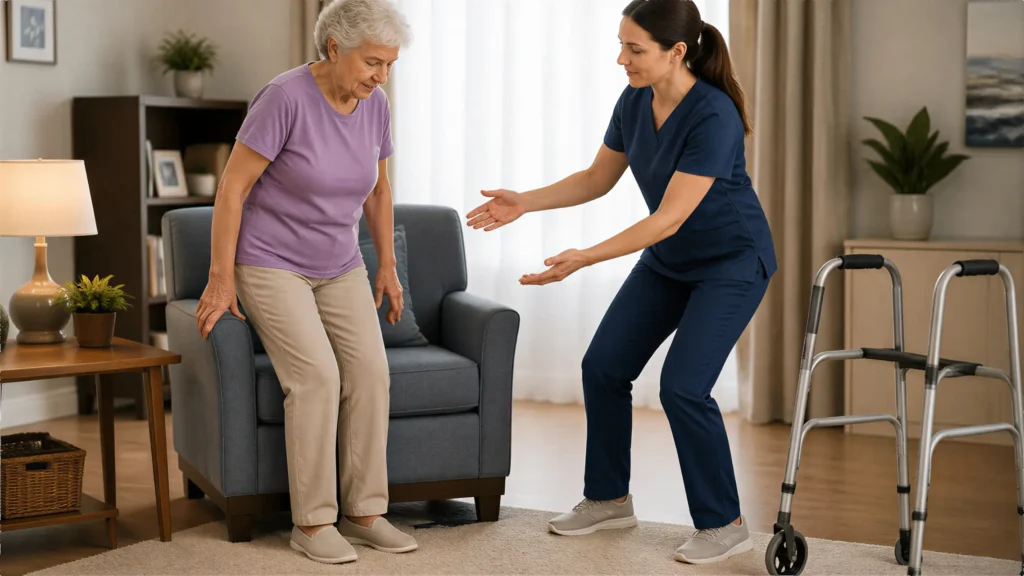
Proper body mechanics for transfers means using your body in a way that protects both you and the person you are helping. It is not about being strong enough to lift someone. It is about planning the move, staying balanced, keeping the person close, using your legs, and knowing when manual help is no longer safe.
Caregivers often get hurt because transfers happen many times a day. One rushed stand from the toilet may not seem like much. But repeated bending, twisting, catching, and pulling can strain the back, shoulders, wrists, and knees. The person being helped can also get hurt if the caregiver loses balance or grabs the wrong place.
Good body mechanics does not make every transfer safe. It makes safe transfers safer. If the person cannot bear weight, cannot follow cues, or needs to be lifted, equipment or more help may be needed. For the full transfer foundation, start with the mobility transfers master guide.
Quick Answer
Use a wide stance, keep the person close, bend at your knees and hips, keep your back neutral, and pivot your feet instead of twisting. Let the person do as much of the work as safely possible. If you are lifting instead of guiding, the transfer needs equipment, another helper, or a different plan.
Why This Matters
Transfers combine two moving bodies. The person may be weak, dizzy, afraid, confused, or in pain. The caregiver may be tired, rushed, or trying to help in a tight space. When either person loses balance, both can fall.
Body mechanics starts with balance. A wide base of support gives you more stability. Keeping your center of gravity close to the person reduces strain. Bending at the knees and hips lets your legs do more work. Turning your feet instead of twisting your spine protects your back.
Communication is part of body mechanics too. If the person moves before you are ready, grabs your neck, or sits too soon, your posture no longer matters. You need a shared plan before the movement starts.
The best transfer is not the one where the caregiver does the most. It is the one where the person does as much as safely possible, the caregiver guides instead of lifts, and equipment fills the gap when human strength is not enough.
Key Factors That Change the Decision
Start with the person's ability. Can they sit at the edge of the bed? Can they put both feet on the floor? Can they bear weight? Can they follow one-step cues? Can they push from the surface? If not, a manual stand-pivot transfer may be unsafe.
Check the environment. You need room for your feet, the person's feet, the wheelchair or chair, and the device. Clutter, rugs, cords, oxygen tubing, wet floors, and poor lighting all force awkward movement.
Check the surface height. A very low chair makes the person work harder to stand. A high bed can cause sliding. When surfaces are closer in height, transfers are usually easier.
Check your own body. If you are already in pain, exhausted, pregnant, recovering from injury, or much smaller than the person you are helping, the safe plan may need another caregiver or equipment.
Check the right tool. A gait belt, transfer board, slide sheet, sit-to-stand lift, or full-body lift can reduce strain when used correctly. If you are unsure which tool fits the task, review common transfer mistakes before trying harder.
Set Up Before You Touch
Prepare the transfer zone first. Lock wheelchair brakes. Move footrests. Clear the path. Put the chair close. Adjust bed height if possible. Make sure the person has shoes or non-slip footwear. Place the walker, cane, or grab bar where it should be.
Tell the person what will happen. Use short words: "Scoot forward. Feet flat. Push from the chair. Stand on three. Turn slowly. Feel the chair. Sit." The person should know their job before you place your hands.
Get close. Standing too far away makes you reach. Reaching pulls your back and shoulders out of alignment. Stand close enough that the person's weight stays near your center, but not so close that your feet block theirs.
Use a wide stance. Put your feet about shoulder-width apart, with one foot slightly ahead of the other if that helps. Keep your knees soft, not locked. This lets you shift weight instead of yanking.
Keep your back neutral. Neutral does not mean stiff. It means keeping the natural curve of your spine while bending at the knees and hips. Avoid rounding forward from the waist.
How to Move During the Transfer
Use a weight shift. Many transfers work better when you shift your weight from one foot to the other instead of lifting with your arms. For sit-to-stand, the person leans forward and pushes up while you guide the movement.
Keep elbows close. Reaching with straight arms puts more strain on your shoulders and back. Keep your arms close to your body when holding a gait belt or guiding the person.
Pivot your feet. Do not twist your spine while the person is moving. If the transfer turns toward a wheelchair or chair, move your feet in small steps so your hips, shoulders, and feet face the same direction.
Let the person use their own strength. They should push from the bed or chair arms if able. They should not hang around your neck or pull your shoulders. If they need a handhold, use a stable surface or safe device.
Lower with control. Sitting down is part of the transfer. Make sure the person feels the chair or bed behind their legs before lowering. They should reach back if safe and sit slowly. If they drop into the seat, the transfer may need a higher surface, more help, or a different method.
For a full example, use bed-to-chair transfer steps and sit-to-stand with a gait belt.
Where a Gait Belt Fits
A gait belt gives you a safer handhold when the person can help with the transfer. It should sit over clothing, fit snugly, and not press on wounds, tubes, painful ribs, or fragile areas.
Use the belt to guide and steady, not to lift the person off the chair. If most of the person's weight is in your hands, the transfer is too heavy for a gait belt alone.
An underhand grip can give better control and reduce hand strain. Stay close and move with the person. Do not jerk the belt. Do not use it as a handle to drag someone sideways.
If you need a belt refresher, read choosing and using a gait belt safely before the next transfer.
Common Mistakes and Red Flags
The first mistake is bending from the waist. This places strain through the low back. Bend your knees and hips instead, and bring yourself closer to the person's level.
The second mistake is twisting during the pivot. If your feet stay planted while your upper body turns, your spine takes the force. Move your feet.
The third mistake is pulling on arms. This can hurt the person's shoulders and throw both of you off balance. Ask the person to push from a stable surface instead.
The fourth mistake is catching a falling person at all costs. If a fall starts and you cannot safely stop it, guide the person down while protecting the head and spine as much as possible. Trying to hold them upright can injure both of you. Read what to do if a transfer starts to fail before this happens.
The fifth mistake is ignoring pain. Caregiver back pain is a warning sign. So is patient pain, fear, knee buckling, dizziness, or repeated near-falls. These are not things to push through.
When Equipment Is Safer Than Body Mechanics
Body mechanics has limits. If the person cannot bear weight, is unpredictable, has severe weakness, or needs repeated heavy transfers, equipment may be safer than manual help.
A transfer board may help when the person has good sitting balance and arm strength but cannot stand well. A slide sheet may help with repositioning in bed. A sit-to-stand lift may help when the person can bear some weight but needs strong support. A full-body lift may be needed when the person cannot assist safely.
Using equipment is not giving up. It can protect the caregiver, reduce fear for the person being moved, and make care more consistent. If you are considering a no-lift approach at home, read safe patient handling policies at home.
When to Get More Help
Ask a physical therapist or occupational therapist for training if you are new to transfers, if the person has changed, or if you are unsure how much help is safe. Hands-on correction matters. A small change in stance, chair angle, or cueing can make a big difference.
Get help quickly if the person has new weakness, recent surgery, a fracture, stroke symptoms, repeated falls, or cannot follow directions. Also get help if a caregiver is getting hurt. A transfer plan that injures the caregiver is not sustainable care.
If two caregivers are needed, use clear roles and a count. One person should lead the movement. Everyone should move at the same time. For more detail, use two-person assist guidance.
Frequently Asked Questions
What are proper body mechanics for transfers?
Use a wide stance, keep the person close, bend at your knees and hips, keep your back neutral, pivot your feet instead of twisting, and let the person help as much as safely possible.
Should caregivers lift with their back?
No. Caregivers should avoid bending and lifting from the back. Use your legs, weight shift, equipment, and the person's own effort. If the transfer still feels heavy, get more help.
Is a gait belt enough for every transfer?
No. A gait belt helps guide and steady someone who can participate. It is not enough when the person cannot bear weight, cannot follow cues, or needs to be lifted.
What should I do if my back hurts after transfers?
Stop treating pain as normal. Review the transfer setup, ask for training, and consider equipment or another helper. Ongoing pain means the current method is not working.
When should a transfer use a lift instead of manual help?
Use a lift when the person cannot safely bear weight, is unpredictable, needs heavy assistance, or transfers are injuring caregivers. A clinician or equipment provider can help choose the right lift and sling.
If your body mechanics fall apart in one specific room, fix the room too. Bathroom transfers may need shower transfer body mechanics. Heavy transfers may need a sit-to-stand lift or full-body lift. The safest technique is the one that matches the person, the caregiver, and the space.