
As an affiliate, we may earn a commission from qualifying purchases. We get commissions for purchases made through links on this website from Amazon and other third parties.
A transfer pole can make one hard moment much easier: getting up. That may be from bed, from a toilet, from a favorite chair, or from the edge of the tub. The right pole gives a stable handhold exactly where the person needs it. The wrong one feels awkward, loosens over time, or gets used for a transfer it was never meant to handle. If you want the broader transfer picture first, start with the main mobility and transfers guide.
These poles work best when the person can still do some of the standing work on their own. They reduce fear, improve leverage, and give caregivers less grabbing and pulling to do. They do not replace a lift when the person can no longer rise safely. If the real problem is heavier standing assistance rather than a simple handhold, compare portable standing aids and sit-to-stand lifts for home use before buying a pole that may not be enough.
Quick Picks
- Best Overall: Stander Wonder Pole with Curve Grab Bar for the best balance of handle reach, room-to-room usefulness, and daily confidence.
- Budget Pick: Stander Wonder Pole Lite for a simpler two-level handle design that still solves the main standing problem well.
- Premium Pick: HealthCraft uPole with Pivot Bar for the most refined pivot-bar support in tighter or more demanding setups.
- Best for Daily Bathroom and Bedside Use: Vive Floor to Ceiling Grab Bar for its broad U-shaped grip and easy grab angle.
Best Overall
Budget Pick
Premium Pick
Best for Daily Bathroom and Bedside Use
Comparison Table
| Product | Best For | Key Strength | Main Tradeoff |
|---|---|---|---|
| Stander Wonder Pole with Curve Grab Bar | Most bedside, toilet, and chair stand-assist needs | Rotating grab bar, broad home fit, and very practical everyday placement | Not for vaulted ceilings or true inside-shower use |
| Stander Wonder Pole Lite | Simpler lower-cost standing support | Two-level handle, easier price point, and very straightforward home setup | Less flexible hand positioning than the full Wonder Pole |
| HealthCraft uPole with Pivot Bar | Tighter spaces and more refined transfer angles | Pivot bar locks into multiple positions and feels more purpose-built | Heavier setup and a more involved install than lighter household poles |
| Vive Floor to Ceiling Grab Bar | Daily bathroom and bedside grabbing from multiple hand positions | U-shaped handle is easy to catch with one or two hands | Mixed long-term confidence means installation and ongoing checks matter |
Quick Decision Guide
- Pick the Wonder Pole if you want the safest all-around option for bed, toilet, chair, and wheelchair-adjacent support.
- Pick the Wonder Pole Lite if the budget matters and the main need is a basic stand-assist handle in one or two home locations.
- Pick the HealthCraft uPole if you want the most refined rotating support bar and do not mind a more serious install.
- Pick the Vive pole if a wide U-shaped grip feels easier for the person to catch from different heights and angles.
- If the person still needs more than a handhold to get upright, compare portable standing aids or gait belts before assuming a pole is enough.
- If the struggle is getting out of bed rather than standing once upright, compare bed rails and safer alternatives because a bedside rail may solve the first half of the move better.
Best Transfer Poles and Floor-to-Ceiling Posts: Top Picks
1 / 4 Type Tension-mounted floor-to-ceiling transfer pole Support Rotating grab bar locks every 45 degrees Fit Works with flat ceilings about 7 to 10 ft Capacity Supports about 300 lb Use Case Bedside, toilet, chair, and wheelchair transfer support Tradeoff Not compatible with vaulted ceilings or true inside-bathtub useStander Wonder Pole with Curve Grab Bar

The Stander Wonder Pole is the best overall pick because it solves the basic standing-assist problem in the widest range of home situations. The pole itself gives a stable vertical grip, while the curved bar rotates and locks at different angles so the person can catch it from the position that actually makes sense. That is what makes it so useful beside a bed, next to a toilet, near a favorite chair, or beside a wheelchair transfer point. It adapts to the room instead of forcing the person into one fixed grip.
That flexibility matters in real homes. Some people need the handle in front of them when rising. Others need it slightly off to the side so they can turn safely. The Wonder Pole covers those situations better than simpler fixed-handle designs. It is also easy to move compared with permanently mounted hardware, which is helpful when the family's needs change or when the best location becomes clear only after a few days of use.
Its limits are straightforward. It needs a flat ceiling, it should not be treated like an in-shower grab bar, and it still only supports a person who can do part of the standing work. But if you want one transfer pole that makes the most common home standing tasks feel safer and more predictable, this is the best-balanced choice.
Why It Helps:
- The rotating grab bar gives more natural hand positions than a fixed straight handle.
- It works well in several key home locations instead of being limited to one use.
- Tension mounting makes it easier to add real support without drilling into walls.
What To Keep In Mind:
- It is only as safe as the install, so setup and re-checking after settling matter.
- This is a stand-assist tool, not a substitute for a lift when the person cannot rise anymore.
2 / 4 Type Tension-mounted transfer pole with two-level handle Support Stand-assist handle at two heights Fit Works with flat ceilings about 7 to 9 ft 6 in Capacity Supports about 300 lb Use Case Bedside, bathroom, living room, and wheelchair-adjacent support Tradeoff Simpler handle layout gives less angle flexibility than the full Wonder PoleStander Wonder Pole Lite

The Wonder Pole Lite is the budget pick because it keeps the most important part of this category and strips out the extra complexity. Many homes do not need a rotating curved bar. They just need a solid pole with a well-placed handle that helps someone stand from bed, sit onto a toilet, or steady themselves before pivoting into a wheelchair. That is exactly what this model does well.
It is also a strong option for first-time families who are not sure whether a transfer pole will solve the problem. The pole is easier to understand, easier to place, and easier to live with than more elaborate designs. For someone who simply needs a dependable place to grab at one or two heights, the two-level handle is enough. It can make a big difference in confidence without turning the room into an equipment zone.
What you give up is reach and angle flexibility. If the person needs to catch the handle from the side or rotate around it through a transfer, the full Wonder Pole is better. But for lower-cost standing support in a bedroom or bathroom, this is the smart value choice.
Why It Helps:
- The simpler two-level handle solves the core stand-assist problem at a lower price.
- It can be moved and installed without permanent changes to the room.
- It works especially well where the person repeats the same motion every day.
What To Keep In Mind:
- The simpler handle layout is less forgiving in awkward transfer angles.
- It still depends on a flat ceiling and a careful install.
3 / 4 Type Tension-mounted floor-to-ceiling transfer pole with pivot bar Support Pivot bar locks into multiple positions around the pole Fit Designed for ceilings about 7 to 10 ft Capacity Supports about 300 lb Build Heavier-duty design with optional fixing holes Tradeoff Heavier setup and more involved assembly than lighter household polesHealthCraft uPole with Pivot Bar
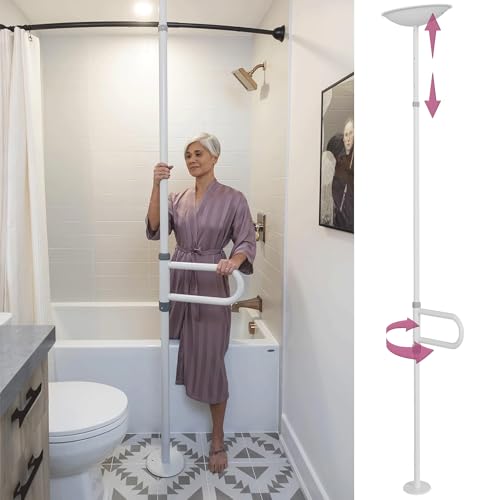
The HealthCraft uPole earns the premium spot because it feels more like a purpose-built support tool than a simple household stand-assist pole. The pivot bar locks into multiple positions, which gives the person a more controlled path from sitting to standing and from standing to turning. In tighter spaces such as small bathrooms or closely placed furniture, that kind of controlled handle movement can feel much safer than a simpler fixed grip.
This is the pole to look at when the home layout is awkward or the person needs a little more thoughtfulness in the handle angle. It can work well at the toilet, near a tub edge, or beside the bed where the approach is not perfectly straight. The heavier design also makes it appealing to families who want something that feels sturdier and more deliberate without committing to a permanent remodel.
Its tradeoff is effort. It is heavier, the assembly is more involved, and it benefits from a careful two-person setup instead of a quick solo install. If the family only needs a straightforward bedside grab point, it may be more pole than necessary. But for refined daily support in a harder home setup, it is one of the strongest options available.
Why It Helps:
- The pivot bar gives more controlled support in tighter or more awkward transfer angles.
- The build feels more serious and deliberate than many basic household poles.
- It can replace a lot of improvised grabbing in bathrooms and beside beds.
What To Keep In Mind:
- Setup is heavier and more involved than with simpler household poles.
- It is a premium option that only makes sense if the extra handle control is truly needed.
4 / 4 Type Tension-mounted floor-to-ceiling support pole Support Wide U-shaped handle for one- or two-hand grip Fit Works with flat ceilings about 7 ft 5 in to 9 ft Capacity Supports about 250 lb Use Case Bathroom, toilet, bedside, and living-room stand assist Tradeoff Long-term confidence depends heavily on careful installation and ongoing checksVive Floor to Ceiling Grab Bar

The Vive pole stands out because the U-shaped handle is easy to catch. That sounds small, but it matters. Some seniors do better with a broad loop they can grab with one hand, both hands, or from slightly different heights without hunting for one exact bar position. In a bathroom or beside the bed, that kind of easy catch can make a daily routine feel calmer and less forced.
It is also a useful shape in smaller spaces. The wide base and top give it a stable feel when installed well, and the pole does not demand much extra room around a toilet or tub entry point. For a person who repeats the same standing or sitting motion every day, the large handle can feel more intuitive than a slimmer bar. That is why it fits well as a daily-use choice.
The caution here is long-term trust. This is a pole to install carefully, test thoroughly, and check regularly rather than assume it will stay perfect forever without attention. Used that way, it can be very helpful. But if the family wants the strongest confidence and the most established support design, the Wonder Pole or HealthCraft options are safer bets.
Why It Helps:
- The broad U-shaped handle is easy to grab from different positions and heights.
- It fits well in bathroom and bedside spots where space is limited.
- The overall shape is intuitive for repeated daily standing and sitting motions.
What To Keep In Mind:
- Ongoing stability checks matter more here than with the stronger top picks.
- It is still limited to users who can do meaningful standing work on their own.
How to Choose a Transfer Pole or Floor-to-Ceiling Post
Start with the exact moment the person needs help. A transfer pole is best when the issue is leverage, not full-body support. If the person can still push through the legs and arms but needs one solid handhold to get upright, a pole can be an excellent solution. If the person needs to be boosted or held up most of the way, it is time to look at portable standing aids, gait belts, or sit-to-stand lifts instead.
Then look at the room. Ceiling height, floor type, and available space all matter. Most of these poles need a flat ceiling and careful tension mounting. Some work better near a bed. Some fit more naturally beside a toilet. Some need just enough rotation clearance for the handle to swing safely. If the main struggle happens during the move from bed to chair, keep bed-to-chair transfer steps in mind so the pole becomes part of a full safe path instead of a single grab point.
Handle design matters more than many families expect. A rotating bar is useful when the person approaches from different angles. A simpler two-level handle can be enough when the motion is always the same. A broad U-shaped grip can be easier for tired or less precise hands to catch. Think about the real move, not the marketing photo. If the person mainly needs bathroom support, what to do if a transfer starts to fail is also worth reviewing, because even a good pole does not fix rushed bathroom transfers.
Finally, be honest about progression. Transfer poles are great tools, but they are often a middle-stage solution. They work best before mobility loss becomes too heavy for one stable handhold. If the person is already hanging from furniture, collapsing backward, or needing two-person boosts, a pole alone is not enough.
Common Mistakes When Choosing Transfer Poles
- Buying a pole when the person really needs a standing aid or lift instead of just a handhold.
- Ignoring ceiling type and assuming any pole will work on any room surface.
- Choosing a handle style without thinking about the actual direction of the stand or pivot.
- Treating a bathroom transfer pole like a full inside-shower grab bar when it is not designed for that use.
- Installing the pole once and never checking tension or stability again.
The biggest mistake is asking a pole to do lifting work. A transfer pole helps a person stand with better leverage and balance. It does not replace leg strength, upper-body control, or safe setup. When families expect it to do more than that, disappointment and unsafe use follow quickly.
Frequently Asked Questions About Transfer Poles
What is a transfer pole used for?
A transfer pole gives a stable handhold to help someone sit, stand, or pivot more safely near a bed, toilet, chair, wheelchair, or tub edge.
Are floor-to-ceiling transfer poles safe?
Yes, when they are installed correctly on suitable flat ceiling and floor surfaces and checked for stability. They are only as safe as the setup and the fit for the person's real needs.
Can a transfer pole replace a grab bar in the bathroom?
Sometimes near a toilet or beside the tub, but not always. Many transfer poles are not meant to be installed inside the shower or used like a permanently mounted wet-area grab bar.
How do I know if a transfer pole is enough support?
It is enough when the person can still do most of the standing work and mainly needs leverage and balance. If they need to be lifted or heavily supported, a different device is safer.
Can a transfer pole help with getting out of bed?
Yes, many families use them that way. They are especially helpful when the person can sit at the bed edge but struggles with the final push to standing.
Do transfer poles damage the ceiling or floor?
They should not when used correctly on appropriate flat surfaces, but careful installation matters. Some homes and surfaces may need extra caution or a different solution.
What is the difference between a transfer pole and a portable standing aid?
A transfer pole is a fixed grab point. A portable standing aid is usually a freestanding device or assist frame that gives more structured support for rising from a seat.
If the person mainly needs help rising from one chair or toilet, compare portable standing aids. If the problem has progressed beyond a handhold and into true assisted lifting, move next to sit-to-stand lifts for home use or full-body lifts and slings before the transfers become unsafe.