As an affiliate, we may earn a commission from qualifying purchases. We get commissions for purchases made through links on this website from Amazon and other third parties.
Choosing between a rollator and a standard walker is not really a style decision. It is a safety decision about how much support the person needs and how much control they still have while moving. The safer device is not the one with more features. It is the one that matches the person's balance, strength, attention, and walking pattern.
That is why people get this wrong so often. A rollator feels smoother and less awkward, so it looks safer. A standard walker feels slower and more cumbersome, so it looks old-fashioned. But the real question is whether the person needs a balance aid or a weight-bearing aid. For the bigger mobility-aid picture, start with mobility aids: walkers, canes, and rollators and proper walker height and posture.
If this device choice sits inside a bigger transfer problem, the mobility and transfers master guide pulls the wider room-setup and equipment picture together.
What Each Option Means
What a standard walker is
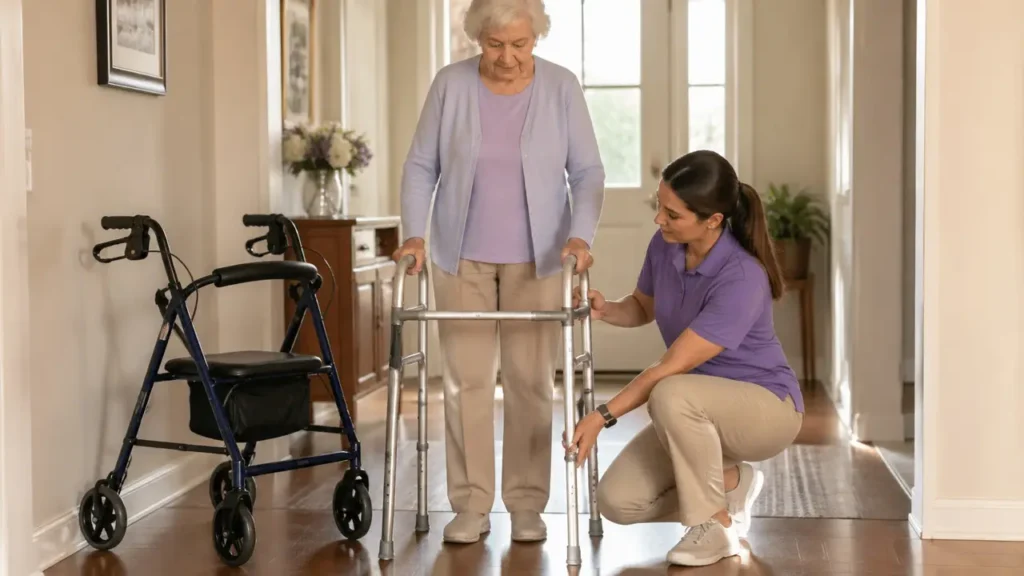
A standard walker has four legs with rubber tips and no wheels. It is usually the most stable walker because it stays planted when all four legs are on the floor. The tradeoff is that it has to be lifted or advanced in short steps during walking.
That makes a standard walker a better match for people who:
- need significant weight-bearing support
- are very unsteady
- cannot control a rolling device well
- are early in recovery and need maximum steadiness more than speed
What a rollator is
A rollator is a four-wheeled walker with hand brakes and usually a seat and storage area. It is designed to help with balance and endurance, not heavy weight-bearing. Because it rolls, it supports a more continuous and natural walking pattern than a standard walker.
That makes a rollator a better match for people who:
- need balance help but not major weight-bearing help
- tire easily and benefit from a seat
- walk longer distances in the community
- have the hand function and attention to manage brakes and movement
If you are still deciding whether wheels help or hurt, compare 2-wheel vs. 4-wheel walkers and proper walker height and posture.
The Biggest Safety and Use Differences
Stability versus movement
This is the core tradeoff.
A standard walker is safer when the person truly needs to lean on the device for support. Because it does not roll, it is less likely to move away unexpectedly.
A rollator is safer when the person can manage a moving device and benefits from smoother, less interrupted walking. It rolls easily, which helps some people and hurts others.
Weight-bearing needs
If the person needs the walker to take a meaningful amount of body weight, a standard walker is usually the safer choice. A rollator is not meant to be a substitute for that level of support.
This is where many bad matches happen. Someone is weak, in pain, or weaker after illness or bed rest, but the family chooses the rollator because it looks easier. Then the device rolls forward when the person actually needed something more planted.
Fatigue and endurance
This is where the rollator often wins. A standard walker can be exhausting because it slows the gait pattern and has to be picked up repeatedly. A rollator is easier to propel and often better for people who need rest breaks because of heart failure, lung disease, or general low endurance.
The seat can be useful, but only if the person can lock the brakes and sit safely. A seat is a benefit only for a person who can control it.
Attention, Judgment, and Brake Control
Rollators ask more of the person. The person has to:
- keep the device close without letting it run ahead
- manage hand brakes correctly
- remember to lock the brakes before sitting
- turn without rushing
That means a standard walker is often safer for someone with poor judgment, poor attention, impulsivity, or limited hand control.
Indoors versus outdoors
Standard walkers are often safer in very controlled indoor settings where maximum stability matters most. Rollators can be better outdoors for the right person because they move more continuously over longer distances and reduce fatigue.
There is a middle ground too. If a standard walker feels too slow but a rollator feels too loose, a two-wheel walker may fit better. See negotiating curbs and ramps with a walker or rollator and posture, step length, and base of support quick wins.
Who Each Option Fits Best
A standard walker often fits best when:
- the person needs substantial weight-bearing help
- balance is poor enough that a rolling device would get away from them
- the home walking distance is short
- transfers are the main concern
- recovery is early and steadiness matters more than speed
Typical examples include someone who is very weak after hospitalization, someone with major leg instability, or someone who has not yet shown safe control of a rolling walker.
A rollator often fits best when:
- the person mainly needs balance support
- they can keep a moving device under control
- fatigue is a major limit
- they walk farther in the community than inside the home
- they need a place to pause and rest
This is common for people who still walk fairly well but need support, especially when longer outdoor walking is the real bottleneck.
Special note on Parkinson's disease
A rollator can help some people with Parkinson's disease, especially for community walking, but it is not automatically safer just because the person freezes or falls. The person still needs enough attention, judgment, and device control. For freezing-specific strategies, compare Parkinson's gait external cues and laser metronome tricks and Parkinson's freezing transfers.
Setup and Home Considerations
Fit matters for both devices
Neither option is safe when it is the wrong height or used with poor posture. Set the handle height to the person, not to whoever last borrowed it, and watch how they actually turn, sit, and stand.
Use proper walker height and posture if you need the quick fitting rules.
Home layout matters
Before choosing, look at:
- doorway width
- bathroom clearance
- clutter
- thresholds and rugs
- storage and transport needs
A rollator takes up more turning space than many people expect. A standard walker can feel awkward in longer walking routes because it is slower and more tiring.
Maintenance matters
Safety depends on the device being in working order. Check:
- rubber tips on a standard walker
- brake function on a rollator
- loose screws or wobble
- seat stability on a rollator
If the person sits on a rollator, the brakes should be locked first and the device should be positioned securely. The seat is for resting, not for being pushed around like a wheelchair.
Common Mistakes
Common mistakes include:
- choosing the rollator because it looks more modern or convenient
- choosing the standard walker without considering how tiring it will be
- using a rollator for heavy weight-bearing support
- forgetting that a rollator can roll away
- sitting on a rollator without locking the brakes
- letting the device get too far ahead
- ignoring doorway, bathroom, and ramp problems at home
Another common mistake is treating this like a forever decision. The safest choice can change after rehab progress, illness, surgery, or a fall.
Frequently Asked Questions
Which is safer for someone who needs to lean heavily on the walker?
A standard walker is usually safer because it gives more planted support for weight-bearing.
Is a rollator safer because it has brakes and a seat?
Not by itself. Those features only help if the person can control the rolling device and use the brakes correctly.
Is a standard walker always best indoors?
Not always, but it is often safer indoors for people who need maximum stability and only walk short distances.
Can a rollator replace a standard walker after surgery?
Sometimes later in recovery, but not if the person still needs major weight-bearing support or cannot control the rollator well.
Can someone be pushed while sitting on a rollator seat?
No. A rollator is not a transport chair unless it was specifically designed for that function.
What if a standard walker is too tiring but a rollator feels too fast?
A two-wheel walker may be a better middle option, and a PT or OT can help match the device to the person's gait and balance.
What is the biggest red flag that the current walker is wrong?
If the person keeps losing control of the device, leaning unsafely on it, or avoiding walking because the device feels exhausting or unstable, the match is probably wrong.
If the current walker still feels like a compromise instead of a fit, continue with mobility aids: walkers, canes, and rollators, proper walker height and posture, and negotiating curbs and ramps with a walker or rollator.