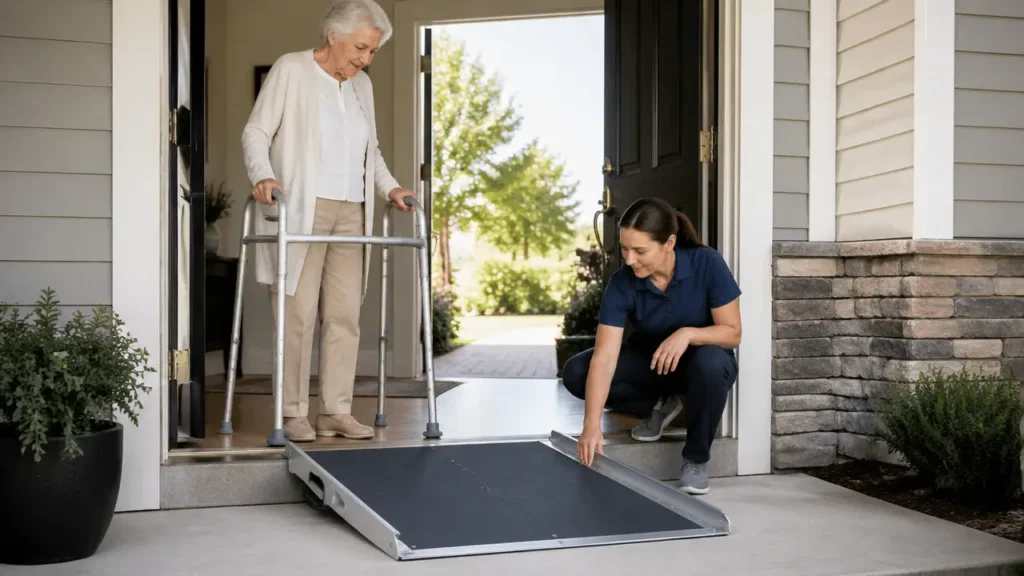
As an affiliate, we may earn a commission from qualifying purchases. We get commissions for purchases made through links on this website from Amazon and other third parties.
Ramps and thresholds are where small height changes become big mobility problems. A one-inch lip can stop a walker cold. A short steep ramp can feel manageable on a sunny day and unsafe in the rain. A doorway that looks simple may still fail because there is no room to turn, stop, or open the door safely at the top.
This guide is the big-picture starting point for ramps, thresholds, and entry access at home. It does not try to solve every doorway in one pass. It helps you sort the problem first: is this a small threshold issue, a true ramp issue, a traction issue, or a full entry-access problem that needs a more permanent solution? For the wider home-mobility picture, start with the mobility and transfers master guide.
What This Guide Covers
At home, ramps and thresholds affect:
- walkers
- canes
- rollators
- wheelchairs and transport chairs
- scooters
- caregiver-assisted transfers
The same height change can feel very different depending on:
- the device
- the person's strength and balance
- the weather
- the available landing space
- whether a caregiver has to push or assist
This guide helps you sort those variables so you can move to the right next article instead of guessing.
How to Assess Readiness and Risk
Before choosing any ramp or threshold fix, check:
- how high the rise actually is
- whether the person walks, rolls, or is pushed
- whether the person can control a stop and start on an incline
- whether wet weather changes the risk
- whether there is enough space at the top and bottom
Also look at the person, not just the doorway. Ramp and threshold problems get much worse when the person already has:
- poor balance
- low foot clearance
- weak grip
- one-sided weakness
- fear of falling
If the body mechanics are already shaky, compare posture, step length, and base of support quick wins and proper walker height and posture before assuming the structure alone is the problem.
Core Techniques and Equipment
Small threshold fixes
A small doorway lip may be solved with:
- a low threshold ramp
- a beveled transition
- a better surface treatment
The key is to keep the transition low enough that it does not create a new trip edge. For those decisions, go next to best threshold ramps for doorways.
Portable ramps
Portable ramps make sense when:
- the rise is modest
- the setup is temporary or travel-related
- storage matters
- the home does not need a permanent structure
The best choice depends on whether you need a full panel, two tracks, or a more stable modular system. Use portable ramp types for that comparison.
Full-use home ramps
When the same entrance is used every day, the important decisions are usually:
- slope
- landing size
- edge or side protection
- surface traction
- drainage and maintenance
Those choices are covered in ramp slope calculator basics and ramps: choosing slope, side guards, and surface.
Surface and wet-weather traction
Sometimes the ramp is structurally fine, but the surface is the real issue. In that case, the next reads are:
- non-slip surfaces for ramps and thresholds
- rain and wet floors traction and towel strategy
- ramp care and anti-slip renewal
Room-by-Room and Scenario-Based Safety
Front and back entries
These are often full-access problems, not just threshold problems. Watch for:
- door swing conflict
- narrow landings
- wet leaves or rain
- poor lighting
Garage and patio entries
These often combine uneven concrete, water, and a step or lip. A threshold ramp may fix the lip, but not the drainage or turning space.
Bathroom thresholds
Bathroom entries are different because water is often part of the problem. In those cases, traction and cleanup matter as much as the height change. Compare rain and wet floors strategy and public restroom and tight space transfers.
Curbs and outdoor path changes
Some households do not need a full ramp but do need a safe way to handle curbs, patio lips, or slight grade changes. Start with negotiating curbs and ramps with a walker or rollator and how to use stairs with a walker.
Common Failure Points and When to Get Help
Common failure points:
- the rise was measured wrong
- the ramp is too steep
- the landing is too short
- the surface gets slick in weather
- the side edge is not protected well enough
- the "temporary" fix became the permanent one
Get more help when:
- the person cannot control the incline safely
- the caregiver strains on the ramp
- the doorway needs turns, switchbacks, or a custom landing
- wet weather repeatedly changes the risk
- the home entry needs a more permanent access solution
At that point, a contractor, accessibility supplier, PT, or OT should look at the whole entry setup instead of one piece at a time.
Frequently Asked Questions
What is the difference between a threshold ramp and a full ramp?
A threshold ramp handles a small height change at a doorway. A full ramp handles a larger rise and usually needs more slope and landing planning.
How do I know if the problem is slope or traction?
If the person struggles even when dry, slope may be the problem. If the setup only feels unsafe in rain or with debris, traction and maintenance may be the bigger issue.
Are portable ramps good for everyday use?
Sometimes, but repeated daily use often exposes stability, storage, and weather limits.
What makes a ramp unsafe even if it technically fits?
Too much steepness, poor landing space, slick surfaces, weak edge protection, and caregiver strain all count as real safety problems.
Do walkers and wheelchairs need different ramp setups?
Often yes. A setup that works for a wheelchair may still be awkward for a walker user, especially if the surface or width is wrong.
Is the doorway landing really that important?
Yes. A ramp can still fail if there is no room to stop, turn, or manage the door safely.
When do I stop trying small fixes and plan a real access solution?
When the same entry keeps causing strain, slips, or workarounds that never feel fully safe.
If you already know the issue is slope, continue with ramp slope calculator basics and ramps: choosing slope, side guards, and surface. If it is a small doorway change, compare best threshold ramps for doorways and non-slip surfaces for ramps and thresholds. If the real problem is weather and upkeep, read rain and wet floors strategy and ramp care and anti-slip renewal.