As an affiliate, we may earn a commission from qualifying purchases. We get commissions for purchases made through links on this website from Amazon and other third parties.
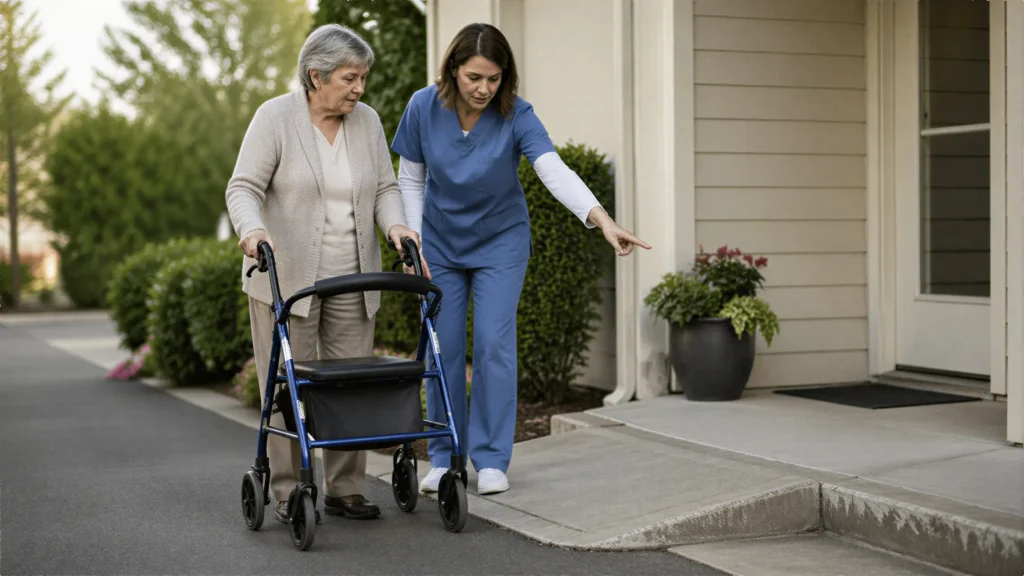
Curbs and ramps are where many people learn the hard way that indoor walking and outdoor walking are not the same task. A walker that feels steady on the kitchen floor may feel awkward at a curb. A rollator that glides smoothly through a hallway may start to pull ahead on a downhill ramp. That is why outdoor technique matters just as much as the device itself.
The safest rule is simple: use the easiest route available. A curb cut is usually safer than a full curb. A gentler ramp is better than a steep one. An elevator is better than stairs. But even with a safer route, the person still needs the right device, the right height, and enough control to handle wheels, brakes, and changing surface levels without panic.
This guide covers the plain-language basics for using a walker or rollator around curbs and ramps. If you want the bigger equipment overview first, read mobility aids: walkers, canes, and rollators. If your first question is whether the current device is even appropriate, rollator vs. standard walker is a good place to start.
If outdoor route problems keep exposing a bigger mobility issue, the mobility and transfers master guide connects the wider transfer and equipment picture.
Why This Matters
Outdoor surfaces add three problems at once:
- the ground changes height
- the walker or rollator changes speed
- the person often changes posture without meaning to
That combination is what makes curbs and ramps risky. People lean too far forward, place the device too far out front, forget the brakes, or try to use a rollator like a fixed support beam. Once the device gets ahead of the body, the fall can happen fast.
Curbs are especially tricky because they create a stop-start moment. The front wheels or walker legs hit the edge, the person hesitates, then either lunges or lifts badly. Ramps are a different problem. The device keeps moving, and the person's job is to control that movement without letting the slope take over.
These obstacles are even more important when the person:
- is weak on one side
- gets tired quickly
- has shaky balance
- cannot manage brakes well
- leans heavily on the device
- uses an indoor walker outdoors
If any of those are true, technique matters, but device choice matters just as much. A safe outdoor route with the wrong mobility aid is still unsafe.
Key Factors That Change the Decision
1. Whether the Device Is a Standard Walker, Two-Wheel Walker, or Rollator
These devices do not handle curbs the same way.
A standard walker is usually the most stable, but it must be lifted and placed. A two-wheel walker rolls more easily, which can help, but it still behaves more like a fixed walker than a rollator. A rollator has more momentum because all wheels move, which means ramps and downhill routes demand more control from the person's hands and posture.
That is why a person who can manage a small curb with a standard or two-wheel walker may still struggle badly with a rollator on a slope.
If device type is still unsettled, compare:
2. Whether the Walker Height and Setup Are Correct
Curbs and ramps expose bad fit fast. If the handles are too low, the person hunches and loads the front too much. If the handles are too high, the arms lose control and the shoulders lift.
As a basic check, the handles should usually line up near wrist-crease height with a slight elbow bend. A walker or rollator that already feels awkward indoors will not become safer outdoors. Fix the fit first. If height is off, review proper walker height and posture before trying another ramp.
3. Whether the Surface Matches the Device
Not all walkers and rollators are built for the same terrain.
Think about:
- wheel size
- tire grip
- brake response
- whether the device was built more for indoor or outdoor use
Smaller wheels usually struggle more with cracks, thresholds, and rough pavement. Larger wheels often handle outdoor surfaces better, but the bigger frame can also change turning space and home fit. That tradeoff matters, so use indoor vs. outdoor walkers before assuming a larger rollator is automatically better.
4. Whether the Person Can Control the Device Without Leaning Hard
Curbs and ramps are not a good place for a person who leans heavily on the device, rushes, or loses control when the device starts moving. A rollator especially needs reliable hand control, because the brakes are part of the technique, not just an emergency feature.
If the person cannot stay upright inside the frame, or if they must hang on the handles to stay up, the real problem may be that the device is not supportive enough for outdoor obstacles.
5. Whether the Better Answer Is Avoidance, Not Technique
Sometimes the safest curb strategy is not mastering the curb. It is avoiding it.
That means:
- choose curb cuts
- pick flatter ramps
- use elevators instead of stairs
- take the longer route if it is safer
- ask for help instead of forcing a steep incline
This is not being overly cautious. It is good judgment. Many falls happen because people try to prove they can still manage an obstacle that no longer matches the device or the day.
How to Use, Choose, or Set It Up Safely
Step 1: Start With the Safer Route
Before the person even moves, look around:
- Is there a curb cut?
- Is there a ramp instead of a curb?
- Is the slope dry?
- Is there room to go straight instead of turning on the incline?
- Is there a handrail nearby if needed?
This matters because a gentle route reduces how much technique has to do. If you can remove the hardest part of the problem, do that first.
If the route is steep, wet, icy, cracked, or crowded, assume it is harder than it looks.
Step 2: Use the General Outdoor Walking Position
For both walkers and rollators:
- stand upright
- keep the body inside the frame, not trailing behind it
- take smaller steps than usual
- move slower than you think you need to
- keep eyes up enough to see the surface change ahead
Do not let the device get so far ahead that it becomes something you are chasing. That is one of the most common failure points on slopes and curbs.
Step 3: Handling a Ramp With a Rollator
Ramps are more about speed control than about lifting.
Going uphill with a rollator:
- keep the body close to the frame
- lean only slightly forward, not dramatically
- push in a steady rhythm
- if needed, use gentle brake pressure so the device does not roll backward between steps
Going downhill with a rollator:
- keep fingers ready on the brakes
- lightly squeeze the brakes to slow the device instead of letting it run
- stay upright and controlled
- take short steps
- stop and lock the brakes if you need to pause
The key mistake downhill is letting the rollator roll freely. Once it gets ahead, the person often leans more, which makes control worse, not better.
If a person has to clamp the brakes hard the whole way just to avoid losing control, that is a sign the slope may be too steep or the device may be the wrong match.
Step 4: Handling a Ramp With a Standard or Two-Wheel Walker
A fixed walker or two-wheel walker usually asks for more deliberate placement:
- place it only a step length ahead
- make sure it is settled before stepping
- do not lunge into it
- keep the steps short
On an uphill, the person may need to lean slightly forward, but should not collapse onto the frame. On a downhill, slow the sequence down and keep the walker under control instead of letting gravity pull the body through the pattern.
If the person already feels shaky turning in doorways or tight spaces, a slope will only magnify that problem. Review walker training for turning and tight spaces if control is poor before the ramp even starts.
Step 5: Curbs With a Standard or Two-Wheel Walker
Curbs take practice and should not be treated casually. For many people, it is better to choose a ramp or curb cut every time. But when a trained curb technique is being used with a standard or two-wheel walker, the usual safety pattern is:
Going up:
- get close to the curb
- place the walker on the higher level so it is flat and steady
- step up with the stronger leg first
- bring the weaker leg up after
Going down:
- get close to the edge with toes safely back from it
- place the walker down on the lower level so it is flat and steady
- step down with the weaker leg first
- bring the stronger leg down last
This is the old memory rule: "up with the good, down with the bad." It is useful, but only if the person already has enough strength and balance for the task and has been taught the technique. It is not a substitute for good judgment.
Step 6: Curbs With a Rollator
This is where caution needs to rise sharply. Rollators are heavier, wheeled, and less stable at curbs than many people realize. Some models have curb-assist features, but using them still requires balance, timing, and hand control.
For many people, the safest advice is simple:
- prefer curb cuts and ramps
- avoid curbs when possible
- do not try to "hop" the rollator up casually
- do not try stairs at all
If the person uses a rollator and must deal with a small curb, the safest setup usually includes:
- approaching straight on
- slowing down completely
- keeping a firm hold on the handles
- using brakes for control and stability as the front wheels are brought over
- making sure all wheels are on the same level before shifting weight forward
But if any of that feels like a balancing act, stop. That is the clue that the obstacle or device is beyond the person's safe ability.
Step 7: What to Avoid Completely
Some rules should stay hard:
- do not use a rollator on stairs
- do not use any walker on an escalator
- do not sit on a rollator seat on a significant slope
- do not let someone push a seated user in a rollator unless the device was specifically designed for that use
- do not carry heavy bags hanging from the front if it changes balance
If curb and threshold problems happen inside the home too, consider whether ramps and thresholds or non-slip surfaces for ramps and thresholds would solve the obstacle better than repeated risky technique.
Common Mistakes and Red Flags
The biggest mistake is trying to make a rollator behave like a fixed support on a slope. It is not. The device moves, and the person has to manage that movement.
Other common mistakes:
- walking too fast
- hunching over the handles
- placing the walker too far ahead
- leaning heavily downhill
- forgetting to test or use brakes
- trying curbs without enough strength or training
- using an indoor rollator on rough pavement
- carrying items that make the device tip or steer badly
- trying stairs because the curb feels inconvenient
Watch for these red flags:
- the person cannot keep the body inside the frame
- downhill ramps make the rollator pull forward hard
- the brakes are weak, sticky, or hard to squeeze
- the person needs to stop mid-slope because control is breaking down
- curb attempts turn into hopping, jerking, or near-tipping
- the front wheels keep catching on thresholds or pavement cracks
- the person avoids going out because the route feels too risky
Those are not just technique problems. They may mean the device, wheel size, route, or whole mobility plan needs to change.
Another red flag is repeated rushing. People often get hurt at ramps and curbs because they are embarrassed to move slowly in public. Slow is correct here. A walker or rollator is a control tool, not a speed tool.
When to Get More Help
Get more help when the outdoor route is becoming the unsafe part of daily life.
PT can help when:
- the person needs curb or ramp training
- the person cannot tell whether the current device is appropriate outdoors
- balance is good enough indoors but poor outside
- there is a weak side, foot drop, or fatigue pattern changing the technique
OT can help when:
- the problem is partly the route, home exit, threshold, or community setup
- the person needs safer ways to carry items or manage doors while using the device
Get equipment help when:
- brakes need repair
- tips or wheels are worn
- the frame feels loose
- the rollator is clearly an indoor model being pushed into outdoor jobs it cannot do well
And get urgent medical help if the person suddenly has new weakness, dizziness, chest pain, severe shortness of breath, or a sudden change in walking ability.
If curb and ramp problems are showing up every week, it may be time to rethink the route or the device itself instead of repeating close calls.
Frequently Asked Questions
Is a rollator safe on ramps?
Often yes, if the ramp is manageable, the brakes work well, and the person can control the device without leaning hard on it. Downhill control is the main issue.
Is a rollator safe on curbs?
Sometimes for small curbs and trained users, but many people are safer avoiding curbs and choosing a curb cut or ramp instead. Curbs are a much harder task for a rollator than flat ground.
Can I use a walker on stairs?
Not as a normal everyday strategy. Stairs need a separate plan and often direct training. Rollators should not be used on stairs.
What is the rule for stepping up and down a curb with a walker?
For a standard or two-wheel walker, the usual memory rule is up with the stronger leg first and down with the weaker leg first, but only when the walker is flat and steady and the person has been taught the technique.
Should I use the brakes going downhill with a rollator?
Yes. Light brake pressure helps control speed so the rollator does not run ahead of the person.
What if the front wheels keep catching on thresholds or rough pavement?
That often means the surface is too rough for the device, the wheels are too small, or the person needs a different route or different outdoor setup.
Can I sit on the rollator seat to rest on a ramp?
Not on a meaningful slope. Rest only on level ground with all wheels stable and both brakes locked.
When should I stop trying to handle curbs with the current device?
Stop when curb attempts feel like a balance trick, the person is near-tipping, the brakes are unreliable, or the person needs heavy help every time. At that point, the route or the device needs to change.
If your bigger question is device choice, compare mobility aids: walkers, canes, and rollators, rollator vs. standard walker, and indoor vs. outdoor walkers. If the main obstacle is the home route itself, continue with ramps and thresholds and non-slip ramp and threshold surfaces.