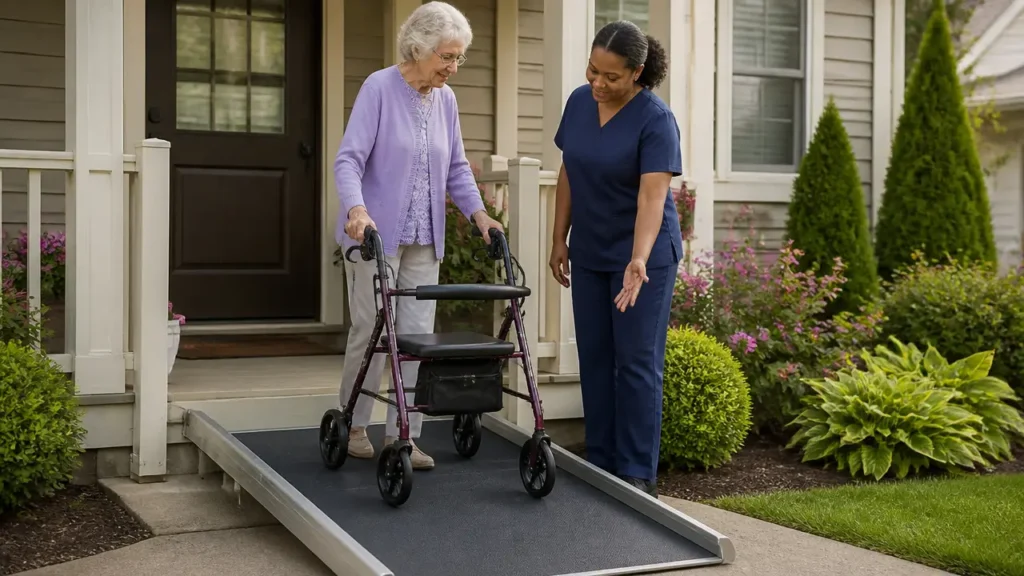
As an affiliate, we may earn a commission from qualifying purchases. We get commissions for purchases made through links on this website from Amazon and other third parties.
A home ramp starts with one number: the rise. If that rise is measured wrong, everything after it is wrong too. The ramp may end up too steep, too tiring to push, or too short to control safely on the way down. That is why a ramp slope calculator is really a safety check, not just a math trick.
The basic idea is simple. A gentler ramp is easier and safer than a steep one. But you still need enough length, landing space, and room for the device and caregiver to use it properly. This guide shows how to think through slope at home without pretending every house has endless space. If you are still deciding between fixed and portable options, compare portable ramp types and ramps and thresholds overview.
If slope is only one part of the access problem, the mobility and transfers master guide connects the wider transfer and equipment picture.
Why This Matters
Slope affects:
- how hard it is to push a wheelchair uphill
- how controlled the descent feels
- whether a person using a walker can keep footing
- whether a caregiver strains or slips
- whether the top and bottom transitions feel stable
A ramp that is too steep can still "work" in the sense that it reaches the doorway. It just may not work safely for the actual person using it.
Key Factors That Change the Decision
Measure the rise first
Rise is the vertical height from the lower surface to the point where the top of the ramp will sit. Measure straight up and down, not along the slanted path.
That sounds basic, but people often confuse:
- rise with ramp length
- rise with threshold width
- rise with total deck or porch size
Know your reference slope
For accessible routes, a common reference is 1:12. That means:
- 1 inch of rise needs 12 inches of ramp length
- 2 inches of rise needs 24 inches of ramp length
- 24 inches of rise needs 24 feet of ramp length
That is the usual maximum reference for a full-use accessible ramp. Gentler is often easier for home use, especially if a caregiver is pushing or a manual wheelchair is involved.
Think beyond the run itself
The ramp is not just the sloped section. You also need:
- stable ground at the bottom
- enough landing at the top
- room for the door swing
- room to turn or stop safely
If the house only has room for a short steep run, the real answer may be a different ramp design, a switchback, or a different entry.
How to Use, Choose, or Set It Up Safely
Basic ramp-slope math
Start with the rise in inches. Then multiply by 12 to get a 1:12 reference length in inches.
Examples:
- 3-inch rise = 36-inch ramp
- 6-inch rise = 72-inch ramp
- 12-inch rise = 144-inch ramp, or 12 feet
- 30-inch rise = 360-inch ramp, or 30 feet
If that result surprises you, that is normal. Safe ramps get long quickly.
Gentler is often better at home
Even when 1:12 is used as the maximum reference, many home users do better with something gentler when space allows. That matters most when:
- a caregiver pushes a chair
- the person pushes the chair on their own
- the person walks with a walker
- fatigue is already a problem
- rain or snow are common
If the goal is everyday home access, do not choose the steepest possible option just because it fits.
Watch landings and turns
Longer ramps often need:
- level landings at top and bottom
- rest or turn platforms on longer runs
- enough depth so a wheelchair or walker can stop before the doorway
The landing is part of the safety plan. If the door swings onto the landing or there is no room to turn, the ramp may still fail in actual use.
Thresholds and portable ramps are different
Small thresholds and temporary loading ramps may use different manufacturer guidance depending on who is in the chair and how the ramp is being used. Do not assume a short portable loading ramp follows the same logic as a full-time home entry ramp.
For those cases, compare best threshold ramps for doorways and portable ramp types.
Common Mistakes and Red Flags
Common mistakes:
- measuring the wrong rise
- forgetting landing space
- picking a ramp based only on what fits in the doorway
- treating a steep temporary ramp as a permanent solution
- ignoring caregiver effort on the uphill push
Red flags:
- the person feels like they might tip backward going up
- the caregiver has to brace hard going down
- the person hesitates or loses traction in wet weather
- the top landing is too short to manage the door safely
- the only ramp that fits would be much steeper than a reasonable full-use home entry ramp
If weather or traction is already part of the issue, add rain and wet floors strategy and ramp care and anti-slip renewal before assuming slope is the only problem.
When to Get More Help
Get more help when:
- the math says the ramp will be very long
- the entry needs turns, switchbacks, or custom landings
- the house has limited space and the slope compromise feels too aggressive
- the person relies on a manual wheelchair, walker, or caregiver push every day
That is the point for an accessibility contractor, clinician, or ramp supplier to assess the full entry setup.
Frequently Asked Questions
What does 1:12 mean for a ramp?
It means 1 inch of rise for every 12 inches of ramp length.
How do I calculate ramp length at home?
Measure the rise in inches and multiply by 12 for a common full-use accessible ramp reference.
Is 1:12 always the best home ramp slope?
Not always. It is a common maximum reference, but gentler slopes are often easier and safer when space allows.
Why do safe ramps get so long?
Because reducing steepness takes more horizontal length.
Do I have to think about the landing too?
Yes. A good ramp can still fail if the top or bottom landing is too small or awkward.
Are threshold ramps calculated the same way?
Not always. Small thresholds and portable ramps may follow different use-case guidance than a full-time entry ramp.
When is the slope too steep for home use?
When the person or caregiver cannot control the ramp safely in real conditions, even if the ramp technically reaches the entry.
If the calculation says you need more than a straight run can handle, continue with ramps: choosing slope, side guards, and surface, portable ramp types, and ramps and thresholds overview. If the problem is a small doorway lip rather than a true ramp run, compare best threshold ramps for doorways and non-slip surfaces for ramps and thresholds.